
Benoit Deper. Credit: World Space Business Week video
PARIS — The merger of the space divisions of Airbus, Thales Group and Leonardo, sill not decided but increasingly likely, could undermine the argument that has underpinned Europe’s Iris2 multi-orbit secure communications constellation, according to industry officials.
Iris2’s reason for being has always been twofold: first as industrial policy, a way to shore up the struggling telecommunications divisions of Airbus and Thales; and second as a critical European government infrastructure at a time of the rise of SpaceX Starlink, the future Amazon Kuiper and Chinese broadband constellations and, of course, Russia’s invasion of Ukraine.
European nations’ determination to invest more heavily in defense has injected its space industrial base with fresh funding, going a long way to reverse the fortunes of the Airbus and Thales space business. There is less urgency on the industrial-policy front.
The national security interest has gone in the opposite direction. The tensions between the European Union and Russia have only heightened in 3.5 years since the Ukraine invasion, and now include widespread jamming and spoofing of satellite navigation services in eastern Europe, the cutting of subsea telecommunications cables and Russian drones flying in European airspace.
Credit: ESPI
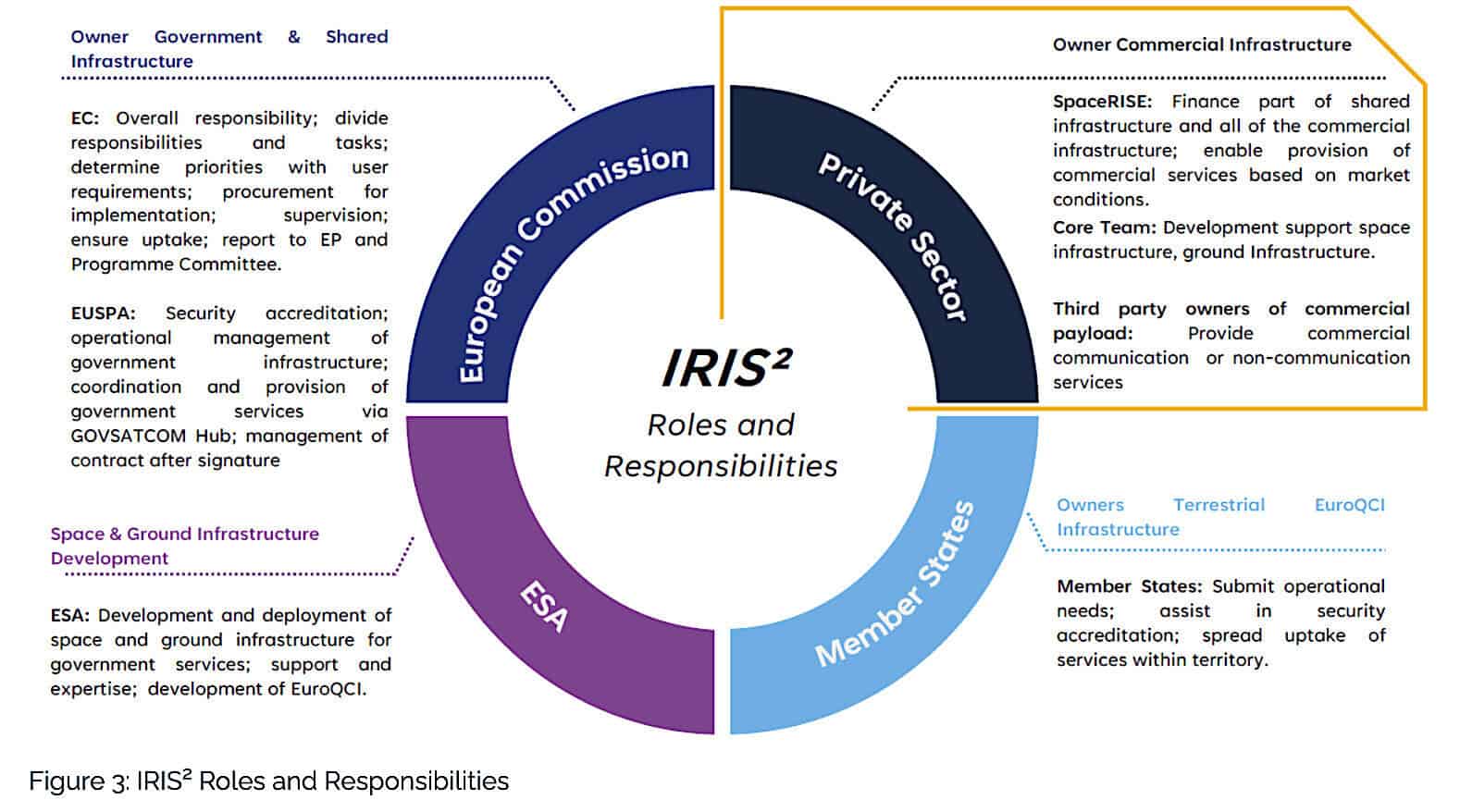
But if Iris2 can be seen as a valid bid by Europe for communications autonomy, the program’s current structure, as a public-private partnership with the private sector paying 40% of the capex, is roundly criticized by several governments and the private sector.
Germany has been considering its own Iris2-type secure constellation that would somehow coexist with Iris2, with German taxpayers financing Iris2 through Germany’s mandatory contributions to the European Commission. The German government has made no final decision on this.
Italy has also critiqued Iris2’s current format, saying its industrial shareholders — satellite fleet operators SES, Eutelsat and Hispasat — may not be willing or able to meet their payment commitments over time. Leonardo Space Managing Director Massimo Comparini has repeatedly said Iris2 is taking too long to move forward.
This sentiment has only spread as it becomes clear that Paris-based Eutelsat, which is responsible for Iris2’s LEO-High component and has committed 2 billion euros ($2.36-billion) to it, will need new financing for the project. In addition to Iris2, Eutelsat needs 2.2 billion euros in capex to replenish its current OneWeb constellation.
A 10-year, billion-euro commitment to OneWeb by the French Defense Ministry, and a recent modest OneWeb equity top-off by the British government, will not do it. The French government would like Germany, italy, Britain and other nations to invest in Eutelsat as a way to invest in Iris2.
“If Bromo goes ahead, it really takes away the need for Iris2,” said a European industry official whose company is counting on Iris2 contracts. Bromo is the code name given to the Airbus-Thales-Leonardo merger project. “The governance is too complicated and they should consider a conventional public procurement.”
Aerospacelab of Belgium is, in principle, competing with Airbus to build Iris2’s LEO constellation. Few believe it stands a chance, especially since Airbus is already building the Eutelsat OneWeb Gen 1 replacement satellites. Iris2’s LEO component will be based on OneWeb and the French Defense Ministry’s contract includes reorienting certain OneWeb features toward military priorities.
Aerospacelab Chief Executive Benoit Deper said here Sept 17 during World Space Business Week, organized by Novaspace, that Iris2 has issues well beyond the Aerospacelab-Airbus competition.
“The main question is not whether we are a rabbit to tease Arbus and get their prices down,” Deper said. “The question is about the complexity of the program. Is it going to move forward or is it going to be reshaped?
“This I don’t know. I am not invited to these meetings. Maybe Airbus is, I dont know. Form our point of view we are learning a lot and we don’t lose anything form being part of this. This is the first time we have been invited to this kind of table. I believe this is totally unclear for all of us.”