
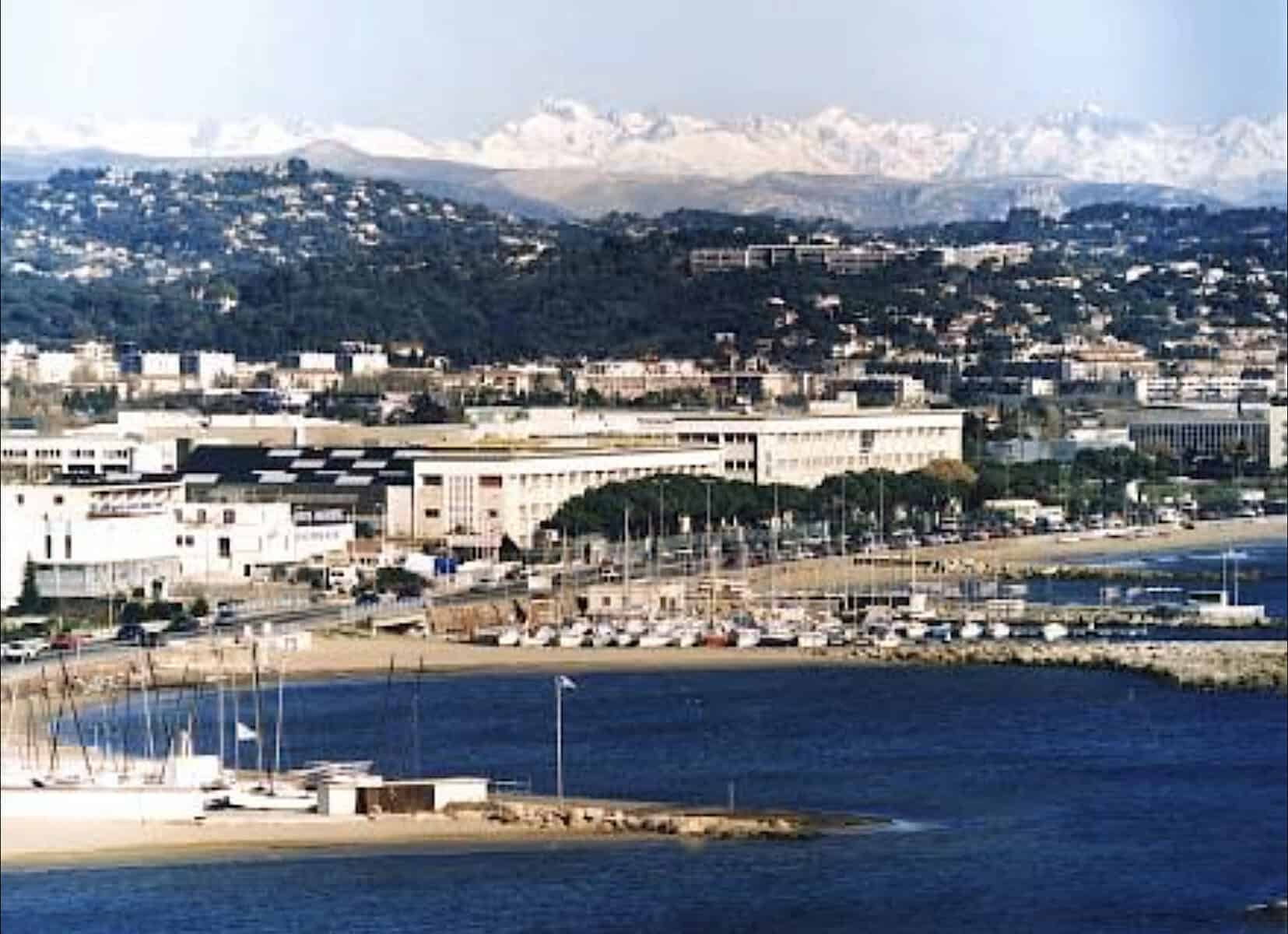
Soon for sale? The Thales Alenia Space production site on the Cannes beachfront. Credit: Wikipedia
LA PLATA, Maryland — Airbus, Thales Group and Leonardo have agreed to merge their space divisions with the promise of generating “mid-triple-digit” millions of euros in annual synergies within five years after a closing, which pending regulatory approvals could start in 2027.
After months of discussions that many believed would never result in an agreement, the three companies announced Oct. 23 that the merged entity would be owned 35% by Airbus and 32.5% each by Thales and Leonardo.
The combination will have some 25,000 employees, with pro forma 2024 revenue of 6.5 billion euros, or $6.8 billion at end-2024 exchange rates, and a backlog equivalent to “more than three years of projected sales,” the statement said.
The memorandum of understanding between the three will now be submitted to their employee unions, which in Europe carry much more weight than their US counterparts and will focus first and foremost on where those 500 million euros or so in synergies will be found.
The Oct. 23 statement said the three “will pool, build and develop a comprehensive portfolio of complementary technologies… from space infrastructure to services” but excluding space launchers.
“Complementary” is far from the situation today among the three, and it’s one reason why the French government has been notably in favor of the merger.
For decades, the French space agency, CNES, and the 23-nation European Space Agency (ESA) have been obliged to support identical R&D programs for two French-led companies: Airbus Defence and Space and Thales Alenia Space.
French government officials have said a merger would allow these resources to be directed to a single entity, or spread out among Europe’s wider space industrial landscape.

Credit: Anywaves
The southern French city of Toulouse may be where the merger is most hotly debated. Airbus and Thales both have major manufacturing facilities there. Layoffs are all but certain.
Thales also has a large production facility in Cannes, located on beachfront property. Thales officials for years have speculated about selling the facility and relocating its production elsewhere, only to be persuaded by Toulouse government officials not to leave. But pressure to do so now may be impossible to resist.
Thales Group owns 67% of Thales Alenia Space. Italy’s Leonardo owns 33%. That ownership ratio is switched for Italy-based Telespazio, whose space services business has been flourishing in recent years, in contrast to the Thales Alenia Space satellite business.
This has generated frustration in Italy, where government and industry officials believe their stake in Thales Alenia Space does not reflect the shift in the business away from telecommunications satellites and toward space infrastructure, including the International Space Station, where Thales Alenia Space Italy has contributed more than 50% of the pressurized modules.
The Italian government has recently ramped its space investment, for civil and military programs, further complicating the balance of control of Thales Alenia Space.
The merged company will now include both Thales Alenia Space, Telespazio and Leonardo’s space division.
Merger talks started in the wake of the downturn in the telecommunications satellite business of Airbus and Thales, a cause of a wider market shift away from geostationary satellites as television broadcasting moved to streaming; and toward low-orbit constellations for broadband communications that benefited from space connectivity.
Leonardo, less exposed to this area of the business, originally appeared less motivated to agree to merger talks.
Since negotiations began, many have said a merger of Europe’s three largest space system prime contractors would mean the creation of “Europe’s SpaceX.”
This reasoning is hard to follow. Certainly the merger — if the synergies pass employee union and government approvals — will give the merged company the scope and scale to invest in larger projects.
But will they? For now, the European Commission’s Iris2 secure broadband project is mainly an Airbus-Thales affair, with Germany’s OHB SE. Will the merger enable the SpaceRise consortium managing Iris2, comprised of satellite fleet operators SES, Eutelsat and Hispasat, to drive down Iris2 infrastructure costs? That’s not clear, especially since Iris2’s schedule calls for these contracts to be signed by early 2026.
The SpaceX challenge to its competitors lies in SpaceX’s ability to marshal huge financial resources on behalf of projects — space launchers, the Starlink broadband network — that require years of investment before paying out. Airbus, Thales and Leonardo are publicly traded companies whose investors are no more likely to support this kind of investment than have been Boeing, Lockheed Martin and Northrop Grumman.
Are foreign governments likely to turn to the new European champion for their own constellations? That appears unlikely, as these projects are often considered important to establish strategic autonomy.