
PARIS — Amazon’s Project Kuiper, which is is under regulatory deadline to launch 1,600 satellites by July 2026, has 102 in orbit now and expects to have a total of 200 launched by the end of the year.
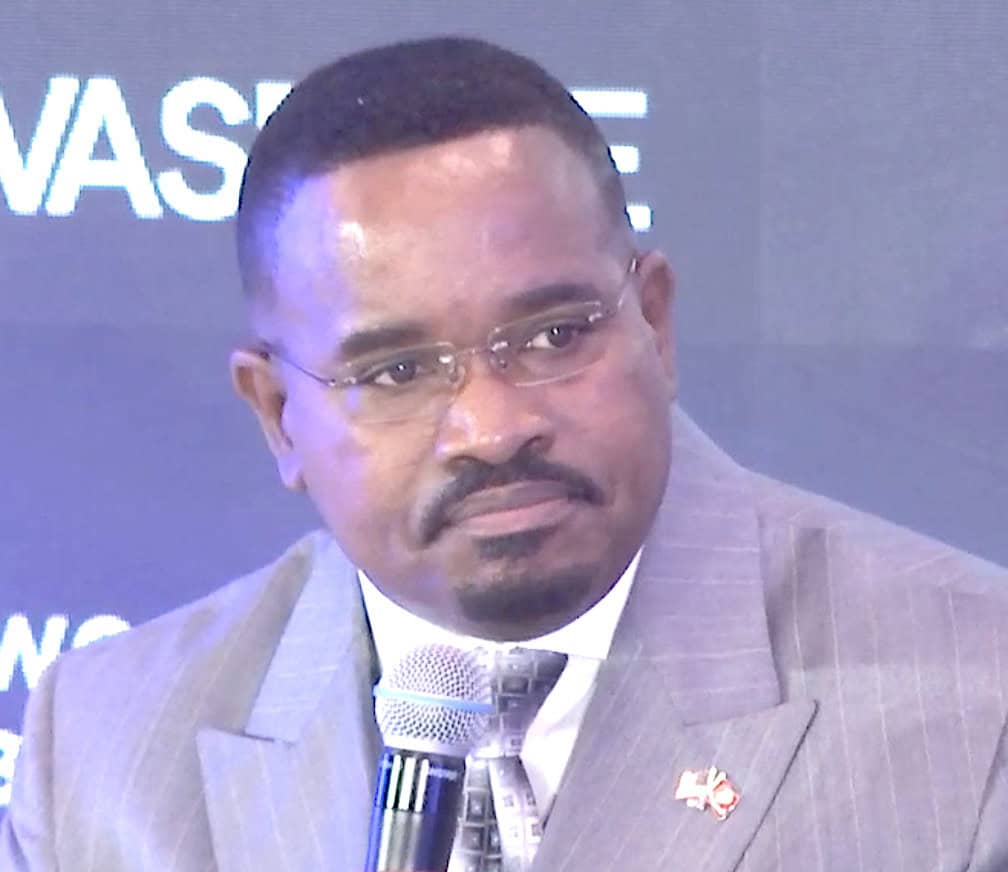
“It’s not exactly where we wanted to be, but we’re making progress,” said Ricky L. Freeman, president of Amazon Kuiper Government Services, in a Sept. 15 address here to World Space Business Week (WSBW), organized by Novaspace.
Freeman said the 102 satellites in orbit are performing as expected, with dowload speeds of 1.8 Gbps and uploads of 450 mbps, “greater than what we anticipated. We have established optical inter-satellite connections at 100 Gbps. I think it too about four seconds to make those signal connections,” he said.
Freeman agreed that the scale of the launch challenge before Kuiper is enough to obscure the health of those that have made it to orbit and are now on their way to their final operating positions.
“My biggest problem now is not the satellites, it’s launch,” Freeman said. “If you had a slingshot I’d probably buy it right about now.”
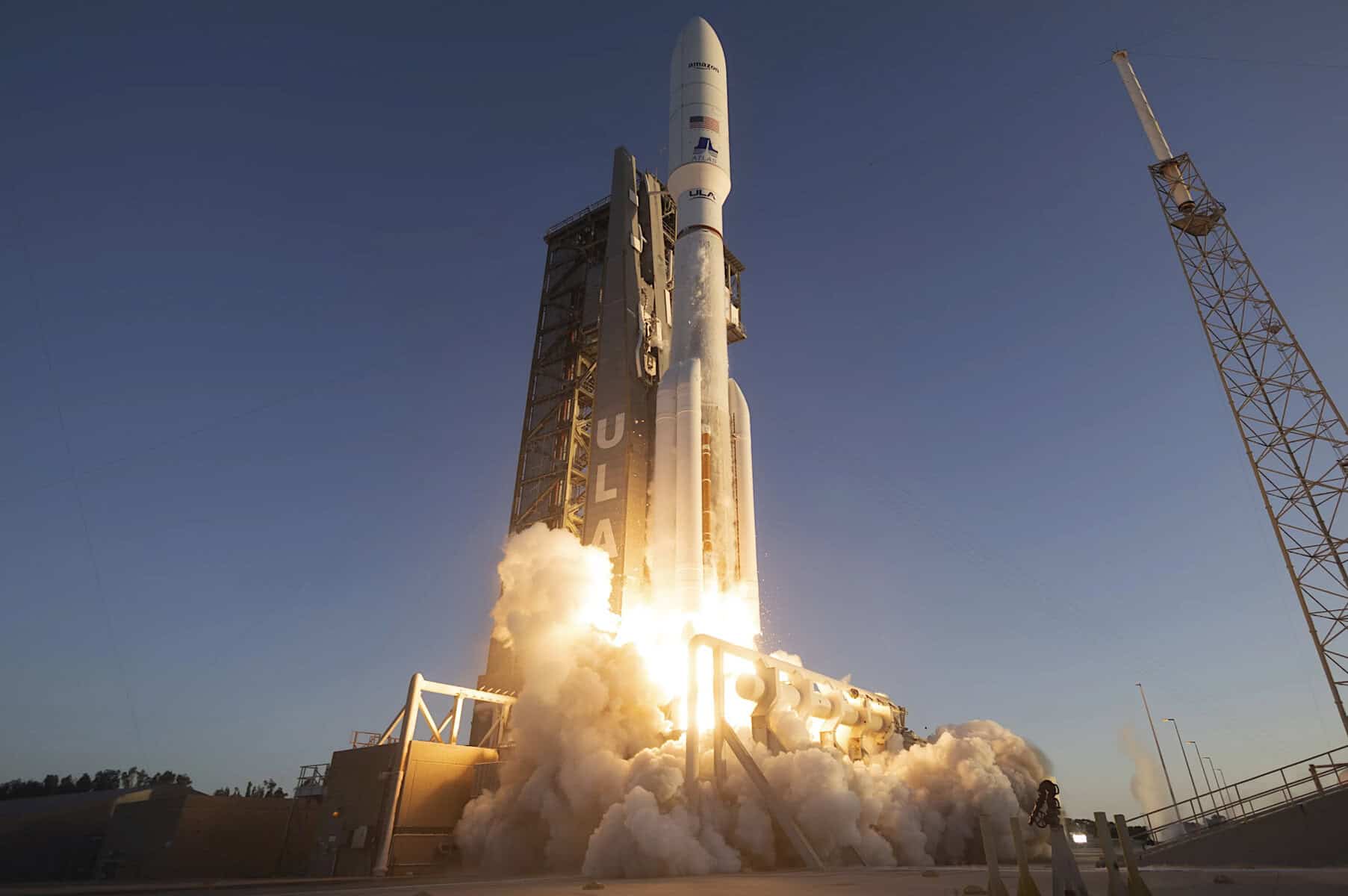
A ULA Atlas 5 rocket lifts of June 23, 2025, carrying 27 Amazon Project Kuiper satellitles. Credit: ULA
Europe’s Arianespace, United Launch Alliance and Blue Origin, all three debuting new heavy-lift vehicles, are well behind their original schedules. In this particular case, supplier diversification was not enough to assure Kuiper a smooth launch cadence. The company has not disclosed its view of the consequences of not meeting its regulatory deadline to launch 50% of its 3,200-satellite constellation by next July.
‘Kuiper will be an open-standards system working with third-party constellations’
With the launch schedule beyond the company’s control, Freeman focused his remarks on how Amazon plans to position Kuiper, an open-standard network that the company hopes to use as a core infrastructure around which other satellite constellations, owned by third-party operators, could be managed.
“There is word out there that Amazon Kuiper will be a closed system,” Freeman said. “That couldn’t be further from the truth. Our entire business model assumes open architecture and partners around the world.
“We are bringing a core set of enablers, of capabilities, with wave-form agnosticism, and providing optical connectivity to be able to connect our partners around the world. We will insert translator satellites into our ecosystem to be able to be interoperable with the varied and disparate assets that are in space,” Freeman said.
He said Kuiper will be be open to carrying hosted payloads by third parties as part of developing the Kuiper-centered ecosystem. He said the company has already working through R&D contracts with partners around the world to demonstrate proofs of concept, “which could lead to long-term contracts with customers,” he said.
“We are developing what we call a fleet concept, bringing turnkey capability to customers to include terminals, customer-premises gateways and hosted payloads.
“We are signing partners who bring critical capabilities to that ecosystem. We are a network provider, creating a network in space. By creating an ecosystem, governments and customers can just buy the service, allowing them of focus on the mission while we focus on the management. We are signing deals around the world to be sure this a system that is for the customer, and not us.”
Freeman said the rising interest, by many governments, in sovereign networks should not be an impediment to the Kuiper network goal. He likened Kuiper to amazon.com. “You are rarely buying an Amazon product” on the website. “I see that very same capability in the space domain.”
There are existing constellations in space and there will be new ones,” he said. “I do not argue that point, nor do I want to hinder it. We will work with those networks build out the inter-satellite links. “I think about them as nodes, networks of networks.
“We are working with customers now who are asking for constellations of various sizes. It’s our ask to figure out with those customers how we get there.
“Nodes of networks — 100 satellites here, 50 satellites there, all tied back to the main network, providing the security they need for each of those networks — this is, in my mind, the future, where we are not attempting to create a space that we own, we are creating a space that we enable. If we can do that, we will be successful.”