
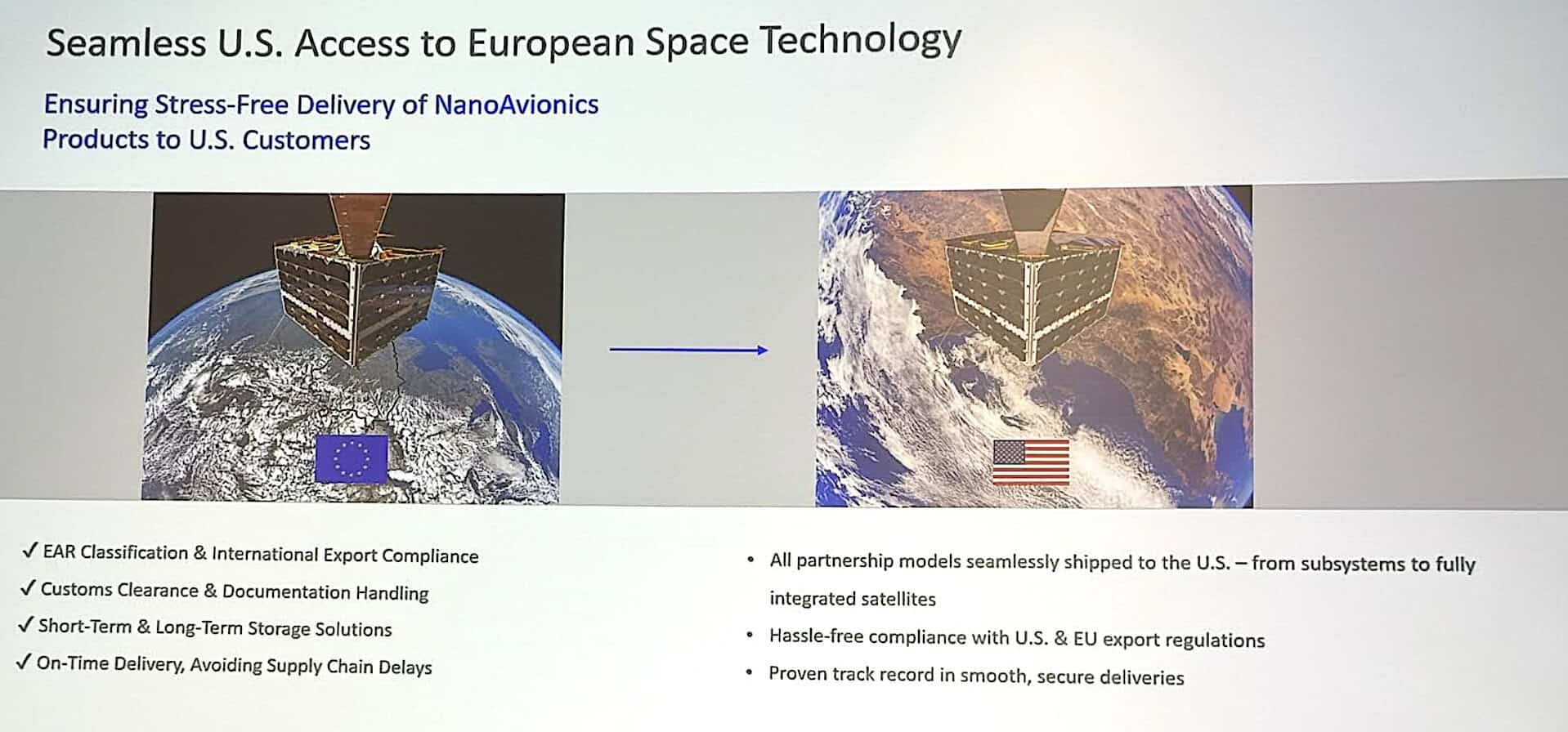
Credit: Kongsberg NanoAvionics
SALT LAKE CITY, UT — Two European space-hardware companies — satellite antenna builder Anywaves and satellite and component provider Kongsberg NanoAvionics — described their strategies for entering the United States, which they view as indispensable if they want to grow beyond the confines of the still-limited European market.
Crossing the Atlantic has been complicated by the imposition of 15% tariffs on European hardware coming into the US, but both companies believe their cost advantage is more than enough to compensate.
Every company has its own approach, but multiple European New Space companies attending the Small Satellite Conference here Aug. 10-13 shared a common belief: For lots of reasons, many European companies can produce space-qualified products less expensively than their U.S. counterparts.
A previous generation of European satellite and launch-service providers such as Airbus, Thales Alenia Space and Arianespace to the same conclusion, succeeding on the global commercial market more often than the larger U.S. players. At the time, there was a view that the lack of the world’s largest space agency — the U.S. Air Force, now Space Force — as a customer forced the Europeans to find efficiencies that enabled their success.

Nicholas Capet, left, and Nicholas Hine. Credit: Anywaves
France-based Anywaves announced at the conference that it had hired Nicholas Hine, whose background includes stints at Mangata Networks, OneWeb Satellites and Raytheon Technologies, as general manager of Anywaves US.
Anywaves has established multiple US customers including Maxar Technologies, Airbus US and Sidus Space. One of Hine’s early priorities will be to find a locale for Anywaves US, with enough space to include a modest factory.
Anywaves Chief Executive Nicholas Capet said the company eventually plans to ship Anywaves-built antennas to the United States, where the US branch will integrate them onto US customers’ satellites.
That means it’s Anywaves US that will be the importer and the company responsible for paying the 15% tariff.
Capet did not rule out eventually building a US factory to replicate the French production site to mitigate risk, but for now the US subsidiary will be adding value to a product that will continue to be built in France.
“We want to address the full market and to be close to our customers in the US,” Capet said. “We think we can absorb the tariff charges and still offer a competitive product here.”
Like Anywaves, Lithuania-based Kongsberg NanoAvionics already has a thriving business. It has sold satellite components, satellite platforms and complete satellite systems — it has delivered more than 50 satellites — around the world, including in the United States to customs including Los Alamos National Laboratory and NASA.
Andrew Swain, business development manager for Kongsberg Avionics US, said that while the company does not have its own manufacturing plant in the US, it has access to production sites where it can assemble and integrate satellites if that’s what the customer wants.
Other customers want to keep control of their satellite payloads and will use NanoAvionics’ platform.
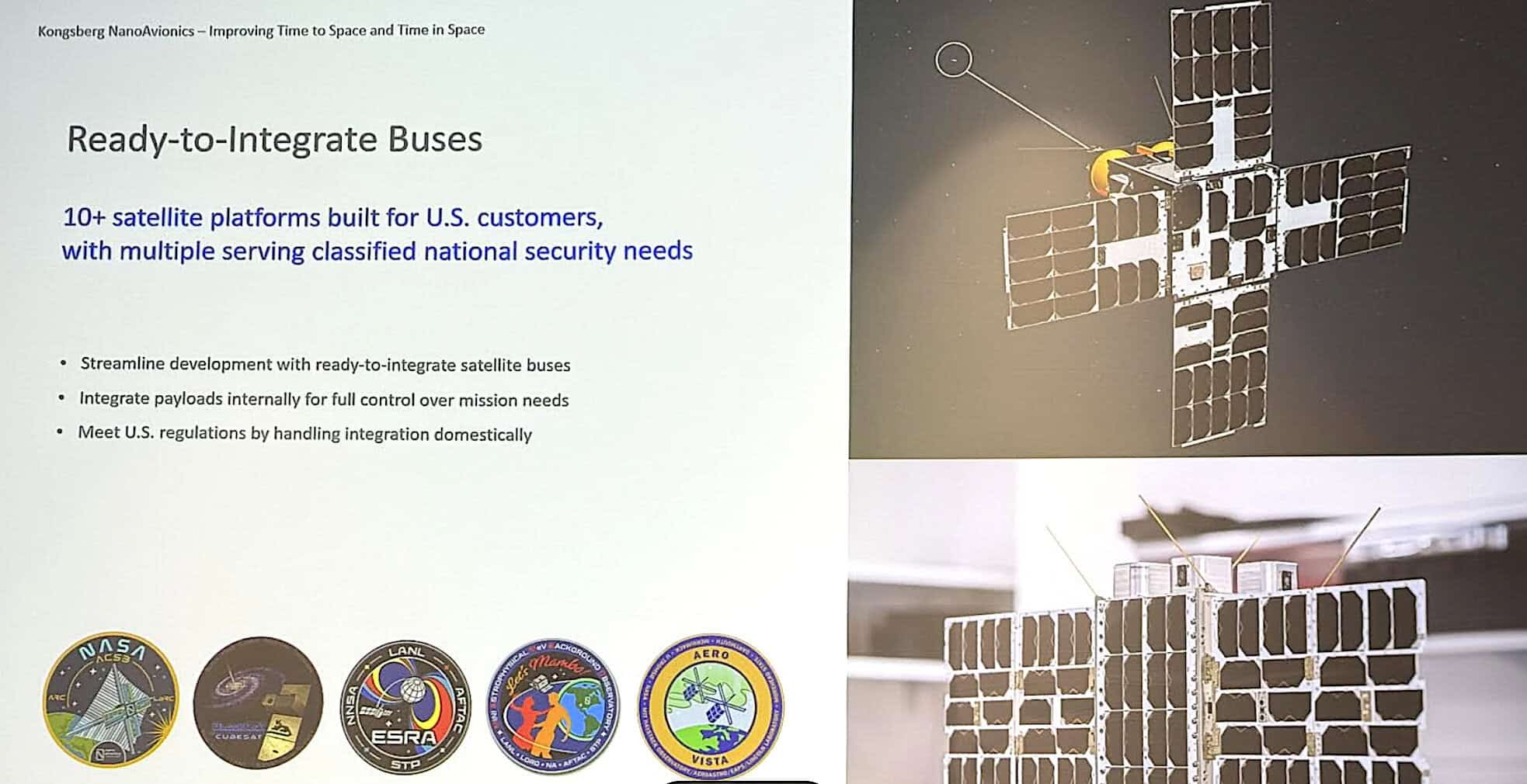
Credit: Kongsberg NanoAvionics
“We have been doing this for nearly a decade,” Swain said of exports to the US, “with 1,000 subsystems already sold into the US in addition to our platforms. where can support EAR [Export Administration Regulations], customs classifications, storage as needed here or in Europe.”
The showcase contract for NanoAvionics came with the April announcement that it would build 280 small broadband satellite platforms for SpinLaunch, a contract valued at 122.5 million euros ($143 million), whose Meridian Space constellation is envisioned as growing to 1,200 satellites.
An in-orbit demonstration model is scheduled for launch in 2026 using NanoAvionics’ MP42 microsatellite platform.
Credit: Kongsberg NanoAvionics
SpinLaunch on Aug. 18 announced it had secured $18 million in fresh funding for the constellation, in addition to a previous $12 million from Kongsberg as part of a strategic partnership between the two companies.
Kongsberg will be exporting its satellite hardware to SpinLaunch, meaning it’s the customer that must digest the 15% tariff. Swain said there is always a hope that the fast-evolving tariff discussion between the United States and Europe could be resolved at a lower rate in the next year or two, before large-scale satellite production begins.
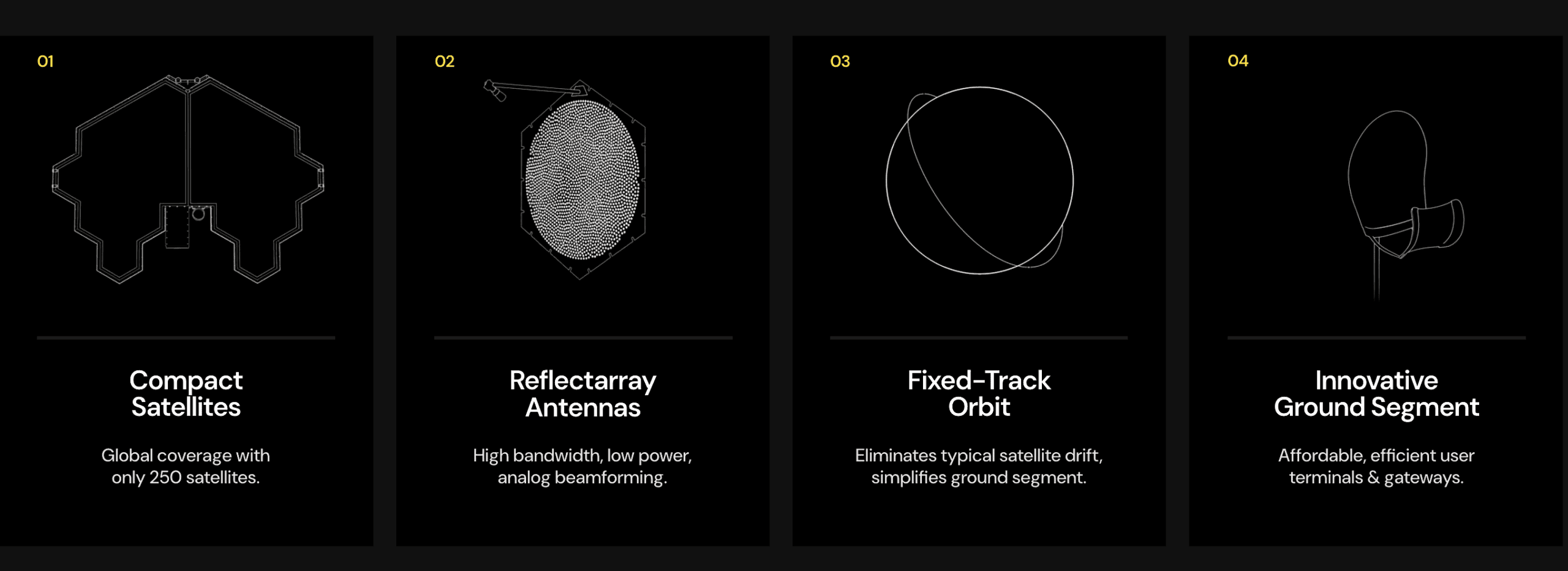
The SpinLaunch Meridian constellation design. Credit: SpinLaunch
“We are scaling up to support this,” Swain said. “Obviously it’s quite a high volume so this will be a serial production facility. SpinLaunch brings the payload, we bring the platform and the integration of the payload.. We’re designing this with high throughput in mind.”