
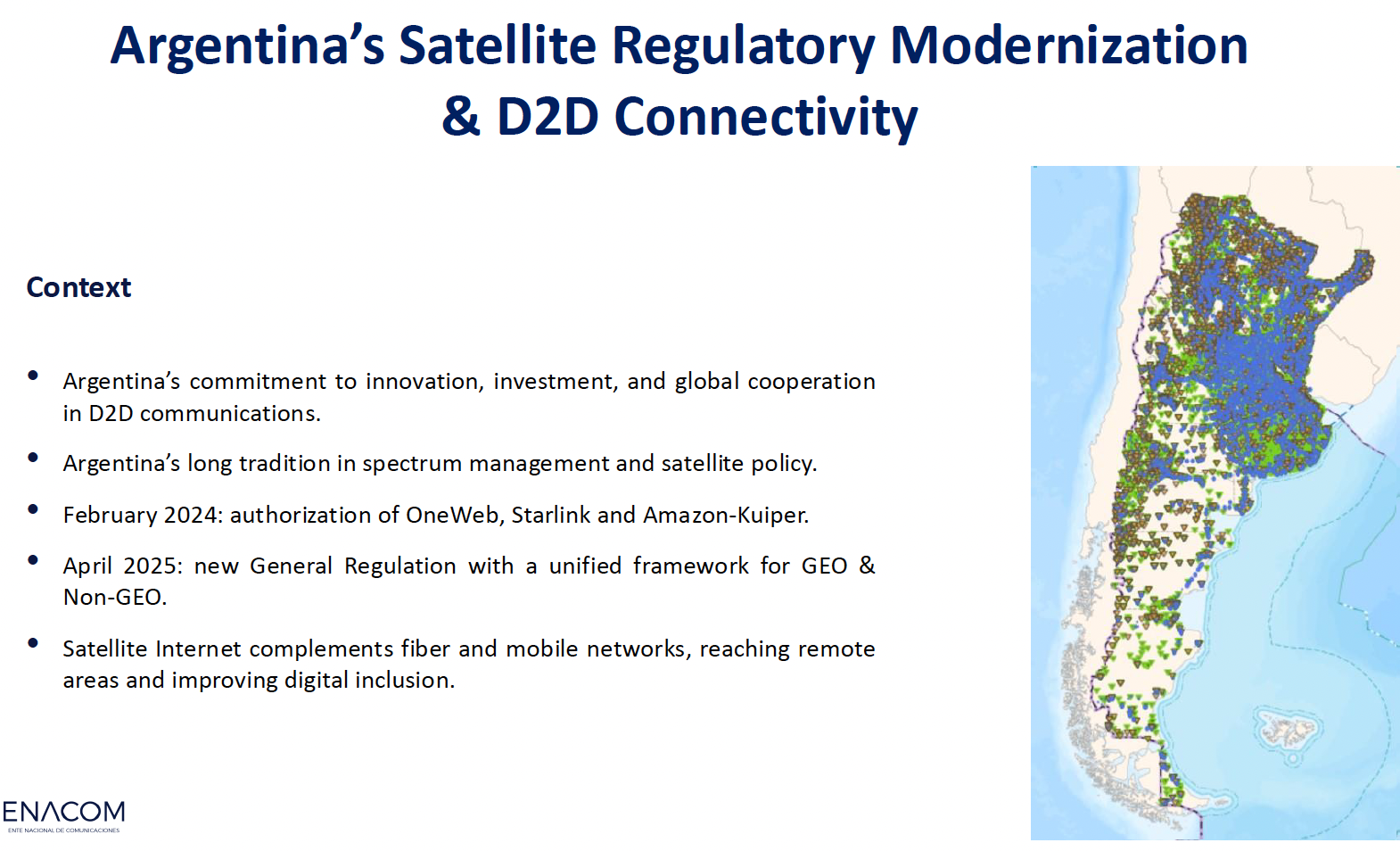
Credit: Enacom
WASHINGTON — It’s unclear whether the WRC-27 conference of International Telecommunication Union (ITU) regulators will see established geostationary-satellite fleet operators opposing technical studies of whether non-GEO constellations could increase their power levels without harming GEO operations.
That was a real battle at WRC-23, but four years is a long time in today’s satellite industry, which is evolving faster than ever.
Since then, the two largest geostationary-orbit operators, SES and Intelsat, have merged. Intelsat had not been opposed to allowing the ITU to conduct studies on whether the power limits imposed on non-GEO fleets, set more than 20 years ago, could be eased based on new technology.
SES has since teamed with SpaceX Starlink in certain vertical markets, including maritime, to offer a combined service from Starlink and from SES’s medium-Earth orbit O3b mPower constellation.
Eutelsat Group has purchased the OneWeb broadband constellation and is basing most of its growth forecasts on it. Telesat of Canada has made clear that its Lightspeed LEO infrastructure is where its future lies, even as it continues to operate a GEO fleet.
Multiple GEO operators have signed resale agreements to provide OneWeb, Starlink or the future Amazon LEO to their customers.
LEO constellation operators argue that they will be able to increase throughput and service quality, and maybe even reduce the size of their constellations, if they are allowed to increase their power.
At the Dec. 9 Americas Space Forum here, organized by ForumGlobal, one LEO operator and two regulators offered their views on how this may play out at WRC-27, to be held in Shanghai.

Kalpak Gude. Credit: LinkedIn
Kalpak Gude, head of global regulatory affairs at Amazon Leo —and previously with Intelsat — outlined why easing Equivalent Power Flux Density rules crafted in the late 1990s are ripe for review.
Gude framed his argument by noting the change in the business of GEO operators since then.
“Twenty-five years ago, GEO was video distribution for the most part,” Gude said. “For that you need four or five 9s of reliability. That’s critical. But in an IP-based world that level of protection is unnecessary. IP networks do not require anything close to that.
“If you modify [the EPFD restraints] you will increase [LEO network] capacity and lower the cost to customers around the world, enabling much more frequency efficiency, potentially with fewer satellites. The efficiencies created from this is absolutely significant. Let’s rely on the technical studies and be aggressive in evaluating reality from fiction. Over-protection in any band means wasted spectrum.”

Carolyn Mahoney. Credit: LinkedIn
The US Federal Communications Commission (FCC) has an active proceeding under way on EPFD and has not come to a conclusion.
But Carolyn Mahoney of the FCC’s Space Bureau said the FCC is determined to deregulate and streamline its satellite rules where possible. The commission is equally determined to remain a leader in the sector and created its Space Bureau in April 2023.
“If there are certain issues where industry is coming to us and finding that there are new technologies that can be [adopted], come to us and show us that something should be given a fresh look,” Mahoney said. “We are certainly willing to to that, and this is a bit of a change from the previous administrations.”
Mahoney said that if the FCC concludes that EPFD limits can be relaxed without causing signal interference with GEO-orbit satellites, it is willing to change the rules for the United States even if the rest of the world, at WRC-27, is unable to decide.
‘We might not need to wait for the rest of the world to catch up’
“If there is something holding the American space industry back — you know, EPFD limits not be talked about until WRC-31. We might not need to wait for the rest of the world to catch up.
“That’s not to say anything about international cooperation, not at all. It’s just that wee want to assure that companies want to stay licensed in the US and enable that.
“We want to make it a really attractive place to license your system. And we are taking the lead on some of these kinds of issues. With EPFD, we’ll see what happens. We are certainly motivated to take the first step in taking a fresh look at something and if we need to take the lead on an issue, we can do that.”
The GEO satellite sector opposing relaxed EPFD rules in 2022 said even accepting that the ITU could study the issue was unacceptable as it could be the thin edge of a wedge to overturning the rules. That argument was difficult to defend then, and even more difficult now.
Argentina has two domestic GEO orbit operators, broadband provider Orbith, which uses Hispasat and SES GEO capacity as well as its own Astranis-built small GEO; and government-owned Arsat.
Argentina has an open competition policy and has licensed OneWeb, Starlink and Amazon LEO to operate there.

Juan Martin Ozores. Credit: Enacom
Juan Martin Ozores, president of the National Communications and Media Regulator of Argentina, Enacom, said that Starlink has signed on more than 400,000 subscribers in less than a year, a remarkable number given the size of Argentina’s market.
“That’s great,” Ozores said of the Starlink success. “Families that were not connected are now connected.”
Ozores said Argentina’s telecom policy is to facilitate business. “We don’t want spectrum that is not being used. Spectrum allocation has to be maximized. I cannot accept a flat definition of this or that in the era of AI. The reality of the market and the services is different.”
Ozores agreed with Gude’s assessment that putting engineers together solves a problem, whereas putting lawyers together creates more problems.
Credit: Enacom
He said the Argentine government is using its Universal Access Fund to protect the businesses of small ISPs from being put out of business by the new LEO constellations through the use of fixed-wireless access technology with 5G links in villages of a few hundred households.
“In this example you have maybe a 2- or 3-kilometer radius and out of that range there is satellite connectivity connecting the remaining areas.
“Some of these ISPs end up being partners with satellite providers. We understand that communications is an economy-of-scale business.”