

The Ariane 62 rocket fairing covering the two Galileo Gen 1 positioning, navigation and timing satellites that were launched Dec. 17. Credit: ESA/CNES/Arianespace
LA PLATA, Maryland —The successful Dec. 17 launch of two European Galileo positioning, navigation and timing satellites proved the new Ariane 62 rocket’s ability to carry some 1,500 kilograms of satellite payload to a 23,000-kilometer orbit in what program managers said is the vehicle’s most challenging mission to date.
It was the fifth launch of Ariane 6 and the fourth in 2025. Coming up in 2026: the first launches of the more-powerful Ariane 64, equipped with four solid-fueled strap-on boosters. Amazon LEO will be the first Ariane 64 customer.

Amazon LEO satellites arrive in French Guiana to prepare for launch aboard the first launch of the heavier version of Ariane 6, the Ariane 64. Credit: Amazon LEO
Ground controllers confirmed that the two satellites are sending signals and had deployed their solar arrays. In-orbit commissioning will take about three months.
Four more satellites remain to be launched from Galileo’s Gen 1 system, built by OHB System of Germany. Two will be launched in late 2026, with the last pair in 2027, bringing the constellation to 34 operational spacecraft.
Galileo’s long-awaited Public Regulated Service (PRS), an encrypted signal for military and government-security missions, is undergoing final review by the Galileo Security Accreditation Board before being declared operational. The signals have been available for use for more than a year, but validation by the security board, expected by mid-year, “is being taken very, very seriously,” said Javier Benedicto, director of navigation at the 23-nation European Space Agency (ESA).

Javier Benedicto. Credit: EU Space Conference video
The declaration of Initial Operating Capability may reopen long-dormant discussions between the European Union and the US government on allowing US military use of PRS. NATO nations have access to the GPS military code, which has similar features to PRS.
The medium-Earth-orbit Galileo is now seen by ESA and the 27-nation European Commission as the first element of a multi-orbit architecture with substantially more capacity.
Up to now, ESA has performed Galileo satellite design and development under contract to the Commission, which owns the network. That is also true for Galileo’s second-generation system. Twelve Gen 2 Galileo satellites, which despite having electrical propulsion are more than three times the mass of Gen 1, are under construction by Thales Alenia Space Italy and Airbus Defence and Space Germany. Each is building six spacecraft, to launch starting in 2027.
ESA governments in 2022 agreed to invest in a new positioning, navigation and timing (PNT) architecture, in low Earth orbit, to complement Galileo and make it more jam- and spoof-resistant by using multiple radio frequencies.
The first two satellites from the 10-satellite LEO PNT demonstration batch — five from GMV and OHB, five from Thales Alenia Space — will be launched starting in February or March aboard a Rocket Lab Electron rocket from New Zealand. The launch will carry one satellite from each of the contracting teams and place the satellites in a 1,500-kilometer orbit.

Credit: ESA
The remaining eight LEO PNT satellites will be launched later in 2026 and in 2027.
“They are going to test PNT signals in a variety of frequencies neger tested before,” Benedicto said. “We are going to transmit at UHF band up to C-band — so UHF, L-band, S-band and C-band — with a variety of signal formats and higher power than those we receive today.
“It will be an unprecedented test bed in a real configuration for Europe — and for the world, because we are going to publish the results,” Benedicto said in a Nov. 27 briefing.
The first LEO PNT satellites need to be launched in 2026 to “bring into use,” in International Telecommunication Union (ITU) language, the S- and C-band frequency registrations made at the ITU.
This first LEO PNT iteration is budgeted at ESA at about 200 million euros ($235 million).

Paul Flament. Credit: European Commission
While it’s an ESA program, LEO PNT was designed from the start as a network that would be taken over by the European Commission and operated as “a new orbital layer in the Galileo constellation, thanks to the technologies ESA has developed,” said Paul Flament, deputy director for space policy, satellite navigation and Earth observation at the Commission.
ESA approved LEO PNT at the agency’s 2022 ministerial conference. At the Nov. 27 ministerial, its member governments approved a larger budget for more LEO PNT work to carry the project for three years. In 2028, the Commission’s new seven-year budget will carry on development.
In a Dec. 17 panel discussion after the Ariane 6 launch, Flament said the Commission’s next budget likely will include substantial improvements to Galileo, including a service that monitors signal interference.
“This is not to know who is the source of the interference, that is for member states’ intelligence services,” Flament said. “We’d like to offer users the possibility of seeing whether the signals they are using are interfered with. This is an opportunity we want to offer in the next MFF [the 7-year budget].
“Another way we want to make positioning and timing services more robust is by not relying only on satellites. Time synchronization is very important and if you lose it, then you have a problem. In the MFF, we propose to develop ground timing distribution systems.”
At ESA’s Nov. 27 ministerial, member governments approved 969 million euros in navigation funding for a broad mix of programs – even more than ESA had requested.
Navigation is popular among ESA governments because it’s a “forever program” to be taken up by the Commission. That makes it likely that companies involved in ESA’s navigation work will be given contracts for the European Commission’s follow-on program.
Credit: ESA
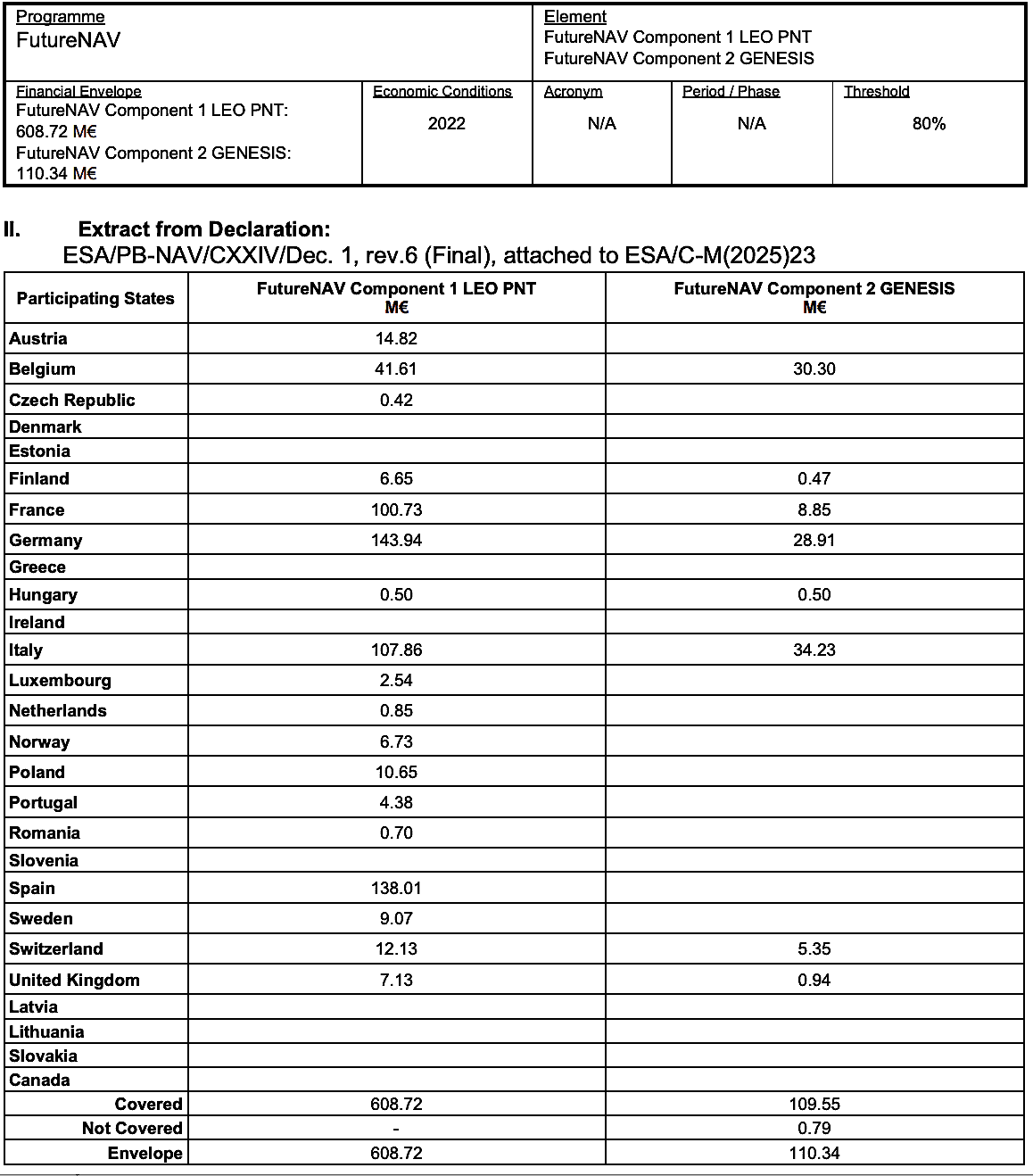
Eighteen nations subscribed to the new LEO PNT program, led by Germany, Spain, Italy and France.
“This is a completely different program,” Benedicto said. “It’s no more about testing. It’s development the technology and industrializing it, validating it in orbit. It’s equivalent to what we did 20 years ago with Galileo.”
Another component of the navigation budget approved at the ministerial as part of the FutureNav program included an OpStar demonstrator of optical signals for navigation, seen as an enabler of future quantum technology.

Credit: ESA
“This will allow Europe to demonstrate an order-of-magnitude improvement in terms of timing and position accuracy,” Benedicto said. “There is no satellite navigation system in the world that is using optical technology operationally.
OpStar secured 188.75 million euros in subscriptions, with Germany accounting for 60% of that.
Current plans are to integrate optical inter-satellite links into the second tranche of Galileo Gen 2 satellites in MEO orbit, although Benedicto said this has not et been confirmed.
“These are for time synchronization and accurate orbit determination. The ranging information will be better than what we have today with ranging from the ground,” Benedicto said.