
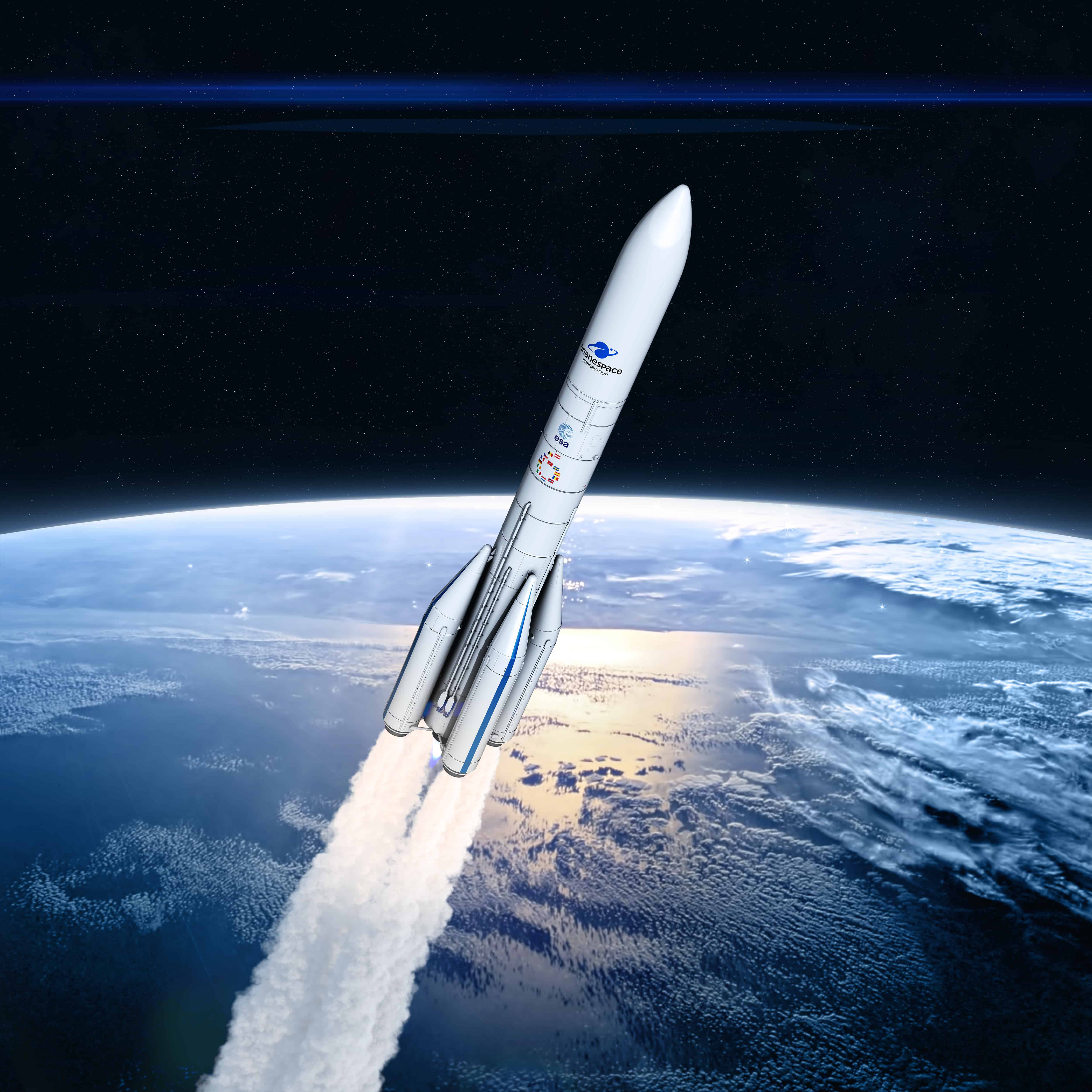
The Ariane 64 rocket, with four strap-on boosters, will make its first flight in February, carrying 32 Amazon Leo satellites. Credit: Arianespace
LA PLATA, Maryland — This year should be the first since 2021 when Arianespace can look at the future without getting a pit in its stomach. Its Ariane 6 vehicle, after a not completely successful inaugural flight in late 2024, posted four success in 2025.
The company is now poised to ramp production and compete in the market after managing the retirement of Ariane 5, the end of the use of Russia’s Soyuz and delays of Ariane 6.
Arianespace plans 7-8 Ariane 6 flights this year, starting with a Feb. 12 launch of 32 Amazon Leo broadband satellites, a launch that will debut the heavier Ariane 64 version. Up to now, only the Ariane 62, with two strap-on boosters, has been used.
In a Jan. 15 briefing, Arianespace Chief Executive David Cavaillolès said if the planned cadence of 7-8 this year is reached, the company will move to reach its full cadence of 9-10 launches starting in 2027.
He said the company has succeeded in reducing the time between Ariane 6 launches to six weeks, and that the technical analysis of the last launch — of two European Galileo navigation satellites — was remarkably clean of even minor technical issues.
The manifest this year includes 2-3 further launches for Amazon Leo, all using the Ariane 64. At some point during the year, Arianespace will introduce the more-powerful P160 boosters, replacing the P120 models to be used on the first launch.
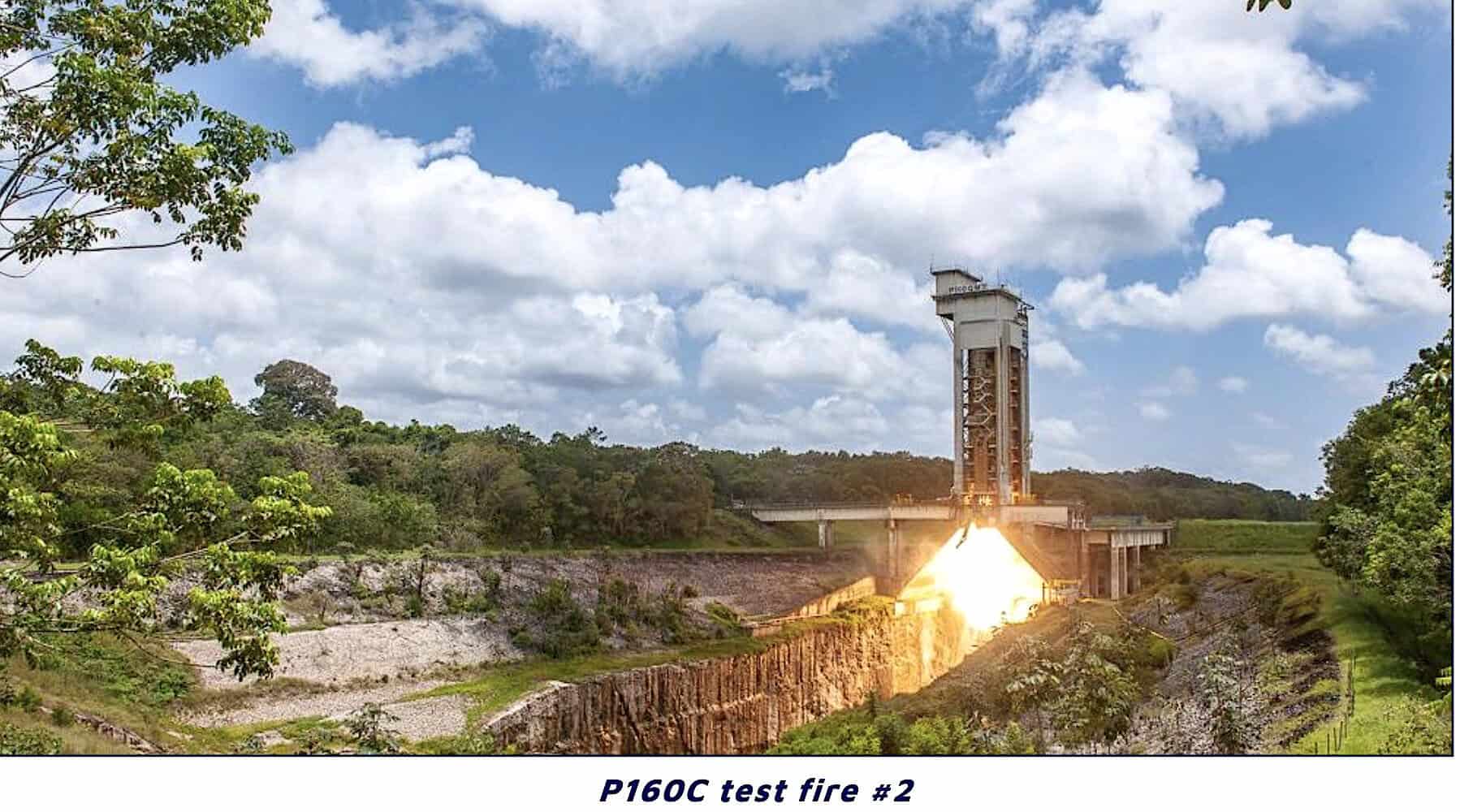
The second test firing of the P160C solid-fueled stage, to boost performance of Ariane 6 and Vega-C. Credit: Avio
“We can carry more mass and for Amazon, more satellites on each launch,” Cavaillolès said. He declined to say how many satellites the P160-equipped rocket can carry but said the new strap-ons are generally expected to add 10-15% to the vehicle’s performance.
Arianespace is under contract for 18 Ariane 6 launches for Amazon Leo.
Cavaillolès said ramping production cadence will mean easing bottlenecks in the Ariane 6 supply chain, in Ariaenspace’s mission-operations procedures and at the Guiana Space Center spaceport in French Guiana, on the northeast coast of South America.
Bottlenecks in the supply chain, mission management and at Guiana Space Center need work
On the launcher supply chain: “We have 100s of companies involved in the ramp-up. Most are on time, some are in advance and for some it’s a bit more complex. We are working very hard with the supply chain to be sure all the missing parts are there so that we can accelerate and synchronize,” Cavaillolès said.
On mission operations: “We have to reduce the time of mission preparation. It takes several months, it’s very complex to determine the trajectory of the launch and so on. We are in a transformation effort to simplify the way we prepare a mission, while maintaining safety and accuracy.”
At the Guiana Space Center: Ariane 6 components are built in Europe and then shipped by boat to the Guiana spaceport for assembly. “We need some more infrastructure, more halls to move the boosters while we keep working on other parts of the launcher. We need to remove those bottlenecks.”


David Cavaillolès. Credit: Paris Air Forum video
Arianespace now shares the use of the Guiana base with Avio, which has taken over operations of the medium-lift Vega-C rocket. Cavaillolès said relations with Avio are good as the two companies book range capacity.
But starting in 2026 or 2027 things could get more complicated. Several start-up small launch companies want to use the spaceport and will be operating from a long-retired launch pad that has been refurbished.
“That will generate complexity in terms of schedule management,” he said.
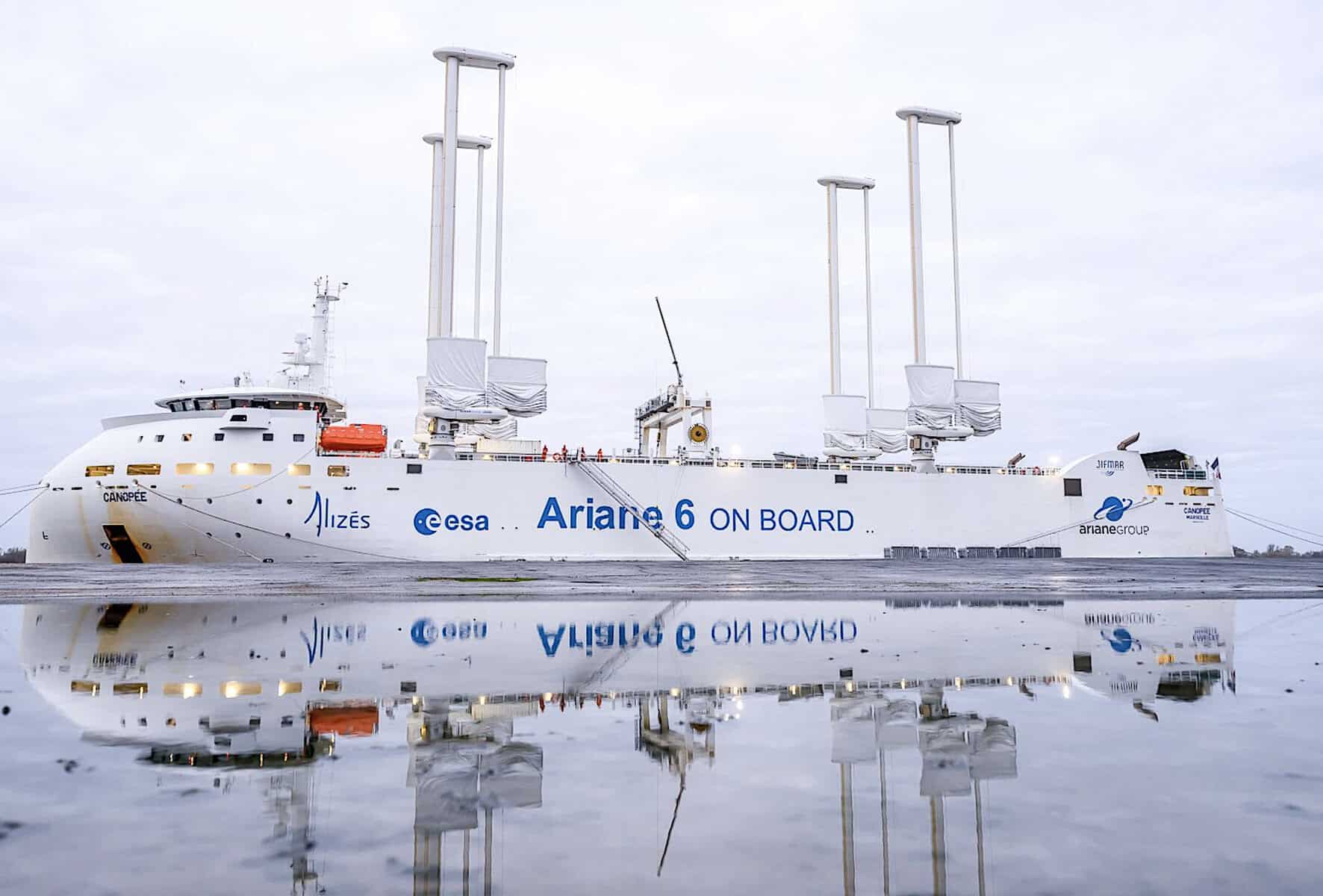
The ArianeGroup Canopée ship carrying Ariane 6 components for the coming Amazon Leo launch. Credit: ArianeGroup
With the Amazon launches now imminent, Arianespace is waiting for clarity on two other big customers — the European Commission’s Iris2 multi-orbit secure communications constellation, and the German Defense Ministry’s expected communications constellation.
Iris2 is going through a planned assessment by the Commission and the SpaceRise consortium contracted to operate it. This assessment, called RDV-1, will determine whether the network as designed needs to be modified.
Cavaillolès said SpaceRise had asked Arianespace to reserve slots in 2029 for the first Iris2 launches. The full constellation — with satellites in orbits of 8,000, 1,200 and 700 kilometers — would require between 10 and 15 Ariane 6 launches.
If Iris2’s schedule slips, as seems likely, the 2029 slots will be sold to commercial customers.
The German military in September announced a budget of 35 billion euros ($41 billion) in space spending through 2030. Cavaillolès noted that German industry builds some 21% of the value of an Ariane 6 rocket, giving the German government ample reason to favor Arianespace. But that decision has not been made.
“My understanding is that Germany wants to go very quickly. My message is simple: From 2028 onwards we have room in our manifest. Part of this program will be a telecom constellation but I don’t have details on its mass or architecture.”
Arianespace is under contract to launch two large GEO-orbit German military telecommunications satellites in 2028-29.
Paris-based Eutelsat has contracted for 440 replenishment satellites for its OneWeb broadband constellation, with launches scheduled to start as early as late this year.
Cavaillolès said Arianespace’s 2027 manifest is about full but has one or more slots that could accommodate a group of OneWeb satellites to be stationed in the same orbital plane.