

David Cavaillolès. Credit: Paris Air Forum video
PARIS — Launch service provider Arianespace is uncertain whether it will begin launching Amazons’s Project Kuiper broadband satellites in December aboard the inaugural flight of the heavy Ariane 64 rocket, or select two European Galileo navigation satellites, which use the lighter Ariane 62, which would put the Kuiper launch into early 2026.
The Ariane 6 has flown three times, including twice this year, all using the lighter 62 variant. The company plans two more Ariane 6 missions this year, and then eight in 2026, as it ramps production of the new rocket.
Amazon has booked 18 Ariane 6 missions with Ariane 64, which uses four strap-on boosters. Ariane 62 uses two boosters..
Amazon is counting on three new vehicles — the United Launch Service Vulcan, Blue Origin’s New Glenn and the Ariane 64 — to launch its 3,200-satellite constellation.
All three rockets are considerably behind the original schedules they had set at the time of signing the contract. Amazon is also behind schedule in producing its satellites.
As a result, there is real doubt about whether Project Kuiper will meet its regulatory deadline of launching 1,600 of its satellites by next July. The company said it expects to have fielded 200 by the end of this year.
In a Sept 16 briefing here during World Space Business Week (WSBW), organized by Novaspace, Arianespace Chief Executive David Cavaillolès said Amazon, in addition to its current 18-launch contract, has notified the company that it would leap at the chance of securing an additional launch if any of Arianespace’s customers were to be delayed.
For now, Arianespace is fully booked for 2026 and is short on open slots for 2027 as well.
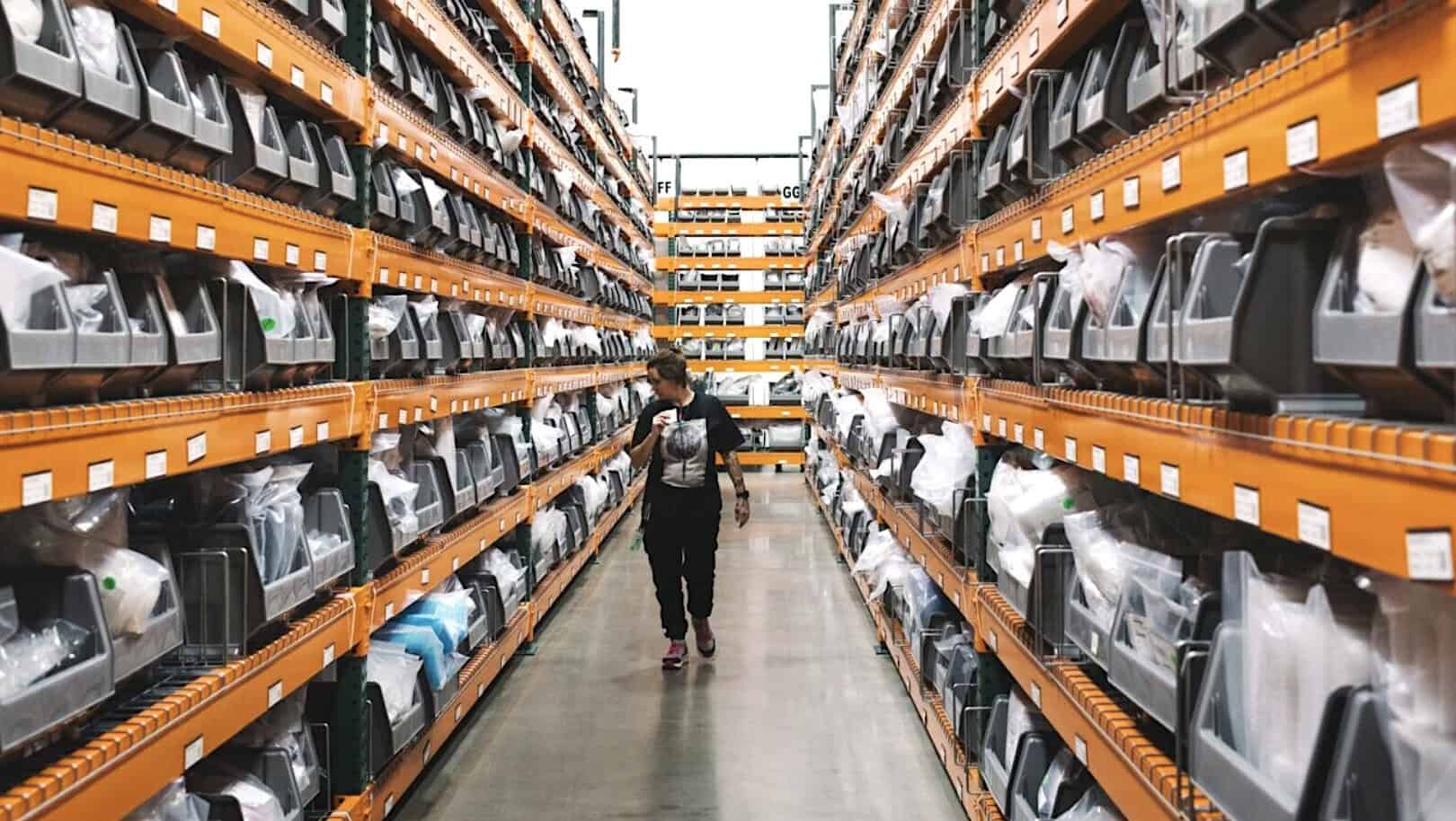
Project Kuiper’s warehouse at its satellite production facility in Kirkland, Washington. Credit: Amazon
“Anything we can do to anticipate launches [beyond the existing contract] will be welcome,” Cavaillolès said of Amazon. “They want us to go fast, and the faster the better. Any solution, any idea we have to accelerate goes in the right direction, whatever we can do to accelerate Kuiper.”
As of Sept. 16, it was unclear whether that would occur in December or early in 2026. Arianespace has scheduled two more Ariane 6 missions this year. The first will be of the European Union’s Sentinel 1D Earth observation satellite, to fly solo on the lighter Ariane 62 version. The second will be either two European Galileo positioning, navigation and timing satellites, also on an Ariane 62; or the first Kuiper flight on the Ariane 64.
Cavaillolès said ending 2025 with the first four Ariane 6 missions completed, while one less than the company had anticipated, is a satisfactory ramp up. In 2026, he said the company expects to conduct eight Ariane 6s, with a mix of Ariane 62 and Ariane 64 variants.
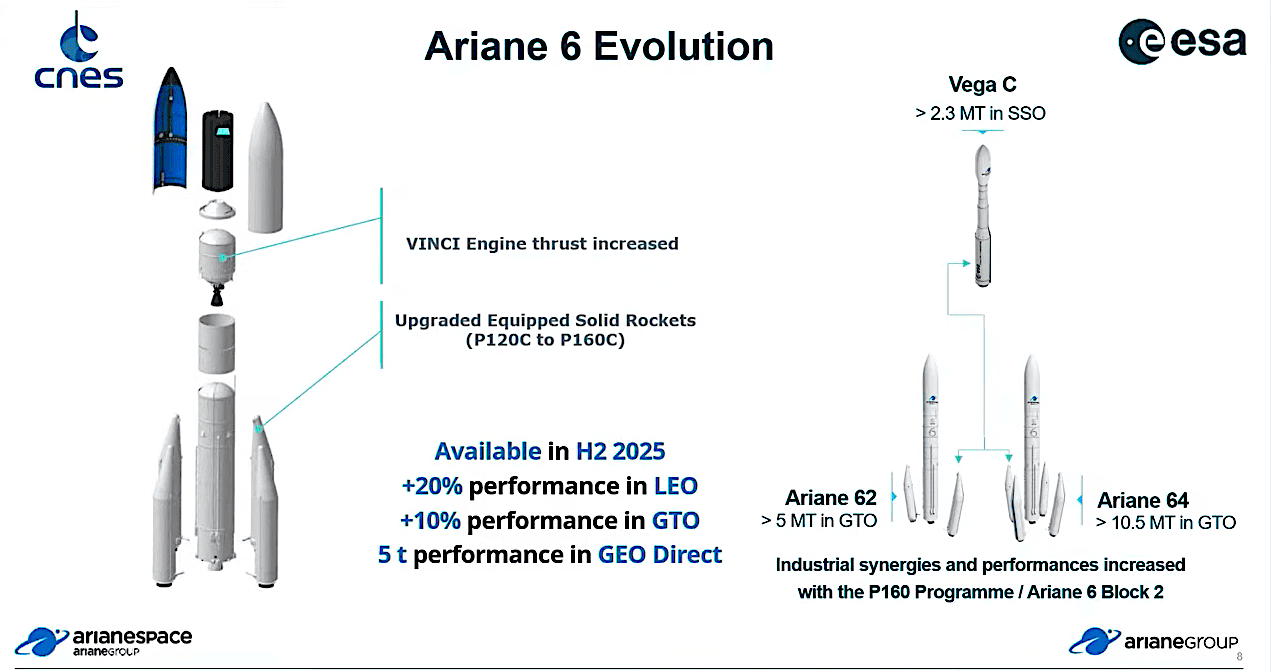
Credit: ArianeGroup
The company is also preparing its Block 2 Ariane 6 version, which is what Project Kuiper is counting on to carry the bulk of its missions with Arianespace. Block 2 features larger strap-on boosters and a more-powerful first stage engine, allowing for more Kuiper satellites to launch than on the current Ariane 64.
Arianespace is ending its commercial responsibility for Europe’s Vega-C rocket following an agreement reached with Avio SpA, Vega’s prime contractor, which sought full control over the vehicle’s sales. The last Arianespace-managed Vega flight will be early in 2026.
Cavaillolès said the successful demonstrations of Ariane 6 and the end of responsibility for Vega C have allowed Arianespace “to reinvent ourselves, internally and externally.”
He said the company would not be taking over sales of the new medium-lift rocket from Maia Space, a startup 100% owned by ArianeGroup, the Ariane prime contractor. For now, Maia Space will manage its own sales force.
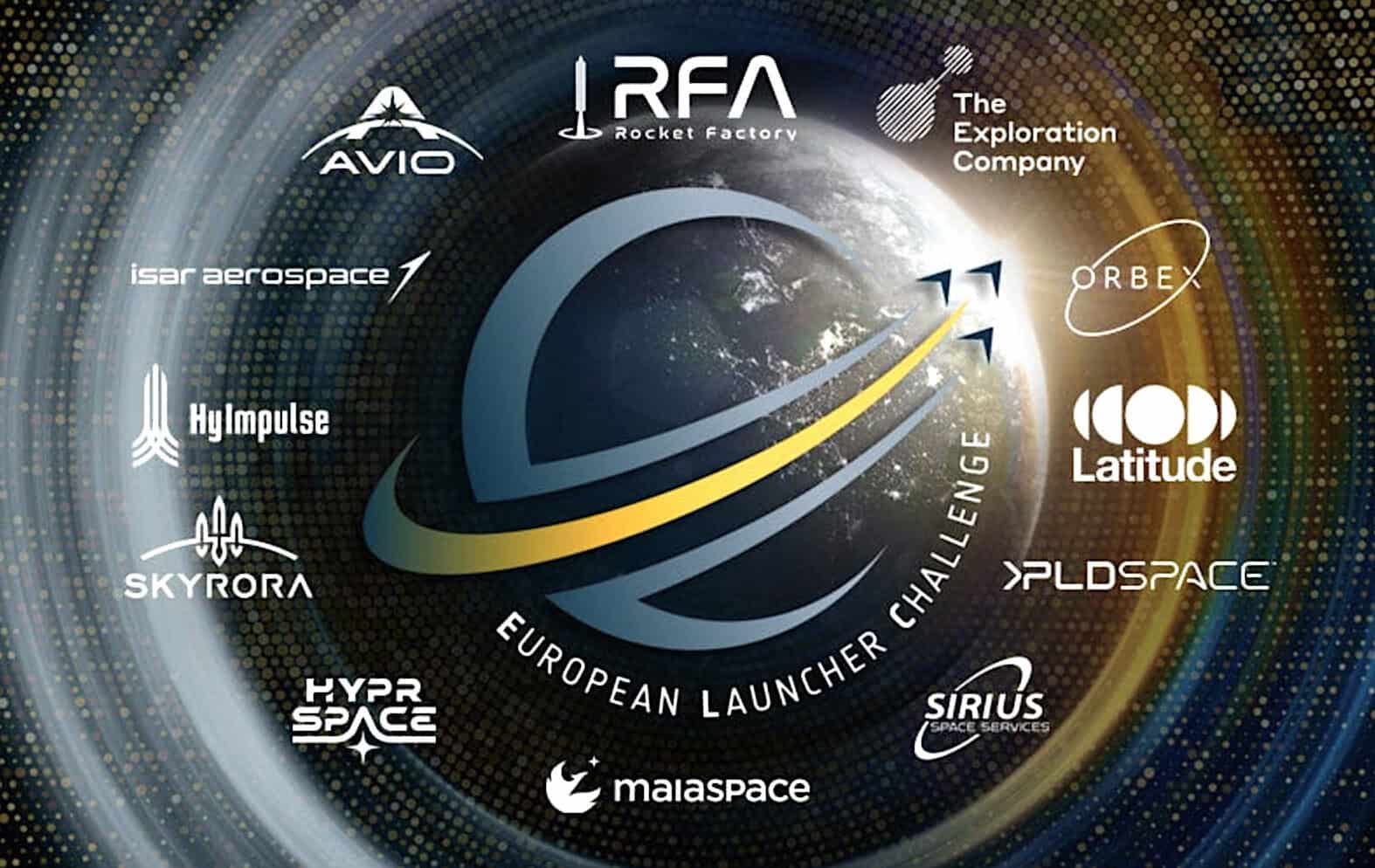
Arianespace wants to establish relations with all European small-launcher companies to prepare for the market’s inevitable shakeout. Credit: ESA
In the meantime, Arianespace wants to nourish relations with other small-launcher startups in Europe, including all five that have won the European Space Agency (ESA) European Launcher Challenge (ELC), which opens the way to ESA funding of their development. Maia Space is one of the ELA winners.
‘We want relations with all European small-launcher players to prepare for inevitable shakeout’
Cavaillolès said Arianespace, despite being majority-owned by ArianeGroup, is positioning itself as a neutral arbiter that can work with multiple launchers and builders of orbital transfer vehicles that carry multiple satellites on Ariane 6.
“There is Arianespace, our mother company ArianeGroup and Maia Space, which is a sister company. Could we do something with them? Yes. Would this be an exclusivity? No. We have discussions not with all five ELC players yet, but with the majority of them.
“It is good to have one foot in the ArianeGroup door, for certain, but it is also good to be able to talk with third parties. This is one of our strengths. As we don’t directly develop the launcher, we are not in competition with anybody to some extent, which allows us to build bridges with everybody.
“The idea is to have Maia as an independent company end to end, and to have all the functions internally. Otherwise they would be part of the group and not different from the group.
“What is clear today is that we have a lot of players in Europe and beyond. There are projects everywhere. We should eventually enter a consolidation phase. Some projects will stop, some will merge. We want partnerships, even light partnerships, with everybody, to prepare some evolution of the landscape,” he said.
‘The satellite launch market is not booming. Chinese launches and SpaceX Starlink are’
Behind Cavaillolès’s statements is a view that the satellite launch market is not witnessing the rapid growth often attributed to it.
“There is not an explosion of the market if you remove Chinese satellites and Starlink,” he said. “The market is not booming. And if you discuss with the satellite builders, they are suffering.”
Accommodating sovereign demand the world over, starting with Germany
What has changed is the number of governments now considering sovereign satellite assets, whether individual satellites in geostationary orbit or low-orbit constellations. How much growth will come from governments remains uncertain.
In addition to pitching itself as a neutral party in Europe, Arianespace sees itself as a launch provider capable of dealing with customers the world over without being subjected to political winds.
“We are historically quite a neutral player, able to partner and work with anybody,” Cavaillolès said. “A sovereign country outside Europe that wants a sovereign launch can come to us with a very high level of confidence that there will not be a political decision preventing us to work with them. You can have national sovereignty with a non-national launcher, which is Ariane.”
How real is Germany’s willingness to invest in its own constellations?
In Europe, the German government is weighing whether to launch its own broadband constellation as a national project despite the European Commission’s Iris2 multi-orbit constellation.
“Germany has made very strong statements and they are very serious,” Cavaillolès said. “It might be a game-changer. ArianeGroup is Franco-German company and might become even more German, at least at our level, depending on what happens.
“The only question is: What is the real ambition of their big infrastructure? When does it come? To what extent is it sovereign or European? We’ll see.”