
Credit: AST SpaceMobile November 2025 investor call
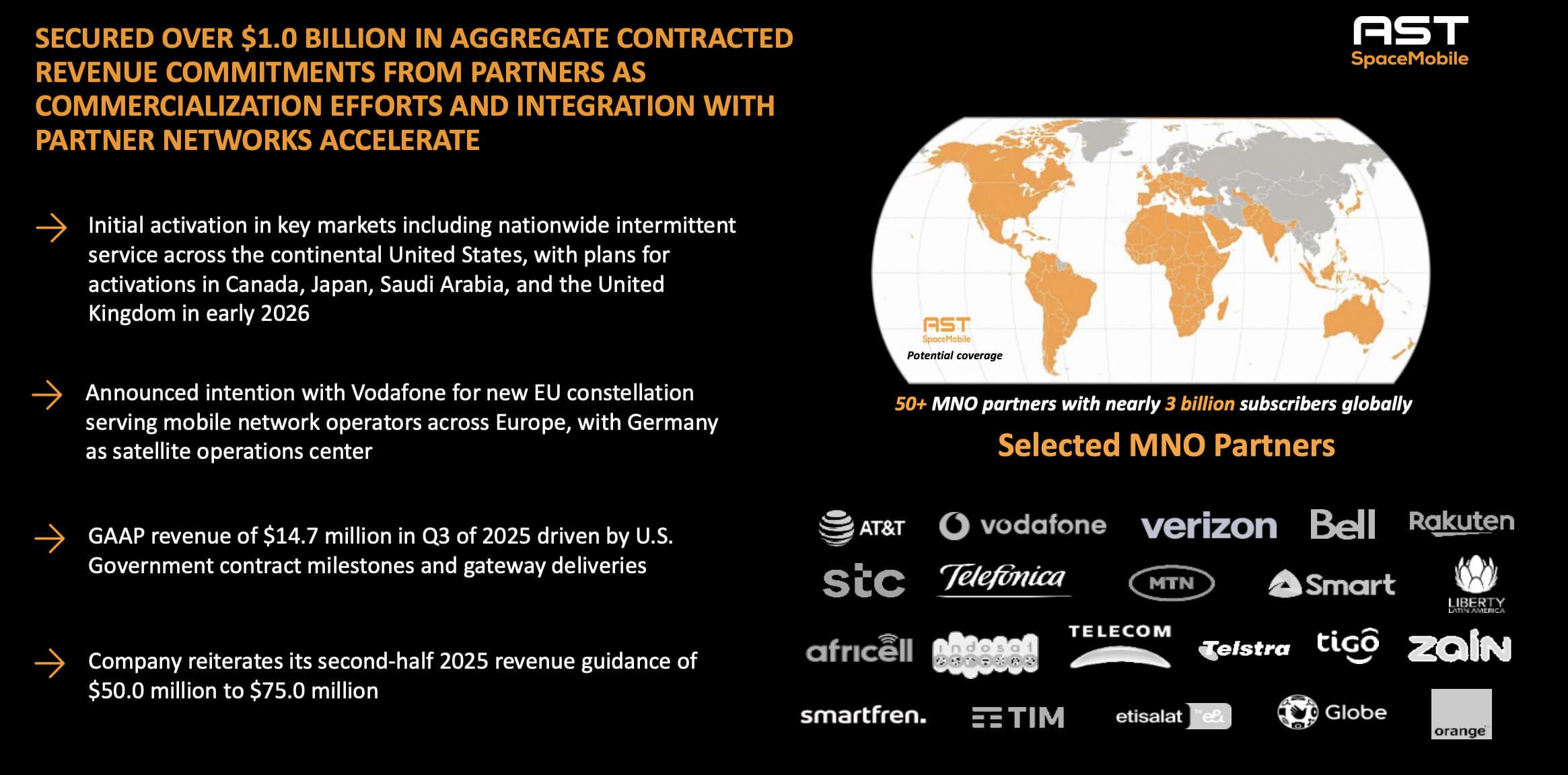
LA PLATA, Maryland — Mobile satellite direct-to-device (D2D) service provider AST SpaceMobile said it had secured over $1 billion in revenue commitments from its commercial telco partners who will use the service to fill in gaps in their cellular coverage, and $3.2 billion in liquidity.
The most recent addition to the revenue commitment is a 10-year agreement with Saudi Arabia’s stc group, with $175 million in prepayments.
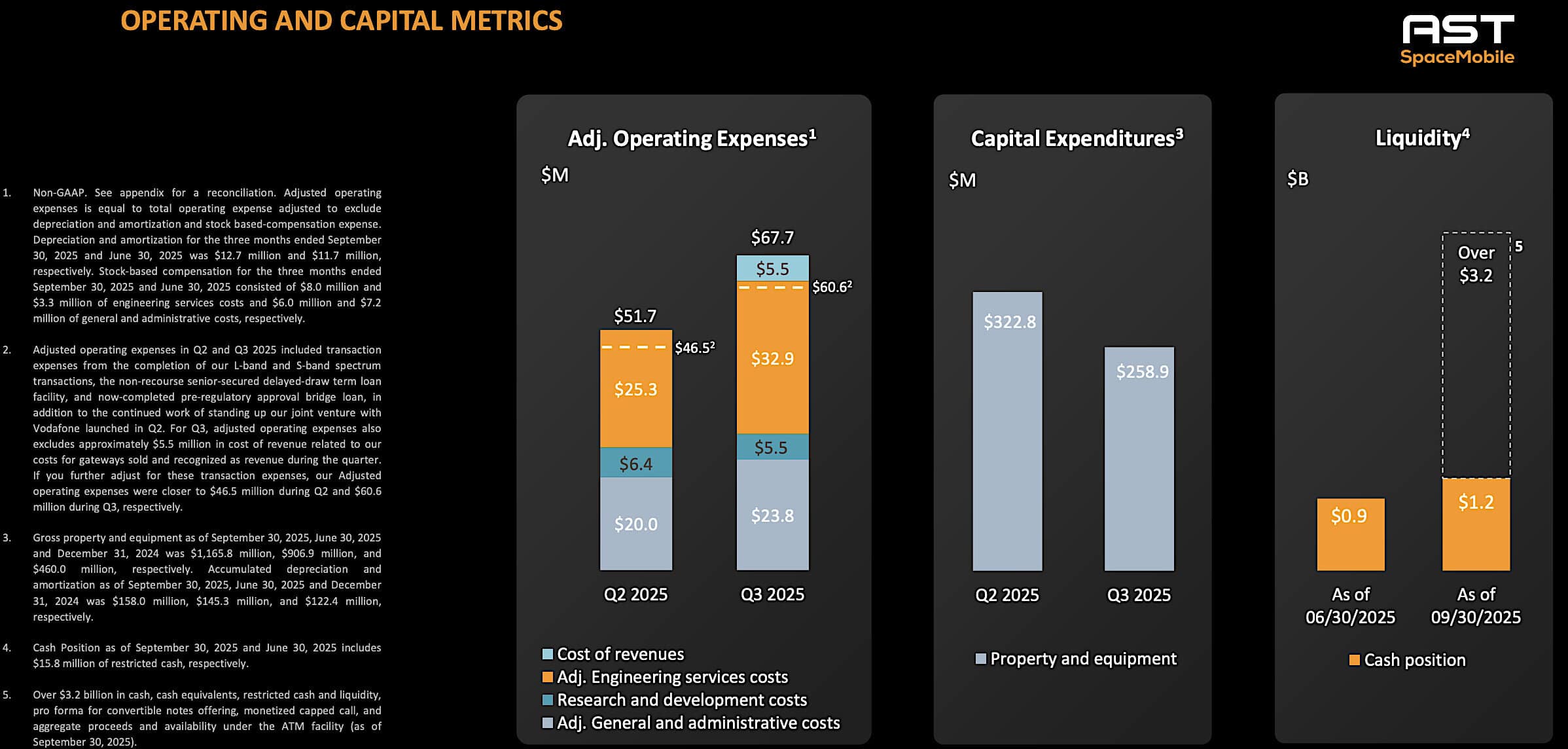
The liquidity is sufficient for the company to deploy the 90 satellites it says it will need to provide continuous coverage to strategic markets worldwide, and give the company time to generate revenue to sustain the business.
Credit: AST SpaceMobile November 2025 investor call
In a Nov. 10 investor call, AST officials said just about all the pieces are in place for it to begin offering intermittent service in the United States, Europe, Japan and Saudi Arabia in early 2026. The company said this non-continuous service can be assured with the five Block 1 satellites in orbit plus 20 Block 2 models being readied for launch starting in December.
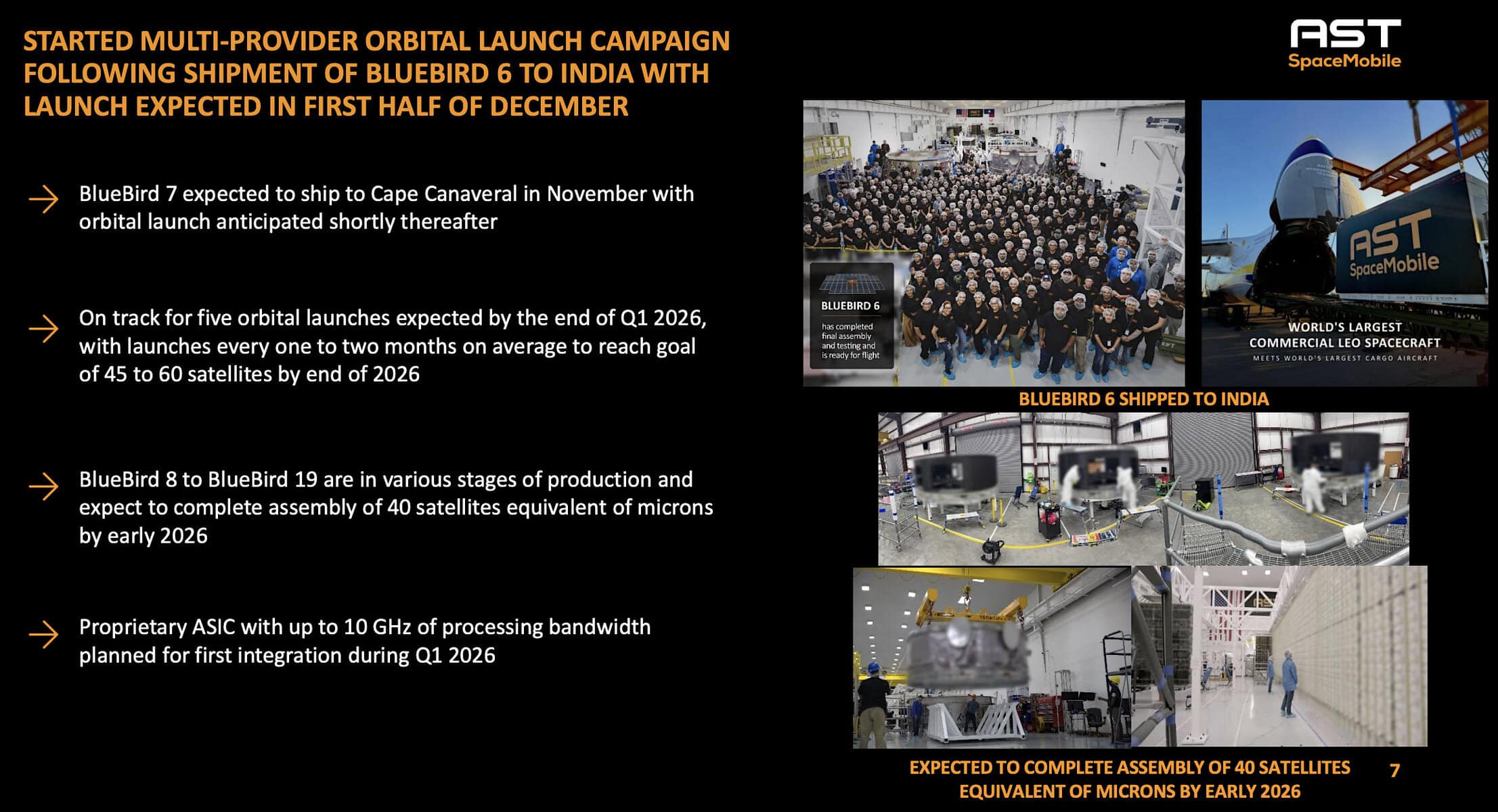
AST has had to pull back from previous launch schedule forecasts, notably with the launch of its first Block 2 satellite, announced for this summer and then early autumn and now scheduled for December aboard an Indian GSLV rocket.
A SpaceX Falcon 9 is likely the next launcher to be used. AST Chief Executive Abel Avellan said a Falcon 9 can carry three Block 2 satellites, each with communications arrays that in orbit measure 223 square meters, three times larger than the Block 1 models.
Avellan said the early AST launches will be mainly on US launchers including the Blue Origin New Glenn, still in early deployment; and SpaceX. He mentioned Japan’s MHI, which is developing the H3 heavy-lift vehicle, also in its early operational lift. Its first successful launch was in February 2024. . Blue Origin’s New Glenn can carry eight Block 2 spacecraft.
Credit: AST SpaceMobile November 2025 investor call
AST has not specified its launch service providers beyond December’s flight from India, but it is maintaining its plans to have five launches, including December’s from India, conducted by March 2026. It forecasts it will have more than 60 Block 2 satellites in orbit by the end of 2026.
AST said continuous coverage in the United Sates, Europe, Japan, Saudi Arabia and other strategic markets can be assured with between 45 and 60 satellites in orbit.
With 90 satellites, it can provide full service globally.
AST Chief Financial Officer Andrew Johnson said during the call that the company has maintained its cost for the Block 2 satellites at some $22 million each, including launch.

Credit: AST SpaceMobile
With the company’s financial issues now behind it, AST can focus on getting satellites into orbit as quickly as possible, even beyond the 90 satellites needed for global commercial service.
The company has filed an application with the US Federal Communications Commission (FCC) to operate a 248-satellite constellation.
So far, the FCC has authorized AST only to launch and perform initial orbit-raising maneuvers and communications with gateway Earth stations for the Block 2 satellite to launch in December.
The company has filed an FCC application to launch and operate all 248 satellites using spectrum licensed to AST telco partners AT&T and Verizon; and FirstNet, a US provider of emergency services.
The agency has approved the launch of 20 Block 2 satellites using V-, S- and UHF-band, but here too only for orbit raising and gateway links, not for commercial operations. The FCC is now seeking public comment on AST’s application. Commercial service cannot begin until it has approved.
The same is true for commercial operations outside the United States. Each nation will need to approve the company’s operations in its territory.
In Europe, Vodafone has been a backer of AST and has made a prepaid commitment for future service.
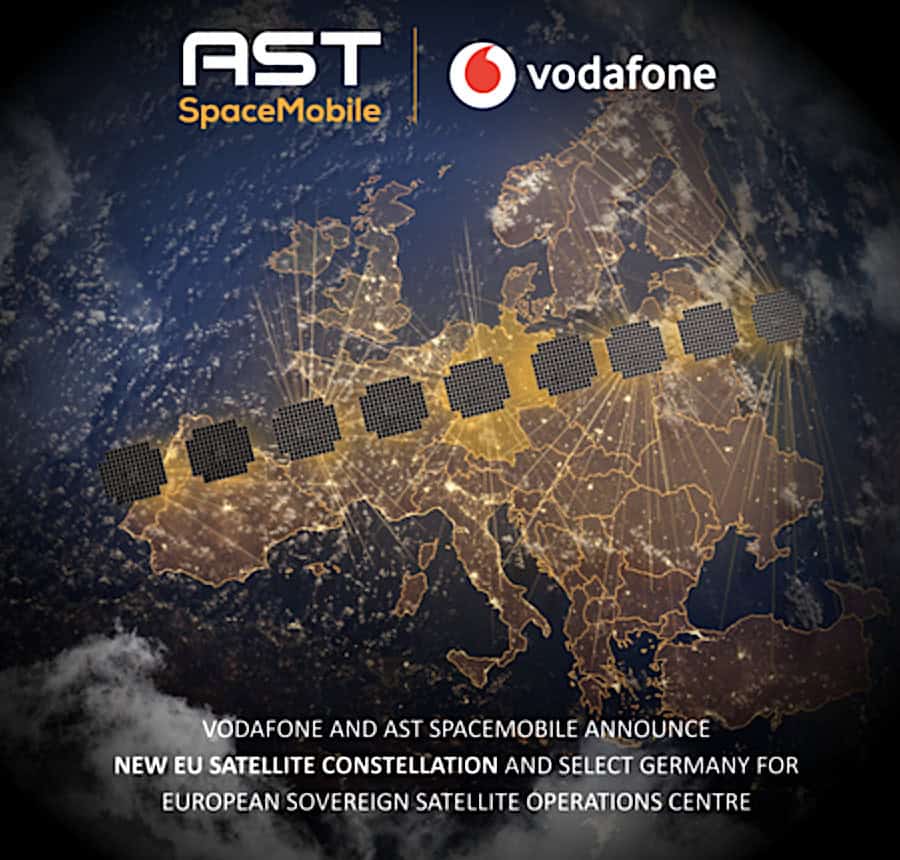
AST clarified that this agreement is not for a separate European constellation, but certain features desired by European telcos to be placed on AST’s already planned constellation. Credit: AST SpaceMobile
AST and Vodafone recently announced what sounded like a separate AST-built constellation dedicated to Europe. Avellan clarified that this is not the case. The company will be “building our constellation with certain features” for European telcos, but the satellites will be the same constellation.
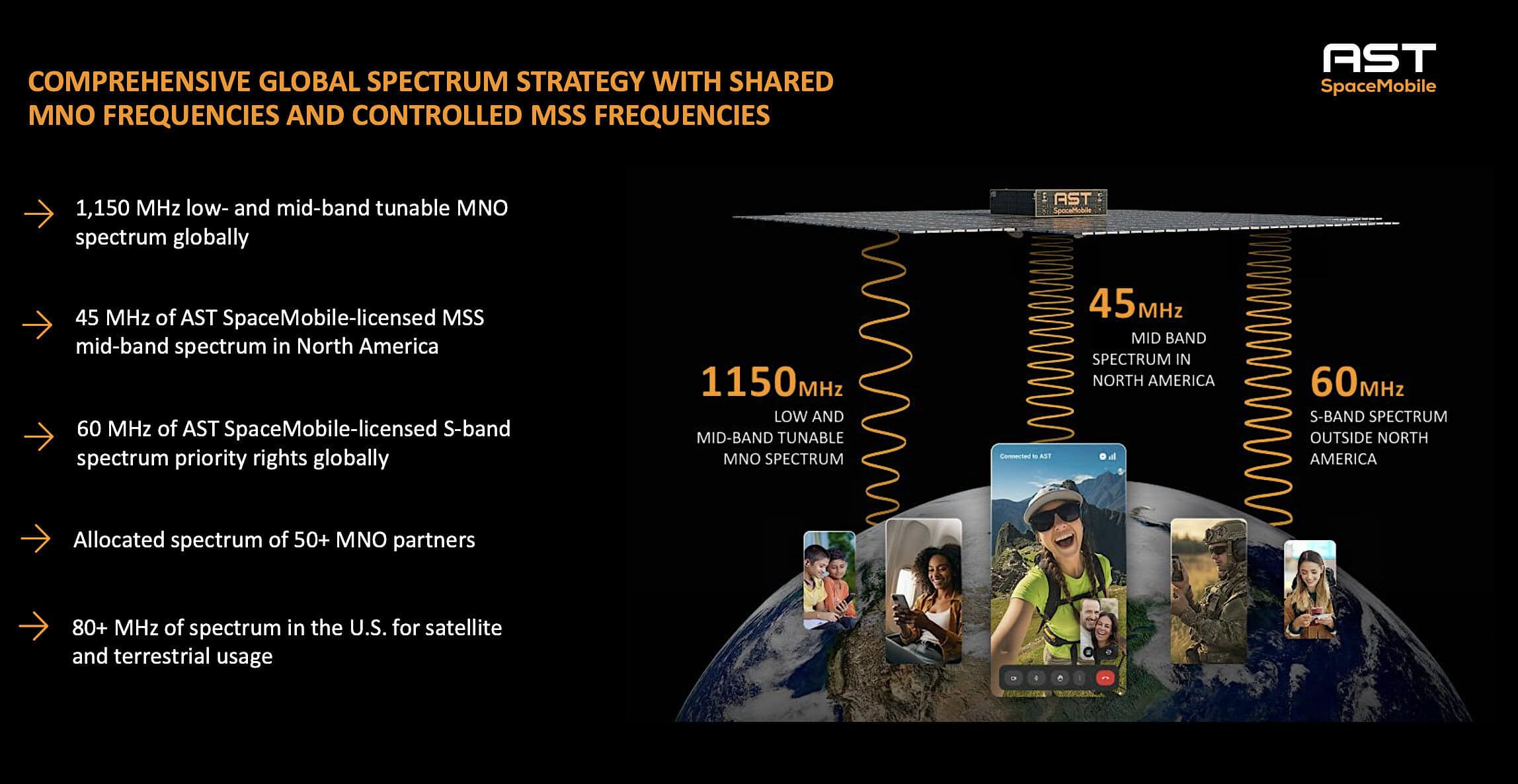
In addition to using the spectrum already licensed to its terrestrial telco partners, AST recently concluded negotiations with Ligado Networks to use that company’s rights to Inmarsat/Viasat Inc. L-band spectrum in the United States. AST has also purchased, for $64.5 million, S-band rights held by EllioSat Ltd.’s Sky and Space Global (UK) Limited, which has ceased operations.
Credit: AST SpaceMobile November 2025 investor call
Avellan said the AST constellation can combine the C-band from its telco partners and the L- and S-band satellite spectrum it has purchased and adjust which is used in which market depending on need.
“Our platform captures over 1,000 MHz of spectrum that can be tuned across all 3GPP bands, in low-band and mid-band, as long as 3GPP is allowed into the devices,” Avellan said. “We can partner with 700-MHz in one jurisdiction and mid-band in another. As long as it’s 3GPP, and as long as it’s in devices.”