
Credit: Astroscale Dec. 12, 2025, investor presentation
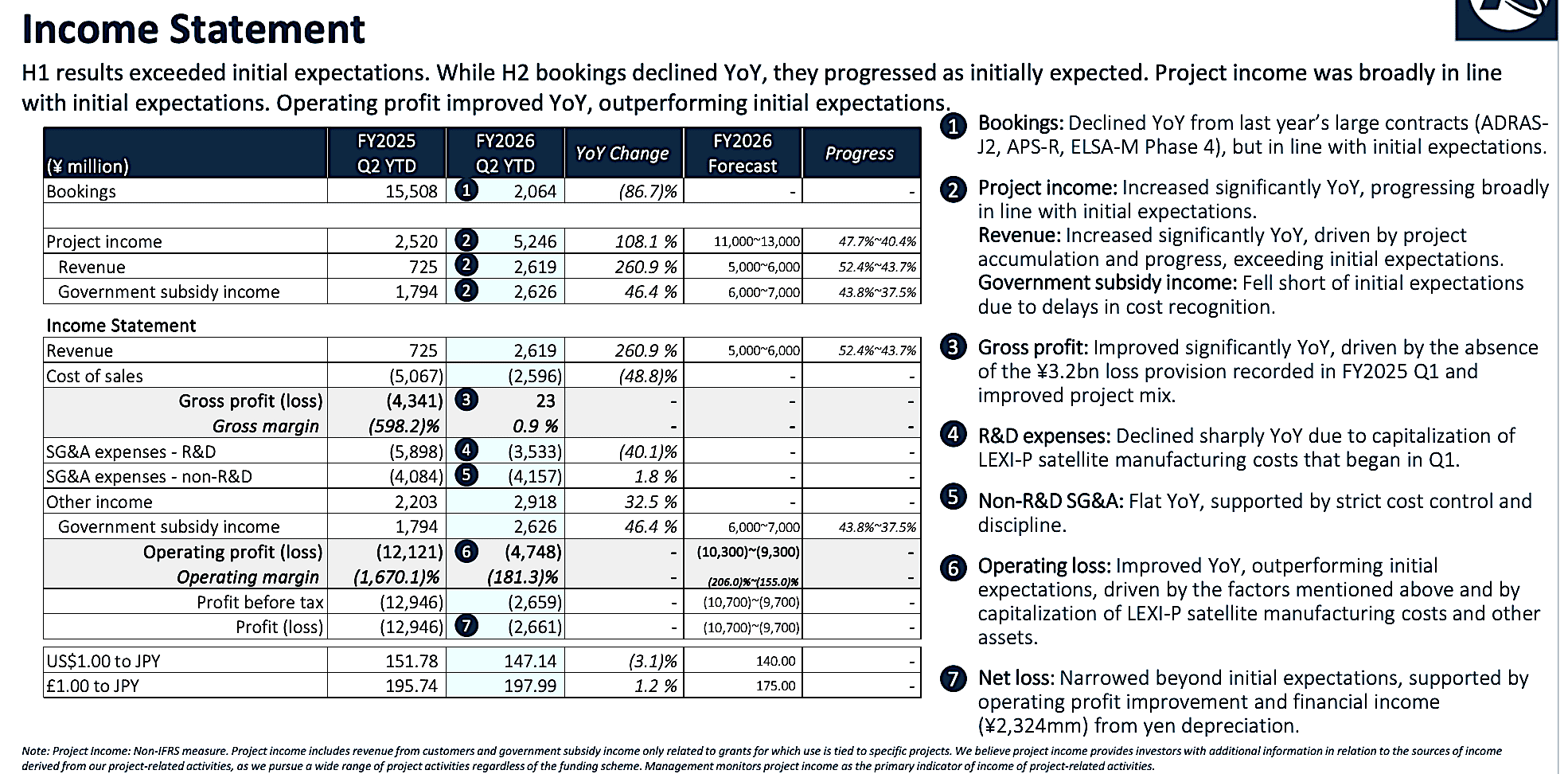
LA PLATA, Maryland — Satellite servicing and debris-removal company Astroscale reported a tripling of revenue and a sharp reduction in its operating loss for the three months ending Oct. 31 and said government policy in all three of its operating regions — Japan, the United States and Europe — is moving to adopt technologies where Astroscale has expertise.
The company reported a positive gross profit of 23 million Japanese yen ($147,600) for a 0.9% gross margin, after a 4.3-billion-yen loss a year earlier following a large loss provision.
Credit: Astroscale Dec. 12, 2025, investor presentation
The commercial markets are not moving that quickly, but Astroscale booked notable orders for its docking plates, which are fitted onto satellites before launch to make them easier to retrieve on retirement, if necessary.
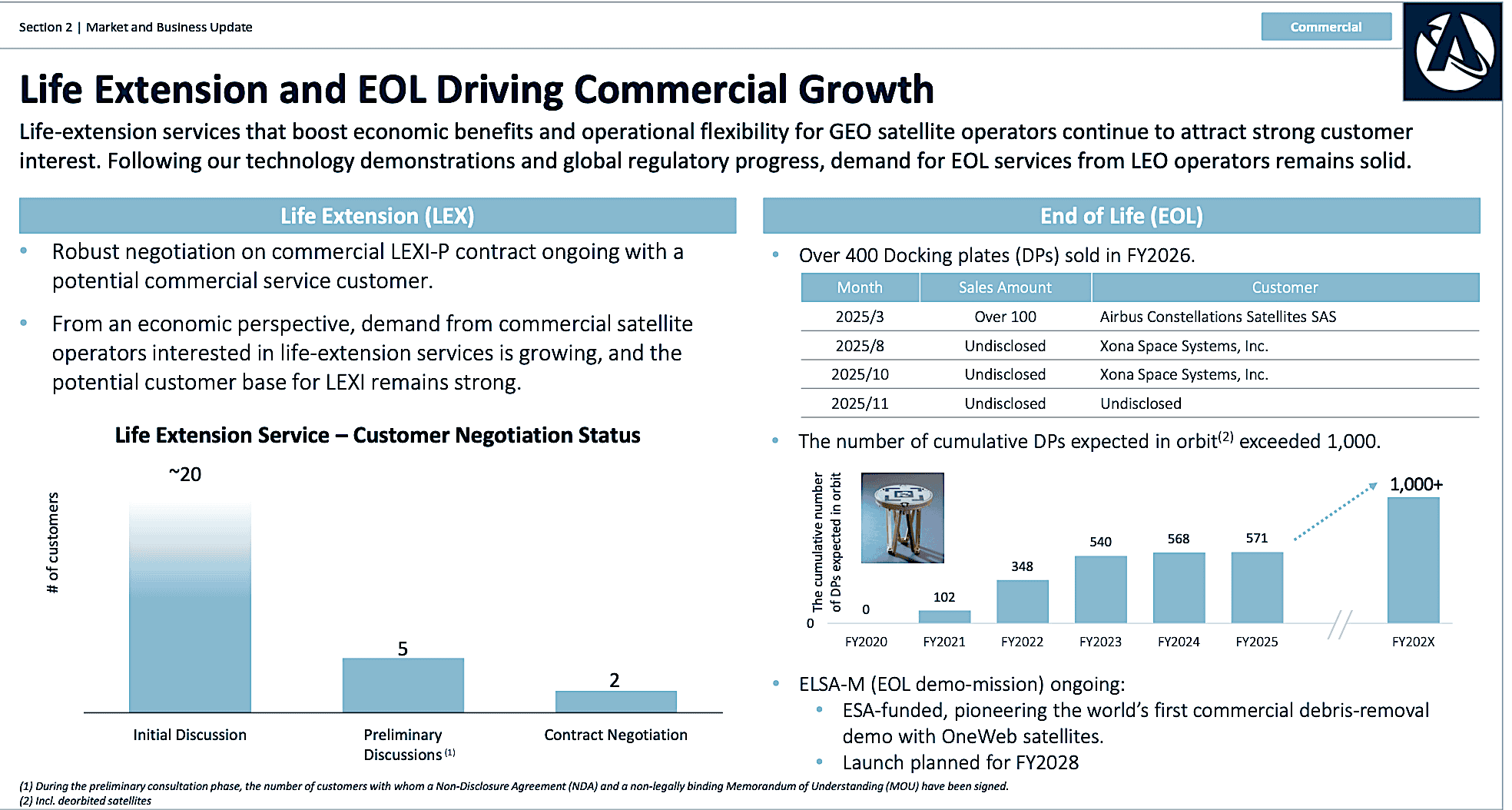
Docking plate contracts were signed with Airbus Defence and Space, which is under contract to Eutelsat Group to build satellites to refresh the OneWeb broadband constellation; and to Xona Space Systems for Xona’s coming fleet of resilient position, navigation and timing satellites.
Astroscale said more than 400 docking plates were sold in fiscal-year 2026 as of Oct. 31, including more than 100 to Airbus, and that the new orders briefing to more than 1,000 the number of plates sold, including those on satellites that have been deorbited.
Credit: Astroscale Dec. 12, 2025, investor presentation
A demonstration flight of a commercial debris-removal mission to remove from orbit an aging OneWeb satellite using a docking plate on the satelite is schedule for fiscal-year 2028 under a contract with the European Space Agency (ESA).
Astroscale’s long-delayed contract with an unnamed commercial fleet operator to perform a life-extension mission in geostationary orbit is still not concluded. Chief Financial Officer Nobuhiro Matsuyama said in a Dec. 12 investor call that the contract, called Lexi-P, remained a risk factor for full-year revenue.
“Negotiations with the commercial customer are ongoing, but the process is taking longer than expected and may require additional time to conclude,” Matsuyama said.
Astroscale nonetheless believes that life-extension services, in which a small satellite carrying fuel attaches itself to an aging GEO-orbit satellite to extend its service life, “continue to attract strong customer interest.” The company said that from initial discussions with around 20 prospective customers, it entered preliminary discussions with five of them and is in contract negotiations with two.
Credit: Astroscale Dec. 12, 2025, investor presentation
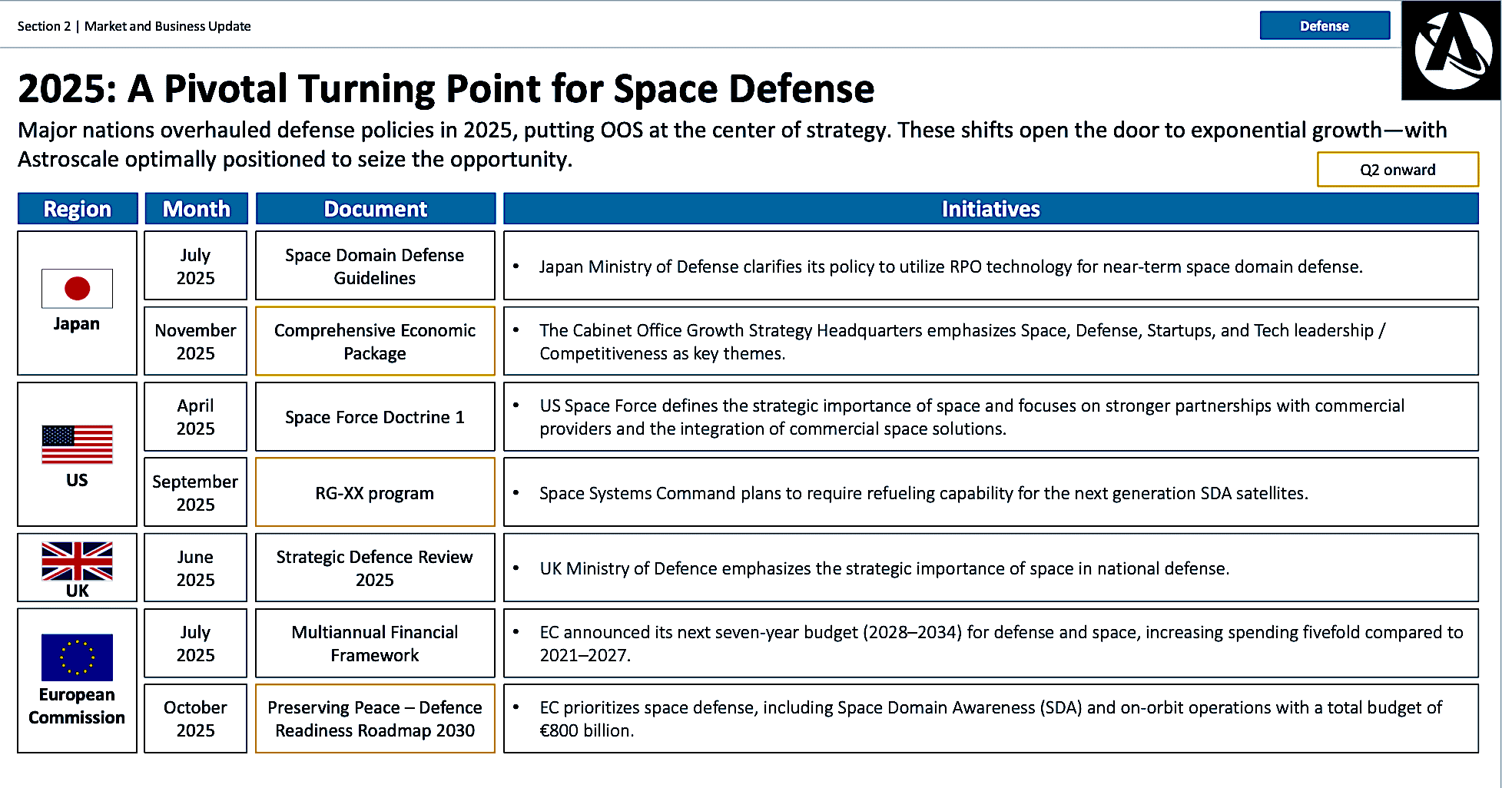
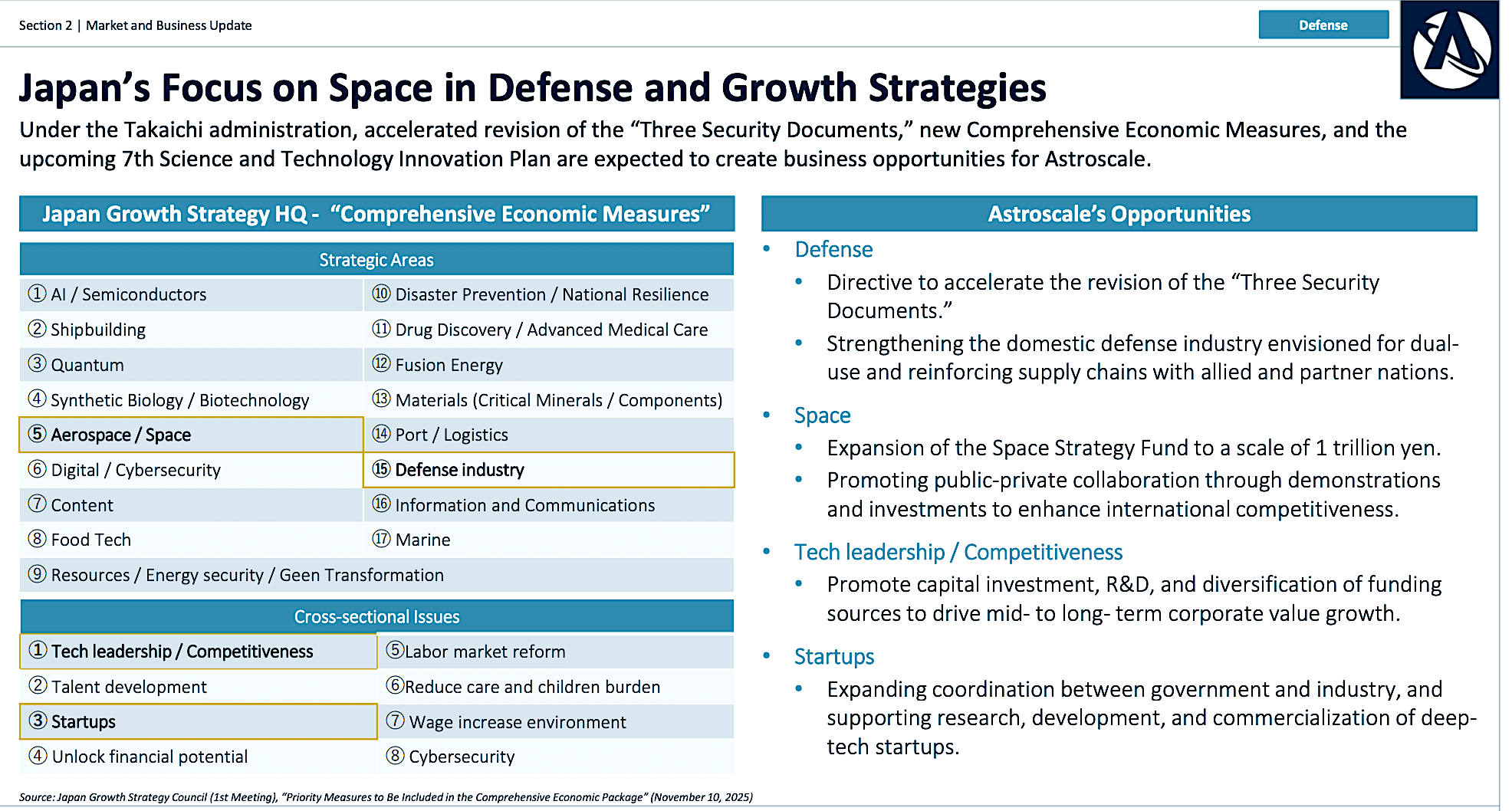
It’s on the government side that Astroscale is counting for near-term growth, with Japan, the United States, Britain and the 27-nation European Union all adopting policies promoting space domain awareness and the protection of in-orbit satellites.
“This is a major tailwind for us as a global leader in RPO technology—rendezvous and proximity operations,” Chief Executive Nobu Okada said during the investor call.
“We expect these initiatives to materialize in the next budget cycles. In addition to projects already under contract with defense agencies, we anticipate earlier-than-expected demand.
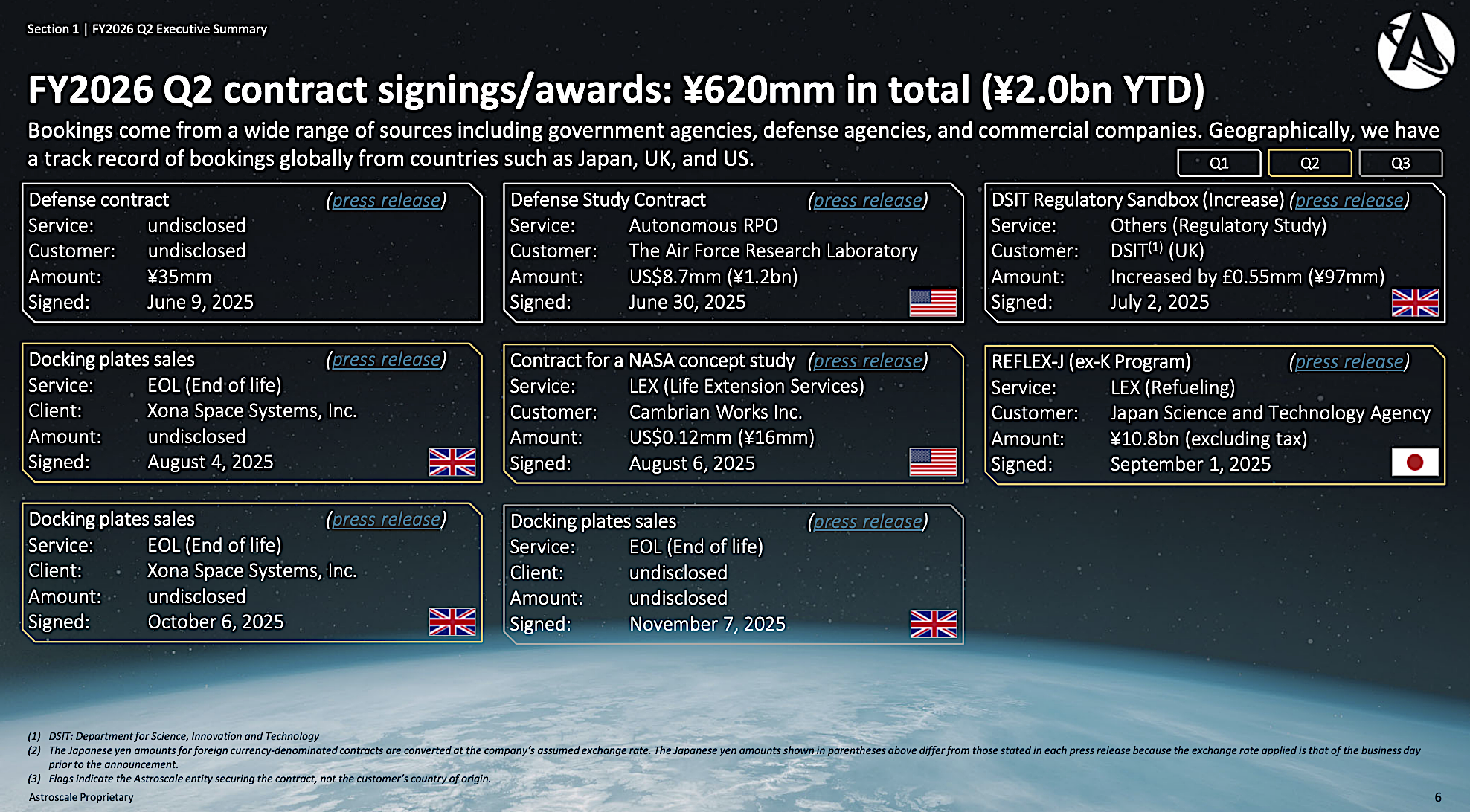
“Although the current contract sizes are relatively small, they include study projects and docking plate sales, which serve as important steppingstones toward future large-scale and recurring projects.
Credit: Astroscale Dec. 12, 2025, investor presentation
Japan’s Space Strategy Fund, approved last year, includes funding for on-orbit servicing, with bid requests issued earlier this year.
“We are actively working to secure these projects,” Okada said. “Astroscale is the only private company worldwide to have demonstrated RPO technology with non-cooperative objects, making us indispensable for strengthening these capabilities. We already have contracts with five defense agencies and are engaged in discussions with all the countries and regions listed here for the next steps.”