
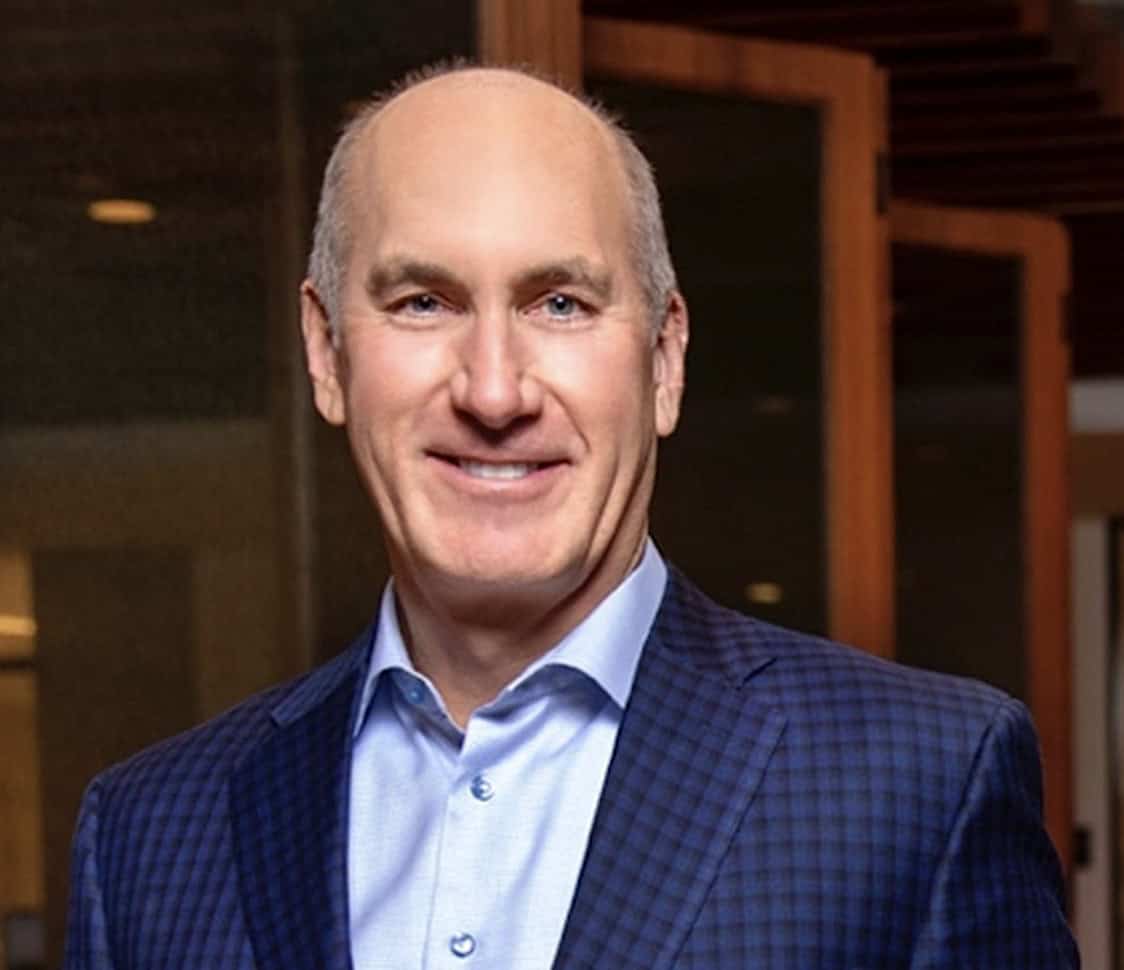
John Stankey. Credit: AT&T
LA PLATA, Maryland — AT&T Chief Executive John Stankey said satellite direct-to-device (D2D) might one day compete with terrestrial wireless in certain markets but that the 40 MHz of spectrum available to D2D in the United States is a long way from the more than 300 MHz of spectrum held by terrestrial wireless operators.
In Sept. 9 remarks at the Goldman Sachs Communacopia + Technology Conference, Stankey said his company spent $23 billion on EchoStar Corp. midband spectrum because the alternative was EchoStar filing for bankruptcy, a process that would have tied up the spectrum for years.
Here’s how he described AT&T’s reasoning behind the purchase.
“One of the missing pieces that we needed to address was to ensure that our wireless network could hang with anybody else’s at best-in-class levels,” Stankey said.
“There was a mid-band opportunity for us to dramatically improve our circumstances and our position in a way that was accretive in terms of driving revenues into the business in addition to doing what it typically does, which is managing our infrastructure in a more capital-efficient fashion — avoiding cell splits, running the network more efficiently, dealing with capacity over time.
“And importantly, when you look at the spectrum that we picked up, particularly the mid-band, I had to be cognizant about where that spectrum was going to go over time.
“My calculus was that it was pretty clear that as a going concern, Dish had its questions. EchoStar had its questions. In fact in its own disclosures they were offering that perspective.
“We know what happens when these owners go into bankruptcy. What that means is that the spectrum generally doesn’t show up in the market for many, many, many years. It becomes a significant regulatory fight and legal fight.
“[W]e could either watch that happen, and more than likely the outcome would not only be extended and take forever to work itself out, it would have resulted in everybody in the industry feeding on something.
“Or we could be preemptive. We could take the initiative to figure out how to solve this without that kind of cleansing process that takes years, get the assets that we felt were going to be best for our business and buy a lot of certainty for our business as we think about completing this decade.
“I don’t sit around today, after having made this move, and wonder what the next spectrum auction is going to be or what the rules are going to be or what bands are being brought in, or whether I am going to have the capacity to do what I need. I now have a lot of knowns in my business.”
AT&T has struck a partnership with AST SpaceMobile, which like SpaceX is building a satellite D2D constellation in low Earth orbit and looking to add mobile satellite-licensed spectrum to its current agreements with mobile network operators to use their terrestrial spectrum. AST has agreed to purchase L-band spectrum rights from Viasat, pending regulatory approval.

Starlink D2D satellites. Credit: SpaceX
SpaceX has agreed to pay EchoStar $17 billion for its AWS-4 and H-block spectrum, including EchoStar’s S-band licenses. EchoStar had planned to build its own D2D constellation but subsequently decided to throw in with SpaceX.
Stankey said he was willing to concede that satelite D2D could grow into a service that would be competitive with terrestrial wireless in certain areas and for certain applications. In that case, he said, establishing a wholesale business relationship with satellite D2D operators would be an option.
The SpaceX-EchoStar deal, he said, was predictable as SpaceX seeks satellite-licensed spectrum to complement its current Starlink D2D service.
“It’s not a surprise that those in the LEO business were looking for spectrum to extend their offerings,” Stankey said.
“One of our partnerships is with SpaceMobile. They are an example of a company that acquired some spectrum recently that bolstered their product offerings. Others in the industry have been looking around for options and solutions.
“I would probably argue that that may be the highest and best use for that spectrum, for a variety of reasons. It does harmonize very well, globally. Ultimately if you’re running a satellite business, especially a LEO business, having the global economics and dynamics work out is really important. That’s kind of what makes that approach to things unique.
“Does 40 MHz of spectrum allow for a robust terrestrial replacement? As we sit here today, the answer to that is no. Over time, could that happen? Could somebody make a commitment to do something maybe different? Sure, it could happen.
“We just had a fourth wireless player [in the United States]. There’s more than four wireless players today when you think about how MVNO structures are set up, but we had a fourth wireless infrastructure player [EchoStar’s Boost Mobile] fail after many years of trying to figure out how to build that scaled infrastructure.
“[T]here is a lot more to building a wireless network than putting up 50,000 towers. You don’t just put up a bunch of sticks and cover stadiums and 50 floors of a skyscraper, and cover hotels and cover hospitals. Those are done in a different way and they require substantial amounts of infrastructure and investment to get that done. They require complicated arrangements with right of access and there are norms about how those things occur.
“Could you have an outdoor-based [satellite D2D] service that offered some fundamental, basic connectivity? Sure, you could do that. Could that present opportunities to a business like ours to alter our cost structure in more rural areas where we have sites that we put up that we refer to as poverty sites that are just picking up traffic along the interstate as people pass through quickly, and possibly rationalize the network and make it more effective through wholesale relationships? Yeah, it could possibly do those kinds of things.
“But when you start looking at it, terrestrial networks are sitting on over 300 MHz of spectrum, that are being engineered to deal with workloads that require low latency, especially as the dawn of AI occurs. Those cores, once you put in 5G stand-alone cores and how you build that backbone, are literally engineered to the round-trip latency that’s required to get into cloud infrastructure.
“That’s going to become more and more important over time as large language models and other things require centralized processing to move through things…. I do believe there is a basis for having a scaled network to get a bit off of the air and into fiber very quickly and that those are highly geographically engineered to do that effectively.
“That’s something that’s going to take some time to get done and in some cases there is speculation about whether the technology can do it fast enough and long enough to keep pace with what occurs on the terrestrial networks over time as the evolution continues to occur on 3GPP standards and other things.
“What I tell the management team is we take nothing for granted. We don’t walk in comfortable and complacent every morning. We should walk in paranoid, understanding that there is a lot of creative people out there using technology in different ways and we should understand what those things are.”