
Jing Chen. Credit: ITU
LA PLATA, Maryland — The state-owned China Satellite Network Group, which after a flurry of launches this summer now has around 100 satellites in orbit as part of a planned 12,000-plus-satellite internet network, said it would back binding international regulations forcing satellite fleet operators to publish data on their satellites’ locations and maneuvers to avoid collisions in low Earth orbit.
SatNet, also known as CSCN, is deploying its Guowang constellation at 1,000 km in altitude and is considering a secondary architecture at 500-600 km, said Jing Chen, SatNet’s senior director for spectrum and orbit resources. The company plans to start service in 2028.
In Oct. 7 statements to the International Telecommunication Union (ITU) Space Sustainability Forum, held in Geneva, Chen agreed with fellow constellation operators SpaceX Starlink, Amazon Project Kuiper, OneWeb constellation owner Eutelsat Group and Telesat that the current voluntary guidelines are no longer sufficient.
“The transparency of the space situation needs to be oimnmproved and it’s also urgent to set up international regulations for orbit coordianot to avoid collisions with satellites and debris,” Chen said.
“I fully agree with the previous speakers [from Starlink, Kuiper, OneWeb and Telsat]. We have the same observations. The ITU is the right place to do something not only on spectrum but for orbital resources.
“The ITU can help improve physical coordination for satellite safety, to follow frequency coordination with orbital coordination. So ITU is the right place to do these kinds of things.”
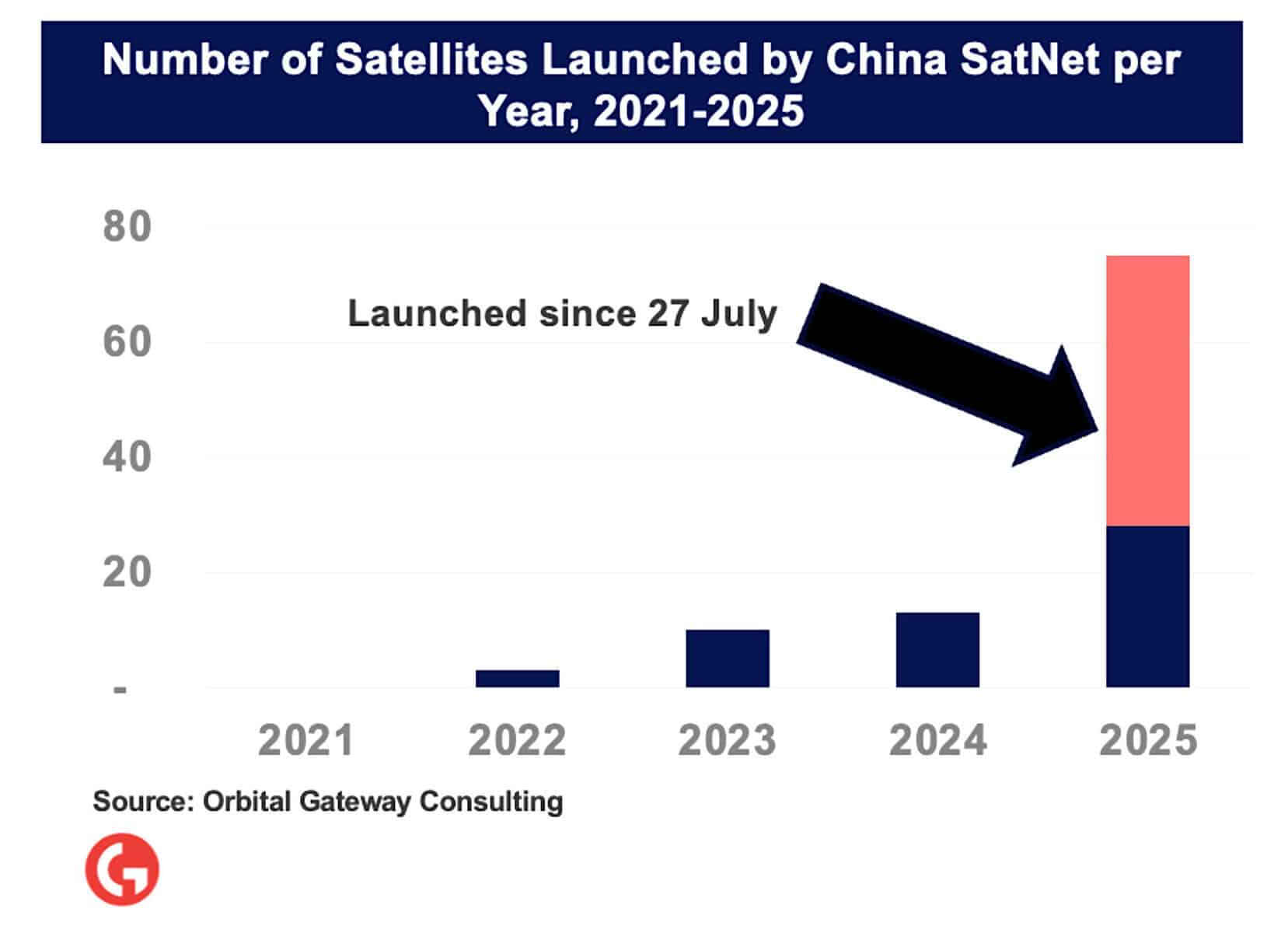
Credit: Orbital Gateway Consulting.
Whether it’s SatNet’s recent experience with its constellation or for other reasons, having a state-owned Chinese constellation operator publicly endorse binding regulations managed by the ITU is an important step.
Satellite fleet operators and government officials by and large agree that “space sustainability” in low Earth orbit, where there is the most urgency, is going nowhere without Chinese backing. China has begun deploying two large LEO b broadband constellations.
Chen said the crowding in low Earth orbit will require regular collision-avoidance maneuvers by its satellites, which will add to the cost of the constellation. “This cost will be applied to our operators, so we are eager to establish additional international regulations to adapt the development of the constellation.”
The 194-nation ITU is not formally mandated to handle sustainability issues but is trying to persuade its governments that there may be no better agency to do it. Giving ITU power to sanction violators that do not design satellites with safety in mind would be a big step that not all would endorse.
David Goldstein. Credit: SpaceX
David Goldstein, SpaceX principal satellite policy engineer, said the single most important decision that national regulators could make would be to require fleet operators to publish data on their satellites’ location and covariances, meaning the formula that arrived at the location, allowing others to assess possible errors.
“The one thing regulators could require that would start making space after right away: Require satellite operators to publish accurate predictions of their satellites and realistic uncertainties,” Goldstein said.
“If you have a new satellite constellation seeking licensing, require them to publish their ephemerides and covariances right after they deploy. That means hours, not days. It takes several days to locate and identify a satellite and follow them” to calculate collision avoidance.”
While the European EU-SST, the US-based Space-Track.org and private companies including LeoLabs all track satellites, the results they publish are not always identical. “Satellite owner/operators probably have the best picture of where their satellites are,” Goldstein said.

Chehineze Bouafia. Credit: Eutelsat
Chehineze Bouafia, manager of regulatory affairs at Eutelsat Group, argued the same point.
“Today, there is no international mechanism for space traffic coordination and this is the root of the issue, Bouafia saId. “Without the right international mechanism, it is very difficult for operators to do it on their own.
“Some operators publish this data publicly. But one or two or a dozen operators cannot be sufficient. The regulatory landscape today is fragmented. Not all operators operate by the same rules. Space is an international zone and it requires international, coordinated, harmonized efforts. Space traffic coordination is one of the easier areas where we could have some kind of harmonization,” Bouafia said.

Josef S. Koller. Credit: IAC
Josef S. Koller, principal safety and sustainability officer at Amazon’s Project Kuiper, which has launched 129 of the 3,200 satellites planned for its network, agreed that information sharing among operators “is the next level of important things that would make space a more sustainable environment.”
Koller did not specifically agree that binding regulations are the way to achieve this, but came close.
“Just the sharing of information — We work very closely with SpaceX on ephemeris sharing and maneuver screening. It’s a very collaborative relationship because it’s in both our interests to operate safely. to make it more commonplace as a policy would be the next step.”

Mario Neri. Credit: Kratos
Mario Neri, director of spectrum strategy, innovation and space sustainability at Telesat, whose Lightspeed broadband constellation is scheduled to begin launching next year, said he could accept regulation if it is backed by science.
“The ITU has a role to play i space sustainability and how to help us operators to do something. Two things the ITU can do: Have a repository of contact details for operators on the ITU website on space sustainability. We’ll need [to contact] people working on flight dynamics and operations. A conjunction alert is usually a few says” of advance notice.
“Every hour the risk increases. We really need a standardized way to communicate with each other to manage risk. Automated collision avoidance would be a goal. Any regulation needs to be backed by scientific work,” Neri said.