
Credit: Planet Dec 10, 2025, investor presentation
LA PLATA, Maryland — Geospatial satellite fleet operator Planet Labs PBC sought to strike a balance between grinning up investor excitement about its Google contract to test data centers in space and acknowledging that the technology is years away from being developed.
Planet’s R&D contract with Google “moonshot” program Suncatcher is to build to small demonstration satellites, based on Planet’s new Owl platform but with extended solar arrays, to launch in 2027. The satellites would test the use of Google’s Tensor Processing Units — custom ASICs — on satellites that would use the Sun’s energy while being able to shed the excess heat to remain operational.
Planet Chief Executive Will Marshall outlined the promise of Suncatcher, which he said is huge, in a Dec. 10 investor call on the company’s results for the three months ending Oct. 31.
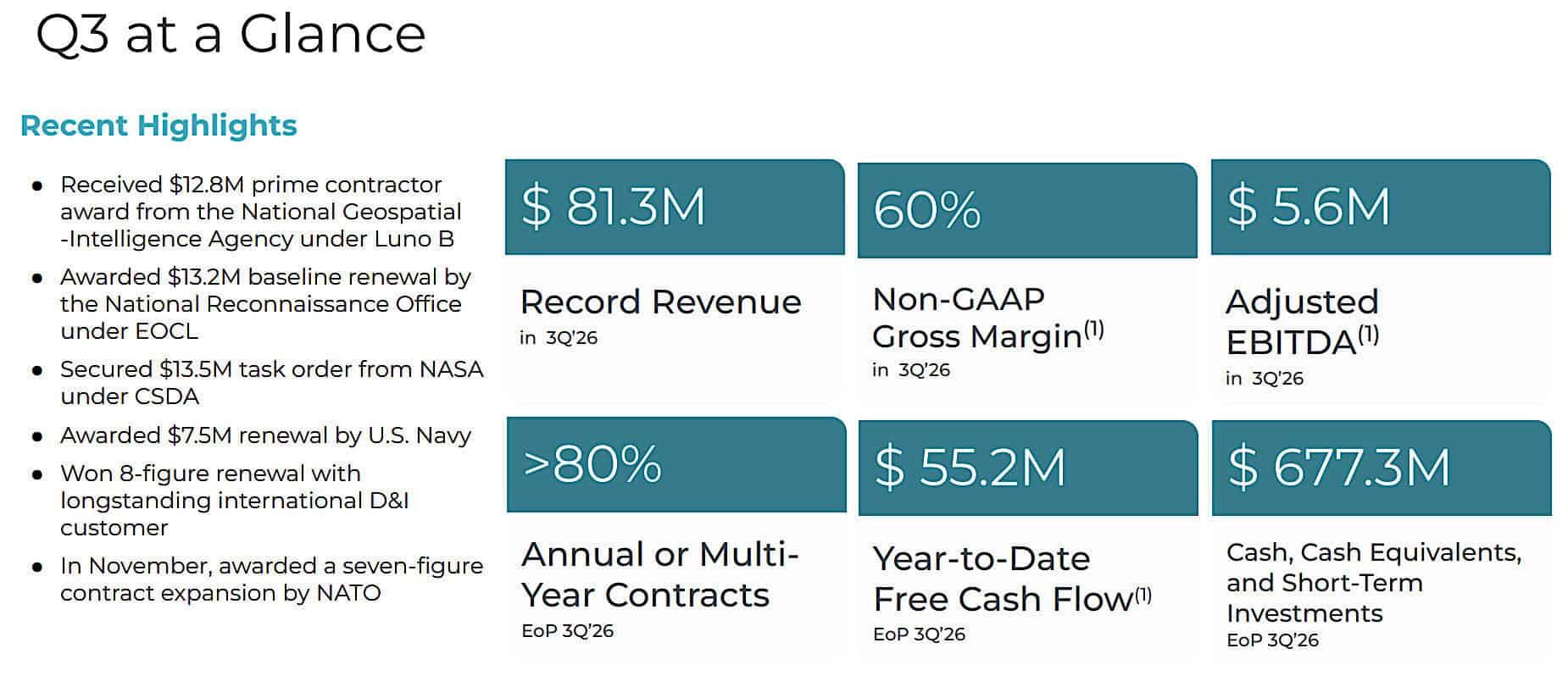
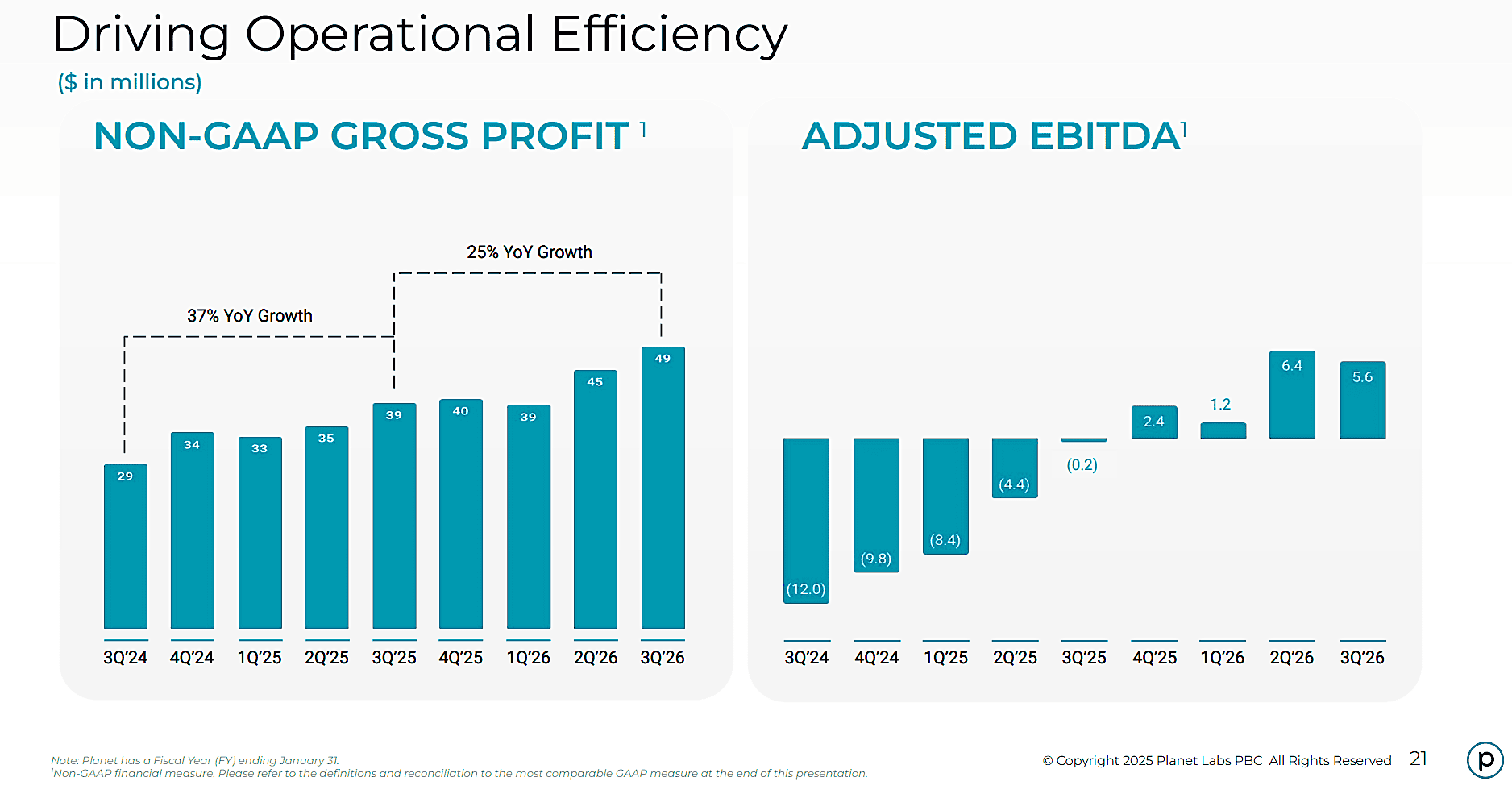
Planet reported $81.3 million in revenue for the period, up 33% from the same period a year ago, with $5.6 million in adjusted EBITDA, marking the fourth consecutive quarter of positive EBITDA. Free cash flow was $55.2 million for the nine months ending Oct. 31. Backlog at Oct. 31 stood at $734.5 million.
Credit: Planet Dec 10, 2025, investor presentation
Following its $460 million convertible note earlier this year, Planet’s cash position was $677 million as of Oct. 31.
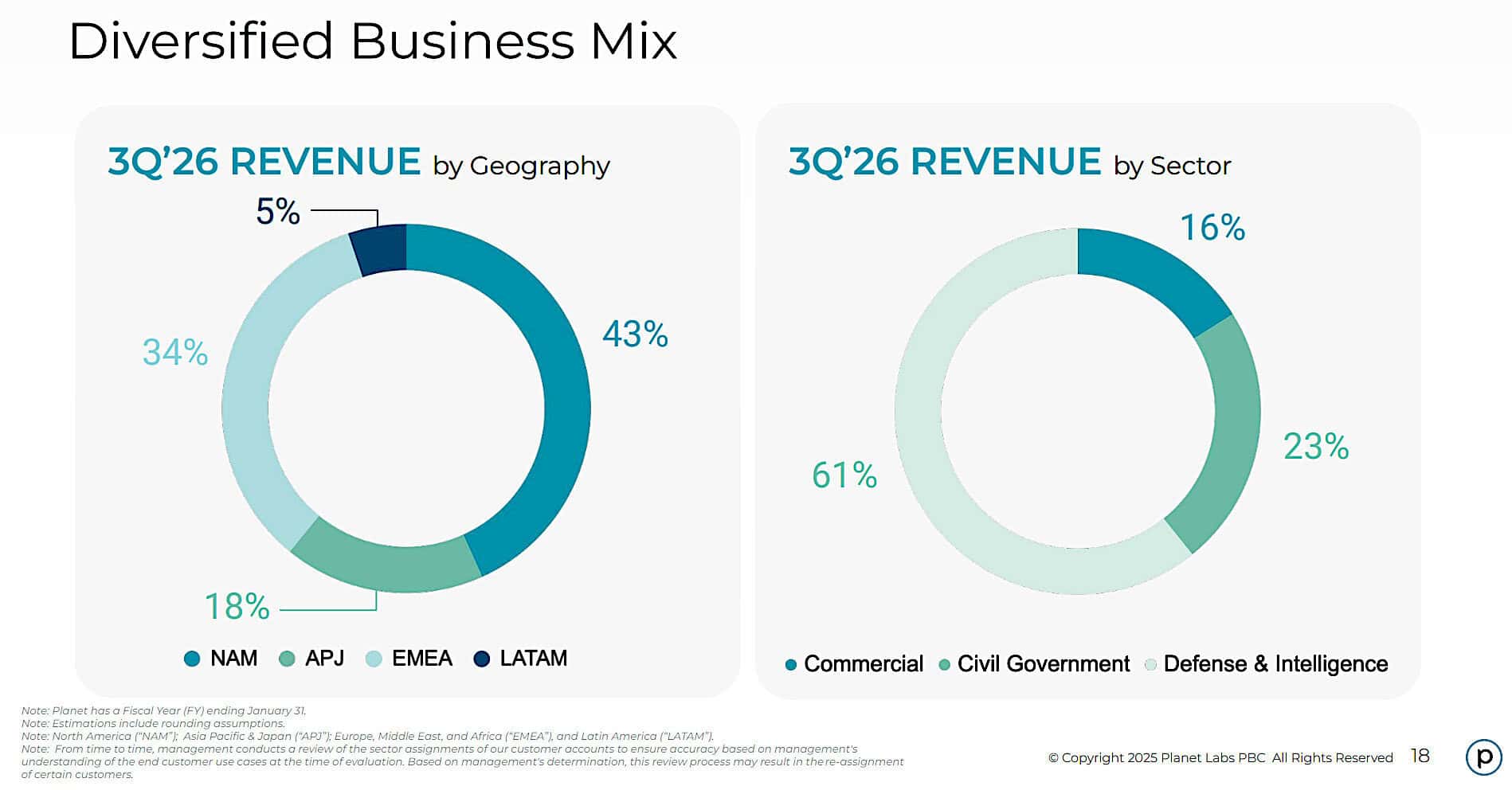
Defense and Intelligence work showed the biggest growth, up 70% from a year ago and up 15% from the previous quarter, despite reduced revenue from the US National Reconnaissance Office’s Electro-Optical Commercial Layer (EOCL) contract following the US government shutdown and budget cuts to the program.
Credit: Planet Dec 10, 2025, investor presentation
Civil government programs were up 1% from a year ago and 15% from the previous quarter. Commercial business was down slightly.
Chief Financial Officer Ashley Johnson said the current quarter, ending Jan. 31, may show an adjusted EBITDA loss given the planned capex, but that Planet is sticking to its promise of ending the year with positive EBITDA.
For the quarter ending Oct. 31, Planet spent 34% of its revenue on capex, compared to 14% a year ago. Johnson said the company has decided to prepay launch reservation and certain hardware purchases to get better prices.
Marshall said Planet’s work on two multi-year satellite services programs, for the Japanese and German governments, was on track. A Berlin satellite production facility, to about double Planet’s production of its high-resolution Pelican satellites, will start operations in 2026.
Marshall cited “growing demand from the European market” that the Berlin facility would meet.
European governments are investing in satellites for defense and security purposes as part of a broader shift to increased military investment. Planet has a long history in Germany and building the factory might enable it to capture part of this market despite its being a U.S. company. Marshall said the company is focusing on “a half-dozen or so” contracts similar to the multi-year deals with Japan and Germany, respectively valued at $230 million and 240 million euros ($281 million).

Credit: Google
Google in November released a preprint paper outlining the potential of data centers in space and their feasibility. The assumptions behind the paper include a decline in launch costs to LEO to below $200 per kilogram within 10 years, and the availability of 10 Tbps optical links:
https://blog.google/technology/research/google-project-suncatcher/
Suncatcher posits an orbital architecture of clusters of 81 satellites flying in formation around a 1-kilometer-diameter area.
Marshall said Planet won a competitive bidding process for Suncatcher based on “our strong history of launching over 600 satellites and AI-enabled solutions collaboration” with Google.

Credit: Google Nov 22, 2025, research paper
He said only Planet and SpaceX have a demonstrated history of fielding and operating a large number of satellites in a constellation, making Planet a likely long-term partner for Google if Suncatcher proves feasible.
“This will take significant R&D dollars,” Marshall said. “If it has the cost advantages we believe it will, this is a scaled operation that will require thousands of satellites. We are one of the few companies that has done this at scale. We already have fast computers in space and we do a bunch of AI work and have a record of working with them. This is an early R&D contract but an option on a big long-term future.
“It’s not about any particular compute demand, it’s about the entire compute demand, in principle, and it depends on us getting to that cost threshold. It is the position of Google and Planet that we are just a few years away from that.”
Google was a little more reserved than that, saying that feasibility might be proved in a decade.