
Credit: ESA
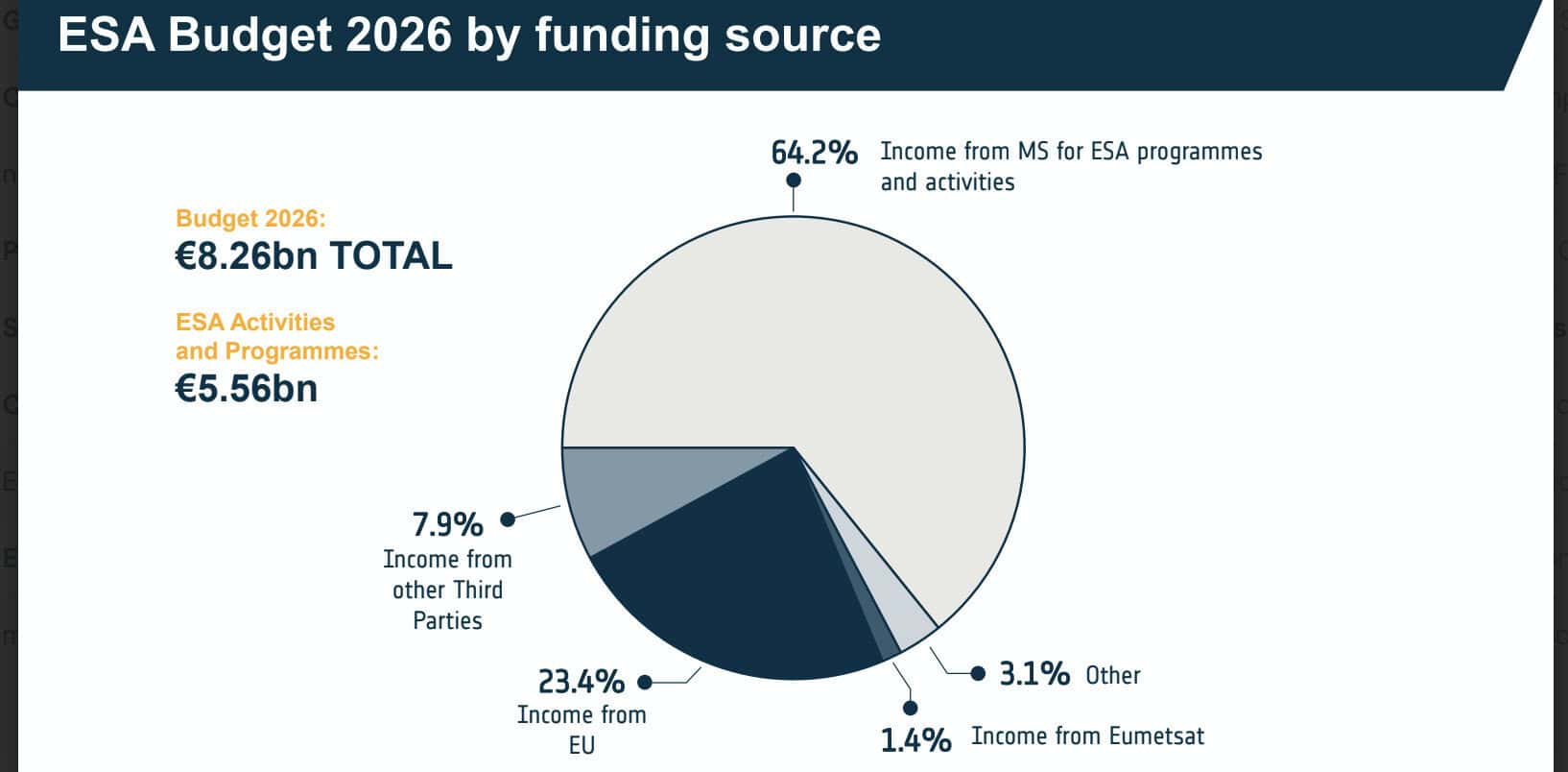
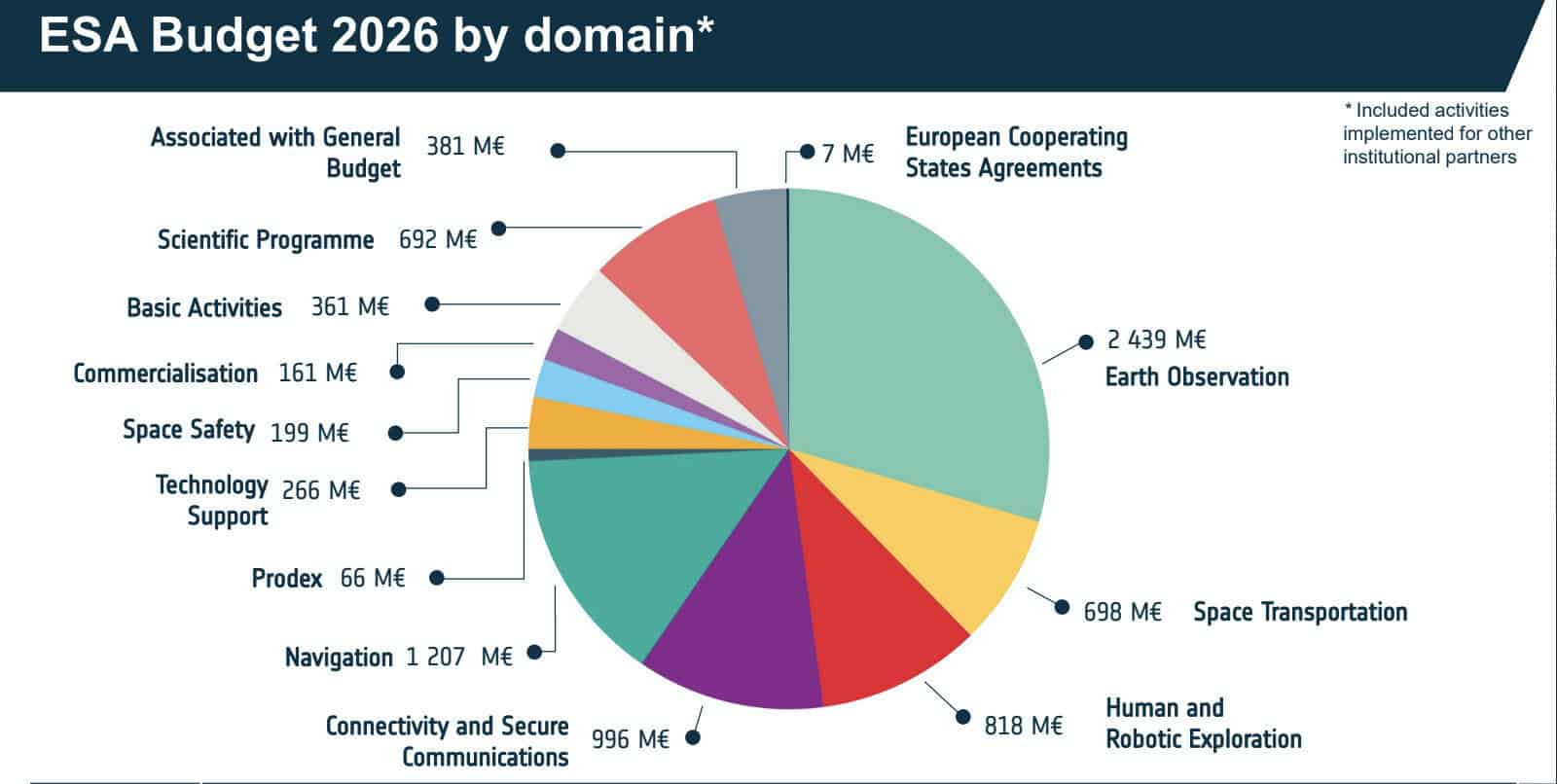
LA PLATA, Maryland — The European Space Agency’s 2026 budget, showing the early effects of the three-year funding increase its governments approved in November, will rise by 7.6%, with Earth observation, navigation and Connectivity and Secure Communications accounting for 56% of the total planned spending.
ESA governments in late November approved 22.3 billion euros ($26.1 billion), most of it to cover spending between 2026 and 2028. That’s a 31% increase from the previous three years, or 17% after inflation.
These monies are not distributed evenly over the three years, but ebb and flow with the requirements of the relevant programs — satellite contracting milestones, launches and in-orbit operations.
The 2026 budget of 8.26 billion euros is over two-thirds paid for by ESA’s 23 member governments, based on the November commitments, with the 27-nation European Union contributing 23.4%, similar to recent years’ spending profiles.
Credit: ESA
The EU Commission, mainly through its Directorate-General for Defence and Space, DG-Defis, has hired ESA to perform much of the technical for for the Copernicus Earth-observation network, the Galileo satellite navigation system and the Iris2 multi-orbit secure connectivity network, which is still taking shape.
Some 7.9% of this year’s budget comes from contracts that individual governments signed with ESA to manage specific satellite development projects, many of them coming from the EU Recovery and Resilience Facility.
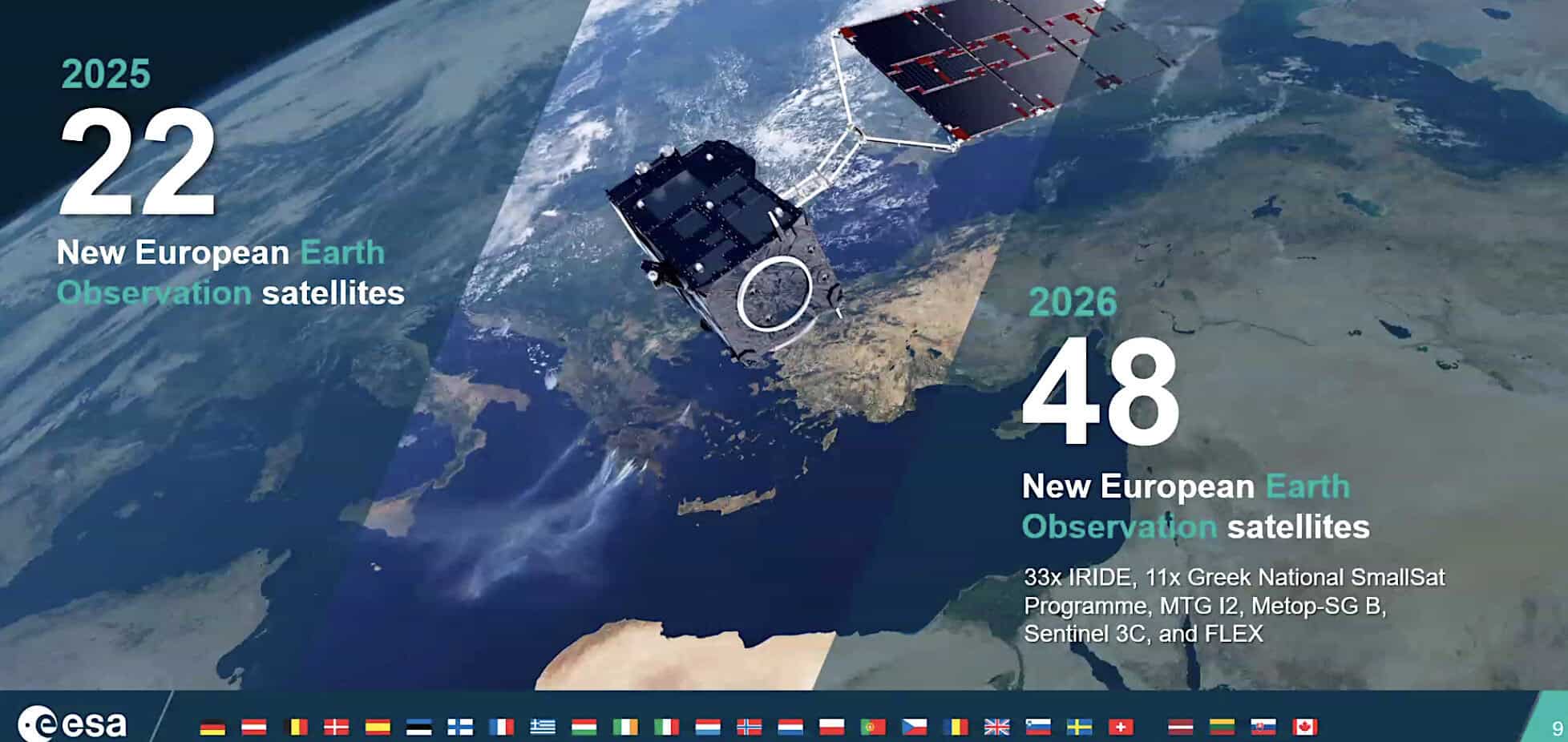
Italy’s Iride and Greece’s National Small Satellite Program are among these. In 2026, 33 Iride satellites and 11 satellites from Greece’s program are scheduled to be launched. These national programs — others are under way in Spain, Portugal and Poland — are part of the reason why ESA’s Earth observation directorate is regularly the agency’s largest.
Credit: ESA Jan. 8, 2026, briefing
This year is no exception. Earth observation account’s for 29.5% of the total budget.
In a Jan. 8 briefing, ESA Director-General Josef Aschbacher said 48 Earth observation satellites would be launched in 2026 under the agency’s aegis, compared to 22 in 2025.
Also to be launched this year are two more first-generation Galileo, positioning, navigation and timing satellites, and the first satellites for ESA’s LEO-PNT initiative, to test new radio frequencies and a new orbit for a future navigation program to mitigate the vulnerability of the Galileo and GPS satellites to jamming and spoofing.

Credit: ESA
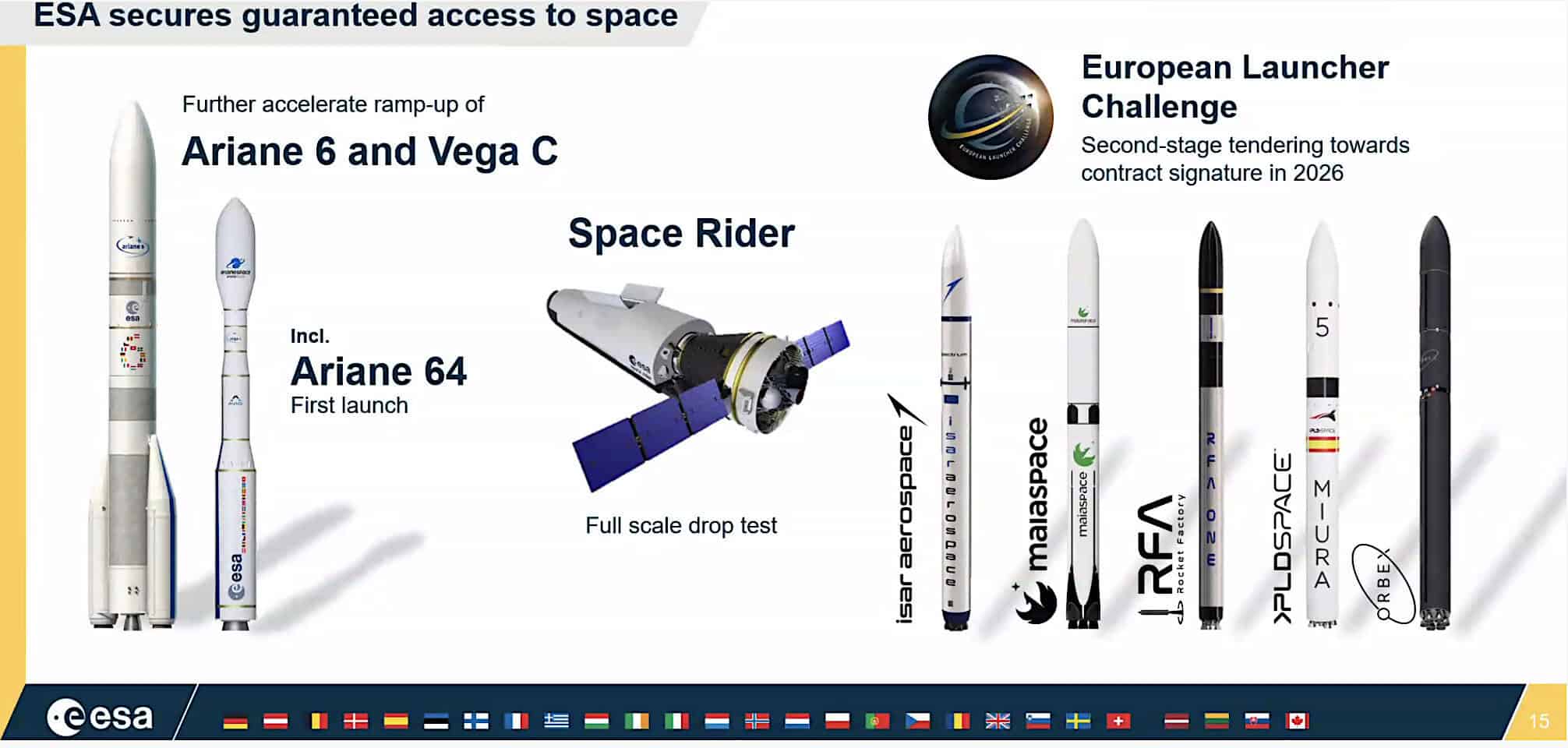
Europe’s Ariane 6 heavy-lift and Vega-C medium-lift rockets are now ramping to their expected long-term cadence, which might be expected to reduce ESA’s spending on launchers.
But both vehicles have been given multi-year support programs that include upgrades. In addition, ESA’s European Launcher Challenge (ELC) is funding several launcher startups with the goal of producing, by the end of the decade, at least one vehicle to compete with whatever heavy-lift rocket succeeds Ariane 6.
ESA had proposed a three-year budget of about 420 million eros for the ELC program. It received 910 million as Germany, France and Spain all invested heavily — Germany mainly in its two candidates, Isar Aerospace and Rocket Factory Augsburg (RFA); France in Maia Space; and Spain in PLD Space.
Britain also invested heavily in ELC, some 144 million euros, with 21.7 million going to Orbex Space, in which the UK Space Agency is a shareholder; and another 10 million euros in RFA’s vehicle. RFA plans to launch from Scotland’s SaxaVord Spaceport.
That left 112.3 million euros remaining in the UK’s ELC subscription that has not been assigned a rocket. It has remained in the “To Be Allocated” column since the Nov. 27 ministerial conference.
The UK Space Agency has not explained why it did not go all-in on Orbex. The agency has been working with ESA to determine an allocation since the ministerial, but as yet has made no decision.
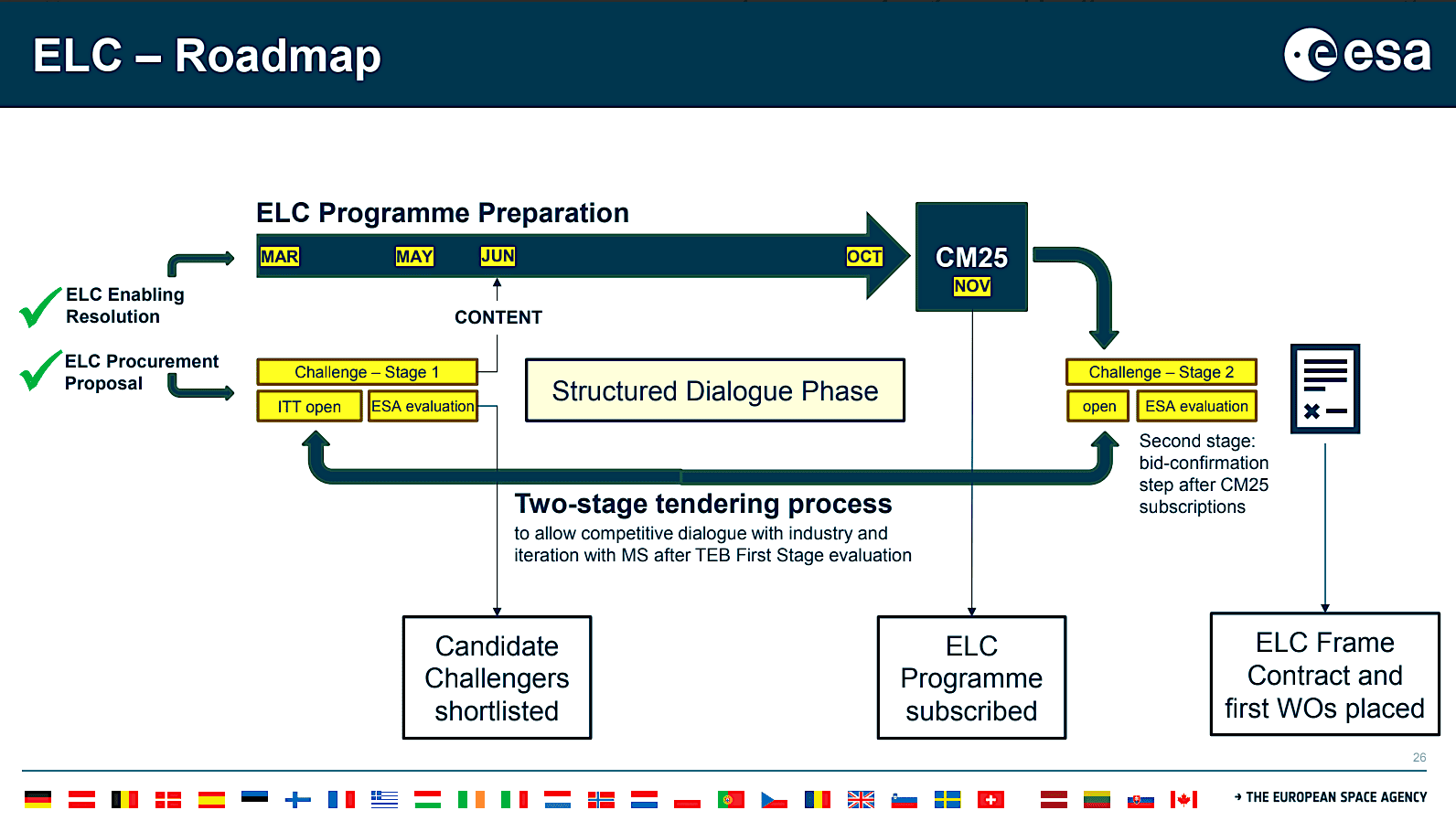
Credit: ESA April 2025 presentation
ESA Space Transportation Director Toni Tolker-Nielsen said that, as scheduled, ESA is preparing ELC Stage 2 tendering, intended to align the five ELC vehicles to future European government satellite demand. Each rocket is required to have conducted a first orbital flight by the end of 2027.
A Tender Evaluation Board will then select winning launchers and begin awarding framework contracts that will determine how much funding each will receive. The ELC’s Stage 2 includes the requirement that the companies complete at least one demonstration flight of an upgraded vehicle by the end of 2028.
Tolker-Nielsen said the UK unallocated money cannot be spent until the UK decides where it should go.
“We are going into this second-stage tendering and an amount of the UK subscription is in the “TBA” box. We cannot place contracts before they move it to a program,” Tolker-Nielsen said. “So that’s the deadline. That should happen in the coming 2-3 months.”