
Credit: ESA
LA PLATA, Maryland — The European Space Agency (ESA) in February will ask its governments for an additional tranche of 250 million euros ($293 million) as part of a year-long process to boost subscriptions to a program preparing a global intelligence, surveillance and reconnaissance (ISR) constellation on behalf of the European Commission.
The 23-nation ESA at its Nov. 27 ministerial council received enough funding for what it calls its European Resilience from Space (ERS) Earth Observation Element 1 Phase 1 program — 166.63 million euros — to begin initial work on constellation building blocks.
The idea is that new ISR satellites combined with high-resolution spacecraft operated by commercial companies or European national militaries would be fitted into a virtual constellation that, starting in 2028, would be developed by the 27-nation European Commission. The Commission calls this the Earth Observation Governmental Service (EOGS).
In 2028 the Commission will have its new seven-year budget. It is proposing a five-fold increase, to 131 billion euros, in combined defense and space spending.
ESA officials said during the ministerial conference that some of its member states needed more time to solicit support from their defense ministries, many of which are not used to working with ESA.
The agency has assured its governments that the EU Satellite Center, and not ESA, will operate the constellation.
Despite having commissioned two parallel EOGS studies in January 2024, with the results submitted in early 2025, the Commission has yet to settle on a list of high-level requirements for EOGS. European Defence and Space Commissioner Andrius Kubilius recently said these requirements would be forwarded to ESA early next year.
Credit: European Commission
In a Dec. 18 briefing, ESA officials said the portion of its ERS program devoted to the future EOGS is moving forward despite the lack of detailed technical specifications.
“High-level requirements — yes, the European Commission will provide them. They will go through the Council on their side and this requires an adaptation of meetings that are planned. That’s why it is expected early next year,” ESA Director-General Josef Aschbacher said.
“That is also when we will start preparing all the contracts for our activities, so it is really going full speed. We have plans to implement this very quickly with the funds we got.”
Aschbacher said ESA will submit to its governments a subscription proposal totaling 250 million euros, with the round left open until November.
Simonetta Cheli, ESA’s director of Earth observation, said that ESA does not need to wait for the Commission’s detailed requirements to release invitations to tender in January to industry for proposals.
“We will use initial draft requirements,” Cheli said. “ We have already progressed a lot on the iteration for the initial activities. And then in February we open it again to subscriptions for Element 1, and also to Element 2.”
ERS EO Element 1 Phase 1 was budgeted at 100 million euros and booked subscriptions of 166.63 million. Phase 2 of the program, budgeted at 250 million euros, received no funding pending further negotiations.
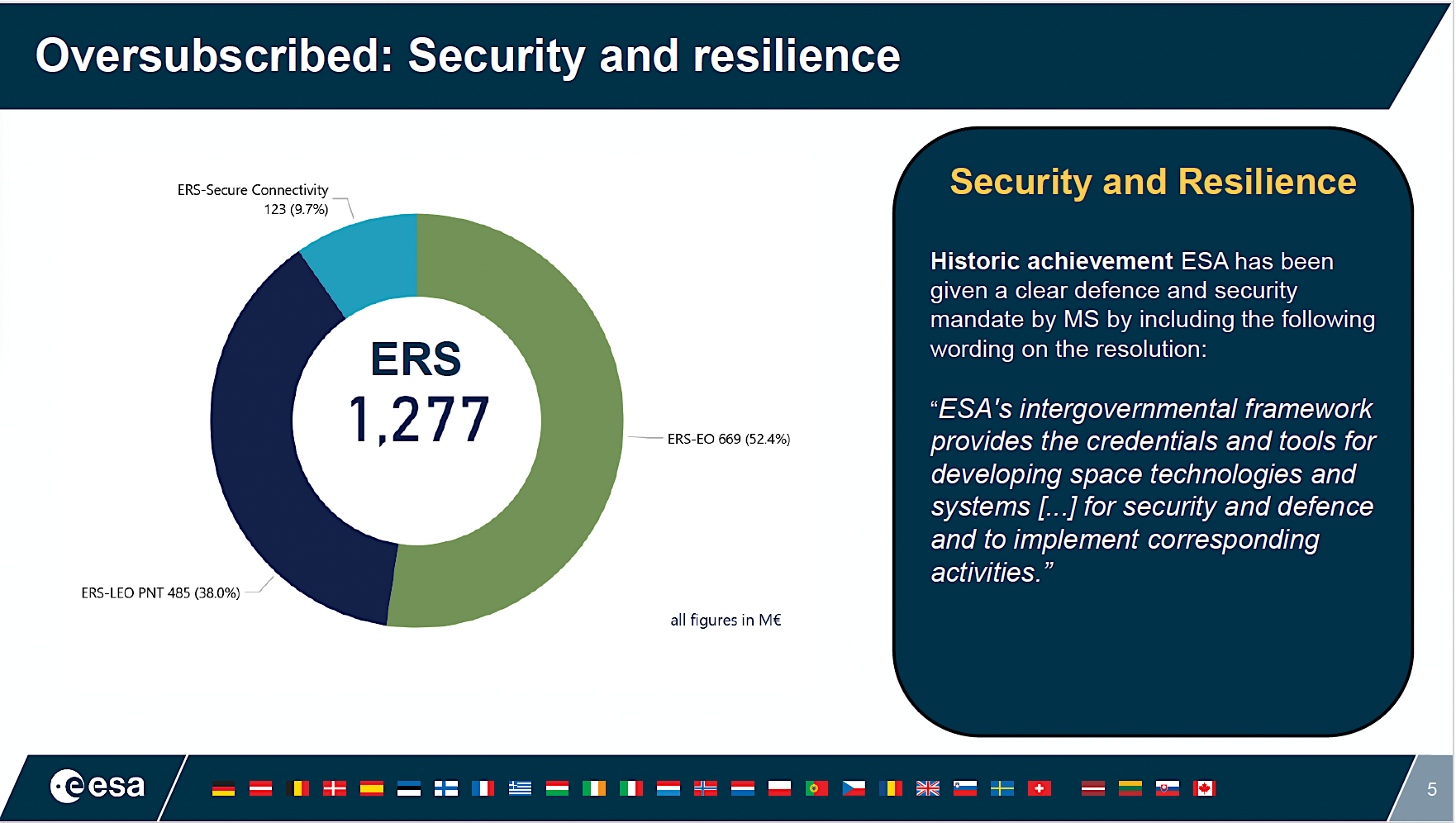
At ESA, ERS is a mix of Earth observation, Navigation and Secure Connectivity elements
For the ministerial council, ESA grouped together a disparate set of programs and technologies under the ERS heading, composed of pieces from the agency’s Earth Observation, Navigation and Secure Connectivity directorates.
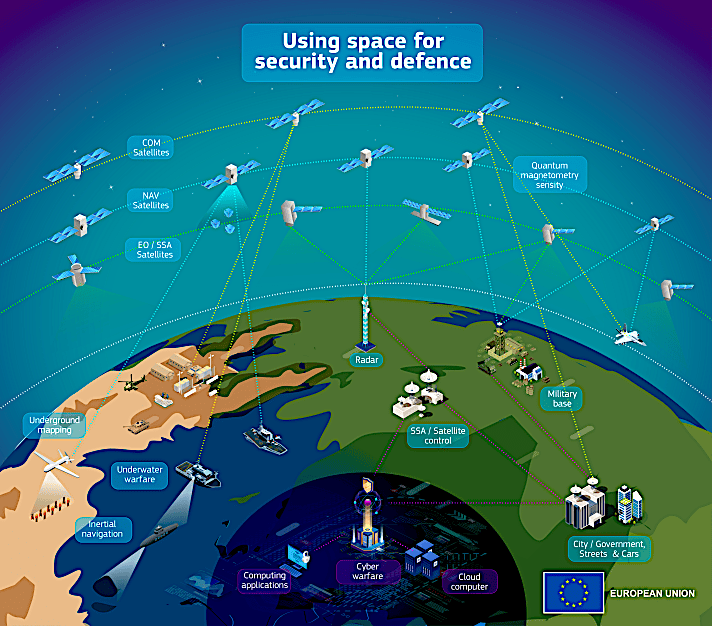
The common thread to these initiatives is that they are all being pursued as part of a closer collaboration with the European Commission’s planned space network for security and defense.
The ERS EO includes funding for early work on the Commission’s future EOGS constellation, but also other work, including 325 million euros for Spain’s Atlantic constellation of Earth imaging satellites, which has little relevance for EOGS.
ERS Secure Connectivity is for technologies needed for the future Iris2 secure connectivity constellation, a public-private partnership between the Commission and satellite fleet operators Eutelsat, SES and Hispasat.
ERS LEO PNT is for work on satellites in low Earth orbit using multiple radio frequencies to render Europe’s Galileo positioning, navigation and timing satellites more resistant to jamming and spoofing.
Aschbacher said the total program was budgeted at 1.1 billion euros and received 1.277 billion euros in subscriptions.