
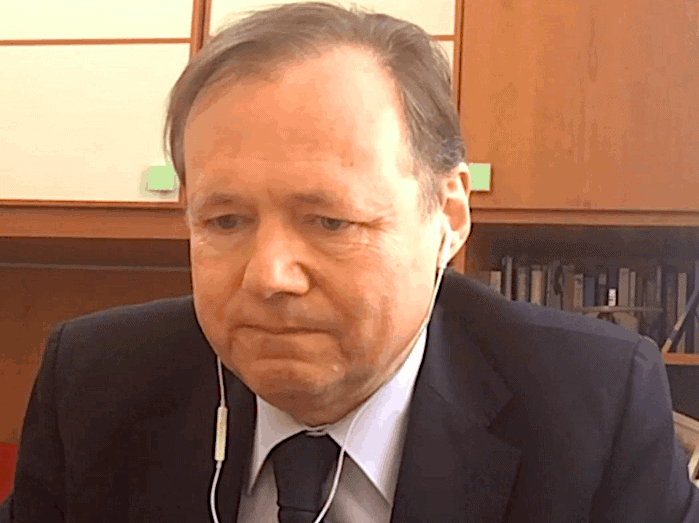
Roberto Viola. Credit: BBE video
PARIS — The European Commission is saddling its proposed broadband satellite constellation with so many missions and deadlines that one European industry official suspected the commission may be trying to scuttle its own initiative.
A kinder interpretation is that the Commission is wrestling with a new and difficult project and still testing ideas to see which catch on with prospective government and industry investors.
Whatever the motivation, a series of briefings Jan. 12-13 featuring industry concerns about the constellation’s business case and the Commission’s piling on of specifications did not help the broadband constellation’s credibility.
In the front line of prospective private-sector financial contributors are the three satellite fleet operators — SES, Eutelsat and Hispasat — that are part of the nine-company team under Commission contract to assess the project as a public-private partnership.
SES and Eutelsat were at the conference, and both voiced the minimum diplomatic support required when talking to a large potential customer.
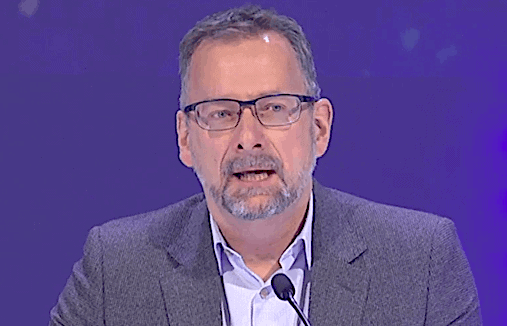
SES CEO Steve Collar. Credit: BBE video
SES Chief Executive Steve Collar said his company fully supports a Commission initiative in Quantum Communications Infrastructure to assure data security.
But adding a commercial consumer broadband service, a secure military telecommunications network, a data-relay service for Earth observation satellites and a positioning, navigation and timing backup for Europe’s Galileo and Egnos systems — all these were mentioned by the Commission — is another story.
Without saying so directly, Collar made clear the current constellation looks more like a contraption where return on investment may be an early casualty.
“We have to balance the needs of successful private businesses… and marring those with the objectives of Europe… in terms of European sovereignty and building a capacity that can protect it for decades to come,” Collar said.
Collar said EU Commissioner Thierry Breton “has been clear about the problems we are trying to solve: broadband in Europe, digital sovereignty, Europe in the quantum era and keeping the continent connected no matter what happens. Those are four very large and very significant missions. The answer to all of them isn’t a LEO constellation. We have to make sure we are clear about what a success for this project is.”
SES has a global constellation of medium-Earth-orbit broadband satellites called O3b and is ramping O3b’s capacity with a second-generation fleet called O3b mPower — a commitment of well over $1 billion.
How comfortably O3b mPower would sit alongside the EU constellation is an obvious issue for SES.
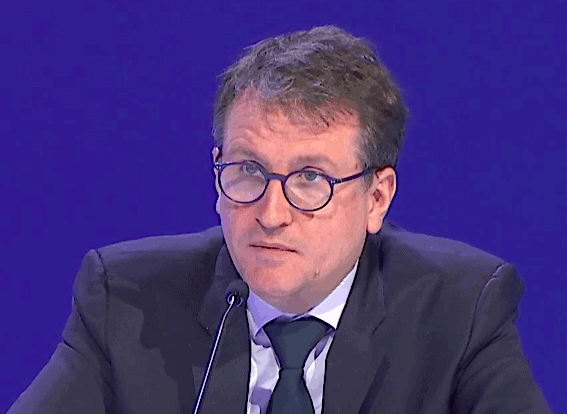
Rodolphe Belmer, CEO, Eutelsat. Credit: BBE video
For Eutelsat, the issue is Eutelsat’s Konnect consumer-broadband satellites in geostationary orbit. The first is launched, and the second, a larger, 500-Gbps called Konnect VHTS, launches this year for coverage in Europe, the Middle East and Africa.
Eutelsat has spent years tinkering with a consumer broadband strategy. Now they think they have a winning formula, and it’s at this point that the Commission proposes to step in with a government-subsidized consumer broadband constellation?
Like Collar, Eutelsat Chief Executive Rodolphe Belmer walked gently around the subject, agreeing with the Commission that several million Europeans — Eutelsat estimates 5 million households — will never get fiber or terrestrial 5G.
Eutelsat to Commission: ‘Excuse me, but we’re already doing this’
“We have a program for that already,” Belmer said. “Eutelsat has launched an ambitious program to address that market and bring connectivity to those people in Europe.”
Could a LEO constellation complement what Eutelsat is doing? Maybe, in the long term, Belmer said. “But it needs to be clarified.”
Belmer was perhaps the only speaker over the two days to mention that the Commission’s constellation has no radio-frequency reservations at the International Telecommunication Union (ITU). Securing such frequencies behind OneWeb, SpaceX’s Starlink, Amazon’s Kuiper Systems and one or two proposed constellations from China will be as difficult as any of the constellation’s technical challenges.
“We need funding, we need vision, we need leadership — but we also need frequency rights to sustain the launch,” Belmer said. “This is a subject we all need to address.”
As to the funding model, Belmer said SpaceX Starlink works for him: “A private initiative supported by a strong commercial drive, supported massively by public institutions and funding and determination…. If all these elements are well understood, we will be in full support.”
Breton said the Commission wants to move quickly, and both Collar and Belmer supported that. The idea of launching satellites even before the full complement of capabilities is not ready — “deploying and learning, deploying and learning” as Collar put it — is a different approach from commercial fleet operators’ past practice, but they said they liked the idea.
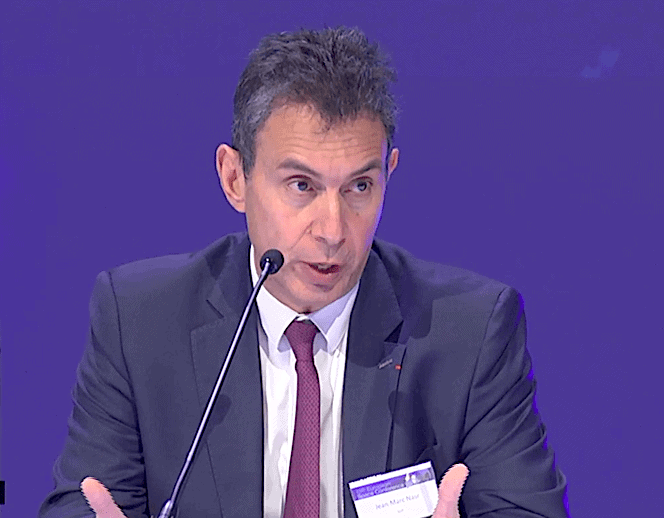
Jean-Marc Nasr, Airbus Defence and Space. Credit: BBE video
Jean-Marc Nasr, head of space systems at Airbus Space and Defence, also liked the idea and regretted that Europe’s Galileo positioning, navigation and timing network took 20 years from the first proposal to the availability of the first services.
“Twenty years from now would be 2040,” Nasr said. “If we do that, we are dead. The service has to be operational by the end of the decade at the latest.”
But Roberto Viola, director-general of the Commission’s DG on Communications Networks, Content and Technology — and with a technical background — detailed what the Commission means by “fast.”
“We need to rush,” Viola said. “If I thought for a second that it’s 2028 for the secure infrastructure in Europe — that’s something completely off line from the plans for [the Commission’s] secure ground connectivity” network.
Viola said the first quantum hybrid computer will be in service on the ground in 2025. The space sector, he said, needed to adopt ground-segment-like development speeds.
Viola: How about a first launch in 2023, and the full constellation by 2025?
“We need to have a very ambitious target,” Viola said. “Our target for the ultra-secure quantum infrastructure for Europe is 2025 for full operations, which means starting deployment in 2023 in terms of first satellites, and then to complete everything by 2025, which means we have to progressively prove the technology.”
The Commission issued its one-year study — 7.1 million euros divided among the nine companies — in December. Breton said he wants early conclusions by April and would present a formal proposal to the European Parliament and the European Council by the end of this ear.
Even if this astonishingly rapid pace can be maintained, that would put contracts to industry in H1 2022 at the earliest.
Viola recalled that mobile satellite communications constellations in low orbit arrived in the late 1990s. By then, the terrestrial cellular industry had progressed to a point where all these constellations went bankrupt.
“We need to completely change the attitude,” Viola said. “That means a more cost-efficient system, ready to fly, and a different way of manufacturing constellations.”