

Credit: Eutelsat Oct. 21, 2025, investor presentation
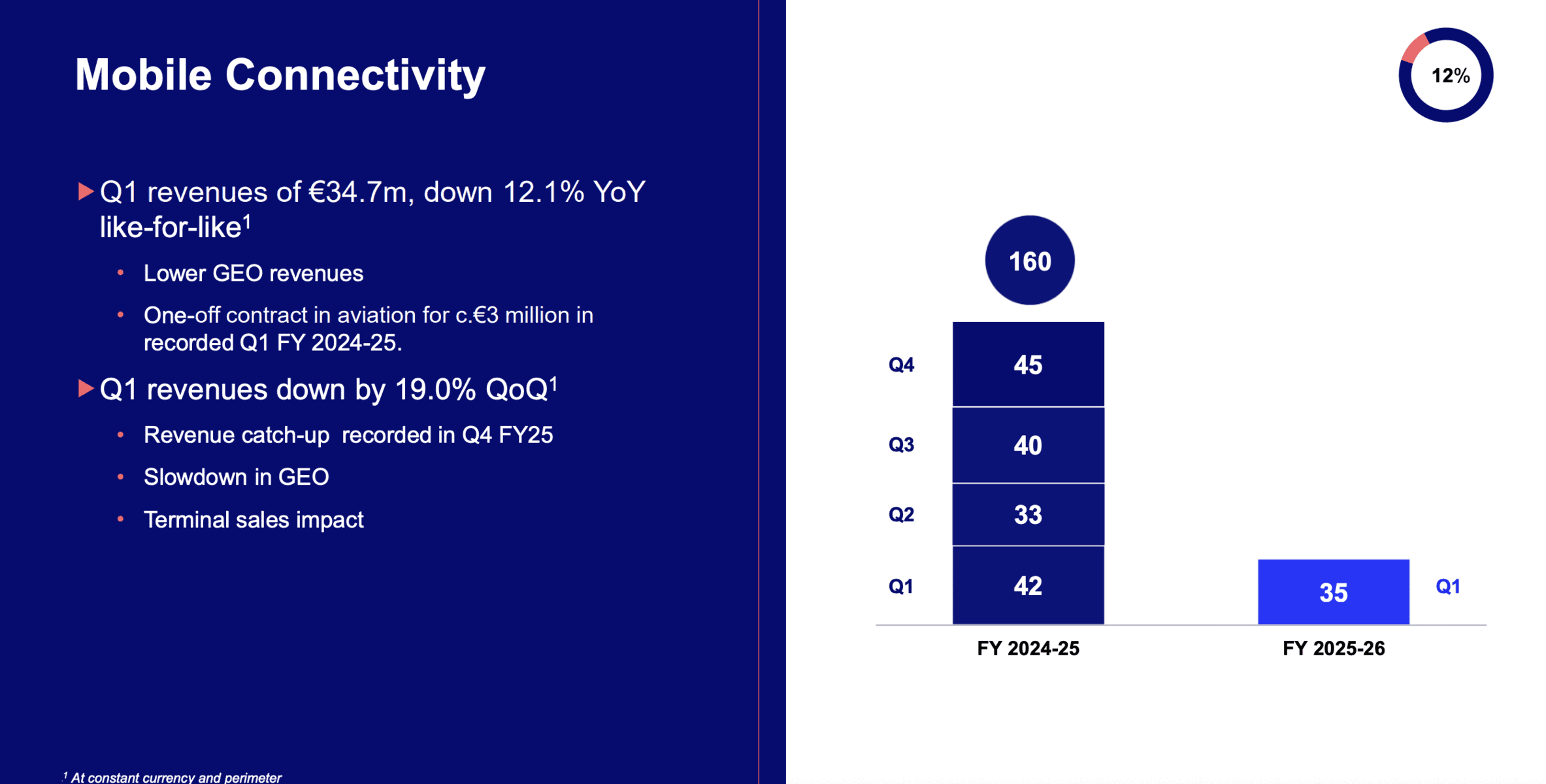
LA PLATA, Maryland — Satellite fleet operator Eutelsat reported a 61% growth in connectivity revenue from its OneWeb LEO-orbit broadband constellation for the three months ending Sept. 30 compared to a year ago and said LEO now accounts for slight more than one-third of its total connectivity business, with the GEO-satellite portion continuing to decline.
The LEO business, which is the center of Eutelsat’s plans for growth, nonetheless dropped 20.1% from the previous three-month period — April-June 2025 — when an exceptional number of OneWeb terminals were sold. In addition, some of the OneWeb service revenue had been previously booked as part of take-or-pay contracts and was not reflected in the most recent quarter’s accounts.
Credit: Eutelsat Oct. 21, 2025, investor presentation
In an Oct. 21 investor call, Eutelsat Chief Financial Officer Christophe Caudrelier said the company is maintaining its forecast of a 50% increase in LEO revenue for the current fiscal year, which closes June 30.
“The high level of equipment sales is a good sign with data usage increasing with installation of UTs [user terminals],” Caudrelier said. “The equipment portion of revenue is still a minor part of the total. And you have a delay as installed equipment allow customers to use more of their take-or-pay, already contracted.”
The increased use of the OneWeb constellation would not show up in new revenue until the take-or-pay agreements wash through the accounts.

Credit: Eutelsat Oct. 21, 2025, investor presentation
Eutelsat is navigating a difficult financial path. Its video business, which now represents 47% of total revenue, is declining slightly faster than previously expected, at mid- to high-single-digit annual percentage levels.
Its LEO business requires substantial new investment, of around 4.2 billion euros ($4.9 billion) to refresh the current constellation and to finance its share of the European Commission’s Iris2 multi-orbit secure connectivity network later in the decade.
The company’s shareholders have approved a capital raise and a rights issue totaling 1.5 billion euros, which is expected to be completed by December. The transaction has received approval from European regulators and the US Committee on Foreign Investment in the United States (CFIUS), but is still waiting for a sign-off from the US Federal Communications Commission (FCC).
Once completed, the capital raise will reduce Eutelsat’s net to adjusted EBITDA to 2.5 times by June 2026.

Credit: Eutelsat Oct. 21, 2025, investor presentation
The company in June signed a 10-year, 1-billion-euro agreement with the French Defense Ministry for OneWeb capacity and for co-development of modifications to the OneWeb network to make it more compatible with military needs. Also included in the agreement is the addition of hosted military payloads aboard OneWeb satellites.
Caudrelier said revenue from this agreement will be weighted toward the latter half of the 10-year duration.
“There are now discussions tie the French government to finalize and detail the agreements, with revenue recognition to start this year,” Caudrelier said. “We are discussing content and hosted payloads, with first contracts by the end of this year.”
He said the US government, which used to be the main source of Eutelsat government revenue, now accounts for less than half of the total as other nations, especially in Europe, have increased their use.

Credit: Eutelsat Oct. 21, 2025, investor presentation
Eutelsat said it expects capital spending to be between 1 and 1.1 billion euros for the year to end June 30. Much of that will go to a contract with Airbus Defence and Space for OneWeb replenishment. A contract for the first 100 satellites has been signed, with another 400 or more to come.
On the heels of that will be Eutelsat’s commitment to Iris2, whose technical and financial details are expected to be set by early next year. Eutelsat has lead role in the Iris2 LEO constellation of 264 satellites in 1,200-km orbit, the same orbit as OneWeb.
The French Defense Ministry commitment, and the French government’s recent increased ownership of Eutelsat, is premised on the idea that OneWeb will have the dual purpose of providing secure communications to European governments and acting as OneWeb’s second-generation network.
No indication of any investment in Iris2 by UK government
The British government, a long-time investor in OneWeb, in June agreed to increase its investment to prevent further dilution of its stake in the company. French government officials have said they’d like the British government to become formally part of Iris2.
Joanna Darlington, Eutelsat’s chief communications and investor relations officer, said during the call that the company had heard nothing from the British government that would suggest it was about to join Iris2.
Eutelsat said it had received about 5 million euros in Iris2 revenue during the three-month period relating to Eutelsat’s work as prime contractor for the main LEO constellation.