

Government revenue was up 18% in the three months ending Sept. 30 compared to a year earlier. This trend should continue if Eutelsat is right about demand. Credit: Eutelsat
BREMEN, Germany — Eutelsat told investors that the company’s OneWeb LEO broadband constellation, powered by government demand, will grow the company’s revenue line by 29% by the end of its 2028-2029 fiscal year, to 1.6 billion euros ($1.86 billion) at the midpoint of its forecast.
That compares with 2024-25 revenue of 1.24 billion euros, a 1.6% increase from the previous year.
The company is forecasting that its EBITDA margin, which was 54.4% at the end of its 2024-25 fiscal year, will rise to 60% during the period.
Paris-based Eutelsat is pitching itself as perhaps the most spectacular turnaround stories among the large satellite fleet owners in the coming years as it replenishes its current OneWeb constellation, with modifications to make it more attractive to the French and other militaries.
Eutelsat already has on order 100 OneWeb Gen 1 replacements with Airbus Defence and Space, with another 340 to be ordered as soon as Eutelsat has settled its more immediate problem of making itself attractive to commercial banks and export-credit agencies.
The first step was the 1.5-billion-euro capital raise from existing shareholders, including the French government, Bharti Space Ltd. of India and the British government.
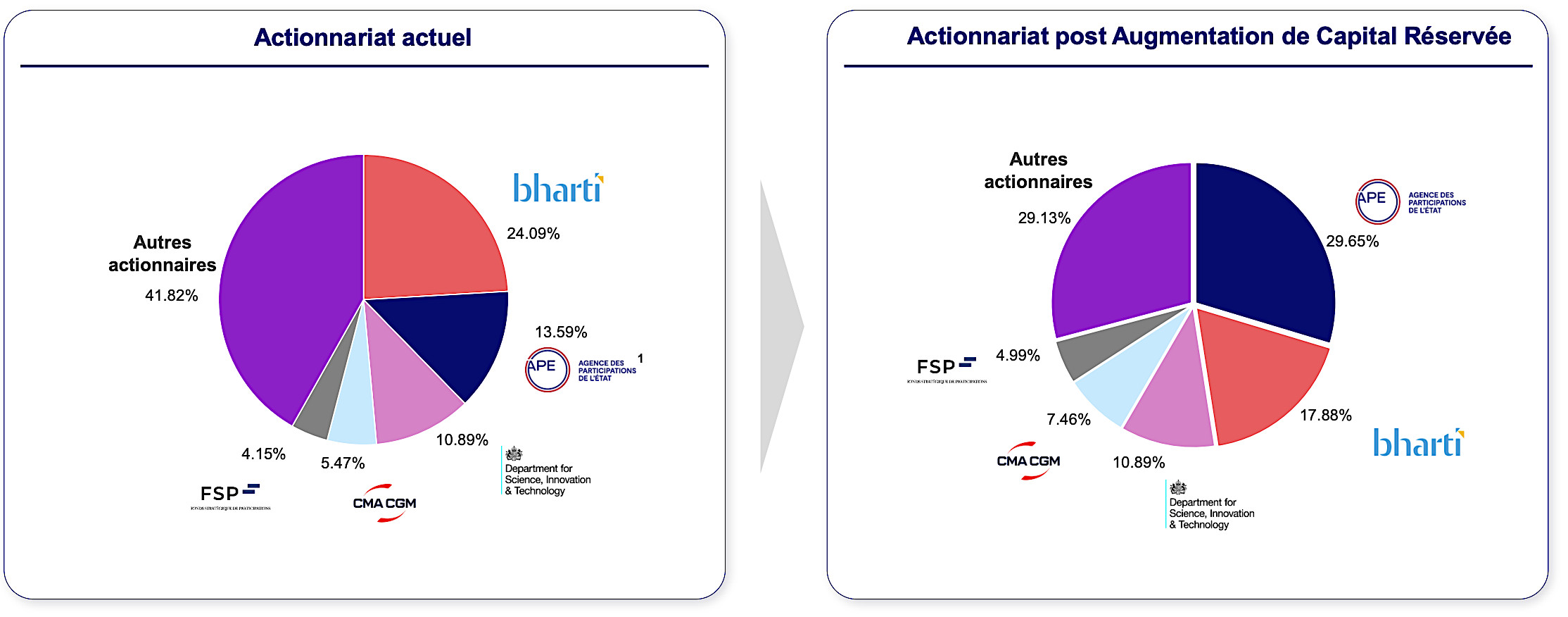
Eutelsat’s shareholder mix before and after the 1.5-billion-euro capital raise. Credit: Eutelsat
In a Nov. 25 presentation to shareholders, Eutelsat said the capital raise will reduce Eutelsat’s leverage — its net debt to EBITDA ration — to 2.5x from the current 3.5x by 2026.
The lower debt will make it more likely that Eutelsat can complete a planned bond issue, which in turn will unlock a refinancing of its current debt.
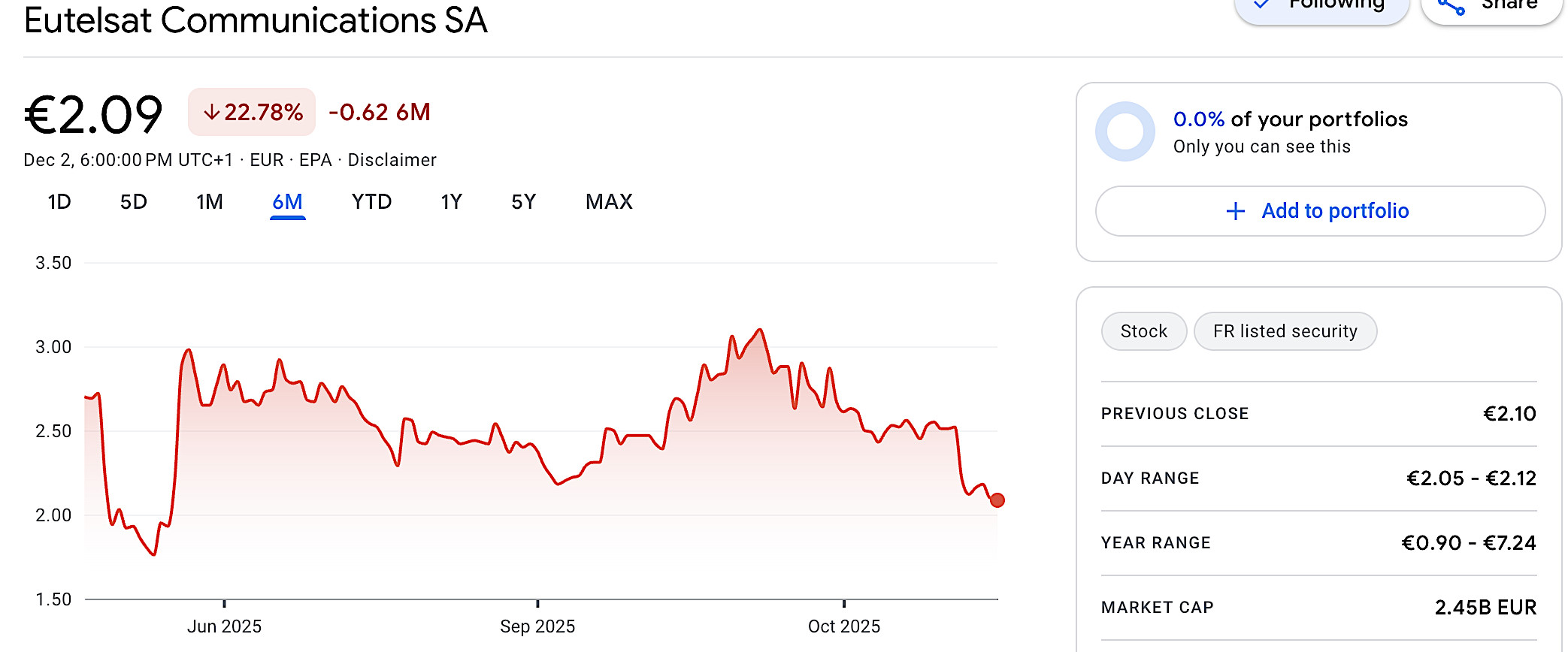
Eutelsat shareholders are accepting a 30% dilution as part of the 1.5-billion-euro capital raise. Credit: Google Finance
Eutelsat said in a Nov. 25 statement that it had already concluded agreements for a 500-million-euro credit facility and a 400-million-euro term loan, with maturities of three years with two one-year extensions. These loans require that Eutelsat first complete the bond issue.
The last piece of the Eutelsat turnaround will be financing from European export-credit agencies.
“These capital increases, combined with a refinancing plan including a bond financing, export-credit financings and an extension of bank debt maturities, should enable to company to finance its medium-term plan and cover 2026-2029 investments of approximately 4 billion euros while reducing leverage to 2.5x at end of 2025-26 financial year,” Eutelsat said. The company said it was in “advanced” negotiations with one or more export-credit agencies.
The company has previously estimated that renewing OneWeb’s Gen 1 fleet would cost some 2.2 billion euros. Immediately after that, Eutelsat must start investing on Europe’s Iris2 multi-orbit constellation, whose cost to Eutelsat has been estimated at 2 billion euros.
Eutelsat is part of the SpaceRise consortium that is scheduled to present to the European Commission this month a detailed accounting of the Iris2 network’s cost, schedule and technology readiness. The Commission then will spend up to three months examining it.
Only then will Iris2’s actual cost and schedule be more visible.
If the project survives this examination more or less intact, SpaceRise and the French government will be in better position to solicit support from other governments in Europe, whether through purchasing Eutelsat equity or making long-term commitments for Iris2 capacity.
By March it may also be clearer whether the German Defense Ministry is serious about building its own version of Iris2. It’s hard to see how a parallel German constellation — using what industrial base, and holding what radio frequency rights? — would be good news for Iris2.

Jean-François Fallacher. Credit: EUtelsat
““We have a unique position because we are the European leader in low-orbit connectivity in a changing geopolitical environment, which is favorable to us because we are the only ones who are not American,” Eutelsat Chief Executive Jean-François Fallacher told shareholders. “
“We are European sovereign. We have managed to achieve significant progress facing our operational challenges, and we are well on our way to offering a complete worldwide service by 2026… [and] support the expansion and growth of our LEO network and help us play a major role in the future of IRIS2.”