

Jay Schwarz. Credit: US Space Foundation video
TUPPER LAKE, NY — The US government remains concerned that the proposed EU Space Act governing conduct in space has protectionist leanings but is hopeful that the ongoing US-EU dialogue will work through the issues, the head of the US Federal Communications Commission’s Space Bureau said.
The US State Department and other US government agencies have been soliciting US industry comment on the proposed EU Space Act, which was published in June.
It now faces a long ratification procedure by the 27 EU member nations and could be adopted in 2027 and take effect in 2030.
The State Department in July cited the Act’s anti-competitive potential, given that its provisions would apply to any company doing business in the European Union, regardless of where it’s headquartered.
In Dec. 2 statements made at the Keeping China Grounded: Ensuring Long-Term US Tech Leadership in Low Earth Orbit conference, organized in Washington by the Center for Strategic and International Studies (CSIS), FCC Space Bureau Chief Jay Schwarz said these concerns remain valid.
“Alongside the rest of the US government, we are very much involved in speaking with the Europeans about their proposal. I think the worry is that there is at least a certain amount of protectionist, anti-competitiveness involved in this proposal and that that would be bad for all of us. This is a really important opportunity for Europe and the United States to work together,” Schwarz said.
Matt Pearl, director of the CSIS Strategic Technologies Program, said the Act appears to specifically target US operators.
“I have a lot of concerns about it as it’s currently written,” Pearl said. “The focus tends to be on the way it would just ensnare US operators primarily, and be anti-competitive.
“There are just some fundamental things there: You have the EUSPA [the European Union Agency for the Space Program], the same government entity that would both be regulating foreign operators and provisioning the European LEO champion, Iris2. Can you imagine if the FCC was both regulating some companies and then standing up a US champion?”
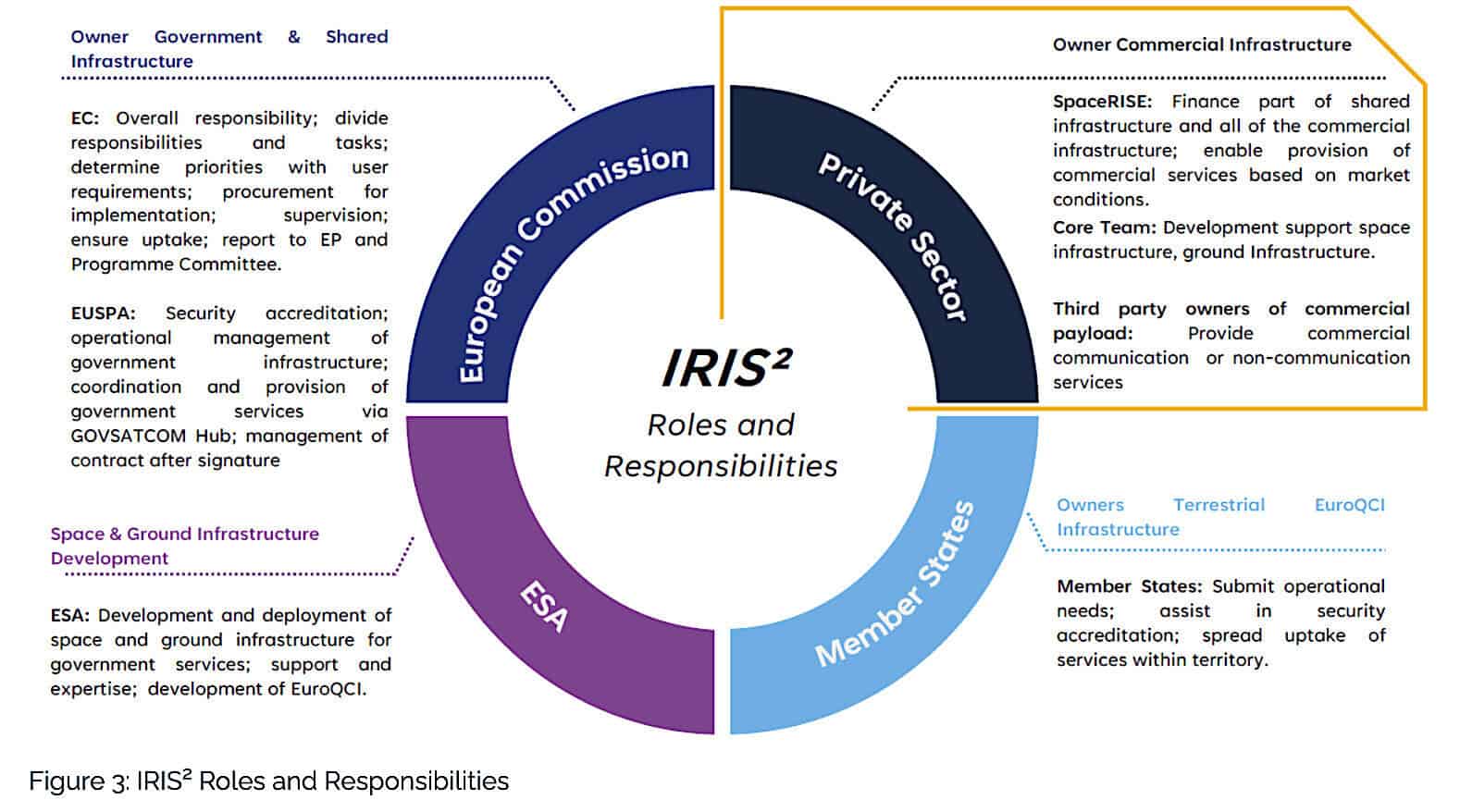
Credit: ESPI
The European Commission’s Iris2 multi-orbit secure connectivity network is designed as a public-private partnership in which three commercial satellite fleet operators — Eutelsat, SES and Hispasat — have created a consortium, called SpaceRise, that would operate the network under a 12-year concession. Pending final reviews of Iris2 costs, schedule and technology readiness, the three SpaceRise members have agreed to finance about 4 billion euros ($4.7 billion) of Iri2 capital costs, with the European Commission and the 23-nation European Space Agency (ESA) investing the remaining 7 billion euros.
The Act’s reception inside the EU has not been smooth, with some questioning whether the Commission has the right to impose itself in the area of space law:
European Commission officials have said they welcome critical reviews of the proposed Space Act, arguing that international consensus over its features would promote global harmonization of space standards.
The Act is also designed to create an EU-wide space conduct policy at a time when 13 EU nations already have their own laws on space operations.
The Act includes provisions that would allow EU regulators to waive strict regulatory examination of space operators based in nations with regulatory regimes acknowledged to be equivalent to what’s required in the Space Act. US-based satellite operators licensed by the FCC likely would fall into that category.
“The groundwork in the proposal is laid there for recognition of equivalence for the United states and I would hope we can get to that place,” Schwarz said.
“And on SSA [space situational awareness] systems, there are some good areas where the proposal talks opportunities to coordinate. This is just a proposal and now is the time for some really healthy dialogue and some recognization that we can work together” Schwarz said.
The EU Council has scheduled its next progress report and debate on the Act for Dec. 9 in Brussels.