
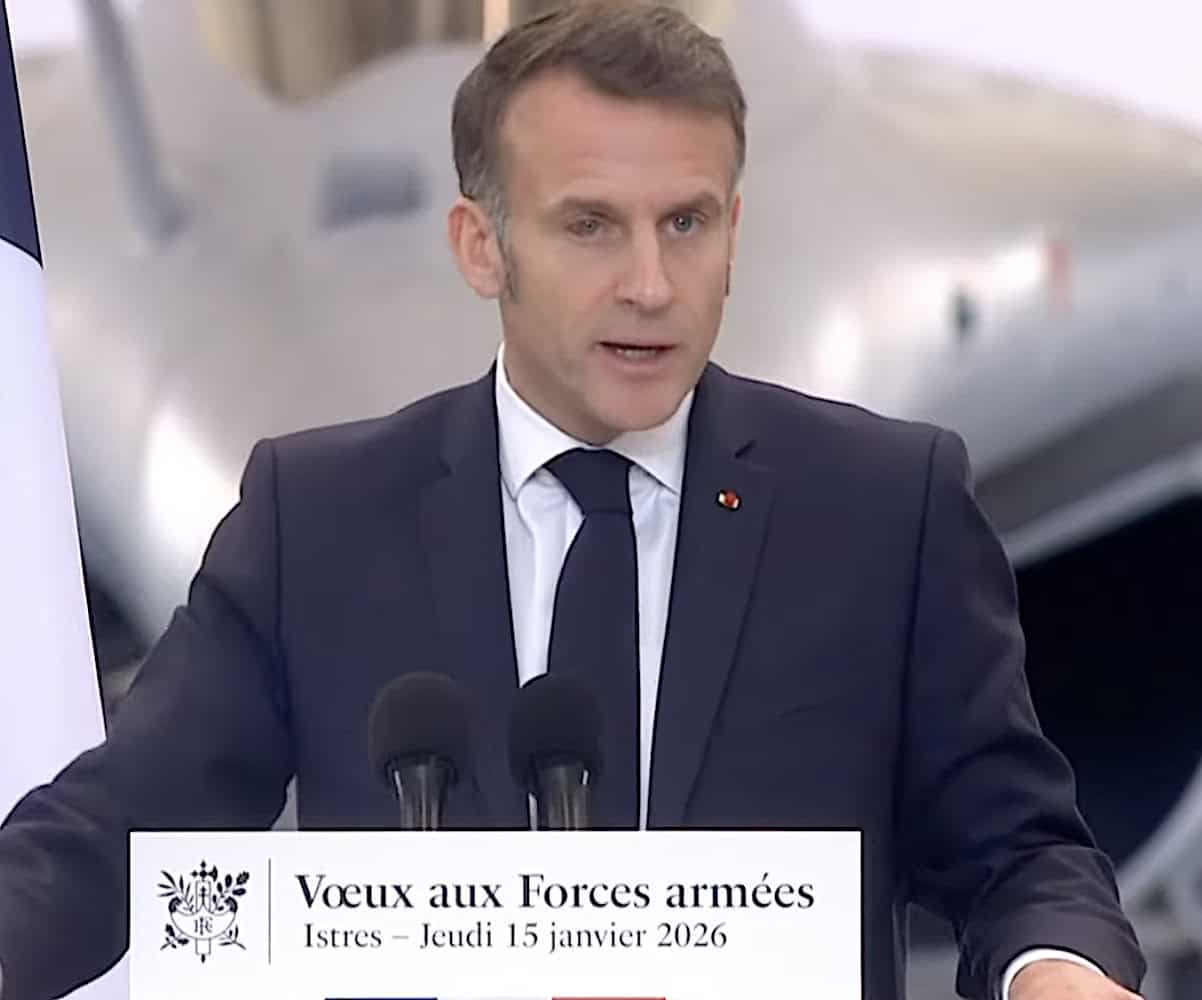
Emmanuel Macron. Credit: Elysée video
LA PLATA, Maryland — French President Emmanuel Macron promised to find supplemental funding to ensure development of the French-German missile-defense system, whose first element is geostationary-orbit satellites launched by each nation.
The program, called Joint Early Warning for a European Lookout (JEWEL), was approved by the two nations’ defense ministries in October. JEWEL is a component of a future European program called Odin’s Eye.
The German Defense Ministry’s September announcement of a five-year, 35-billion-euro ($41 billion) budget for military space lent credibility to its determination to raise its military space profile.
Things are more complicated in France. The government is still operating without a 2026 budget and whatever budget is approved will likely include program delays or eliminations.
In a Jan. 15 speech at France’s Istres air base, Macron said France’s JEWEL investment remains a priority. He also called for France and Europe to accelerate the effort at building low-orbit constellations of satellites.
“In space, we are going to accelerate our use of constellations in low Earth orbit to improve connectivity and the acquisition of intelligence,” Macron said. “We are consolidating in Europe with the so-called Bromo operation [the proposed merger of the space divisions of Airbus, Thales and Leonardo]. But we have to build real European constellations, to go more quickly and decisively than what was foreseen, in a lighter way.”
It was unclear whether Macron was suggesting that Europe’s proposed Iris2 multi-orbit constellation be revised to permit faster deployment.
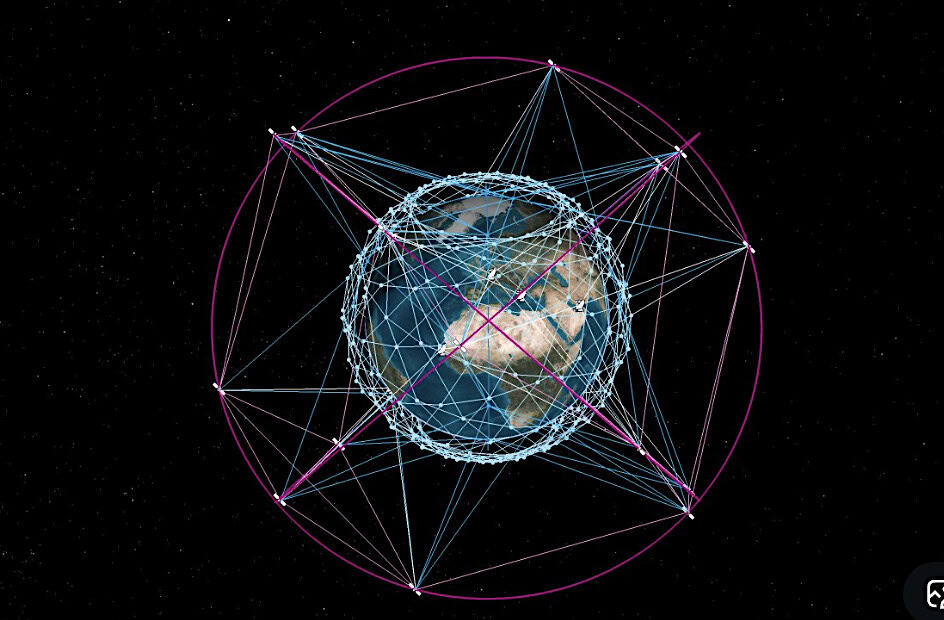
The planned Iris2 multi-orbit constellation. The SpaceRise Iris2 consortium announced Jan. 19 that had successfully registered the constellation’s military-Ka-band spectrum through a dedicated low-Earth orbit satellite owned by Eutelsat, which “further assures flexibility of use for a wide array of key applications on IRIS², designed to connect Europe and the world securely, supporting sovereign and governmental communications.” Credit: SpaceRise
Iris2’s whose cost, schedule and technical specifications are now being finalized by the European Commission and the SpaceRise consortium of Eutelsat, SES and Hispasat. The Commission has said it wants Iris2 launches to start in 2030.
The Franco-German JEWEL agreement foresees the launch of 1-2 geostationary-orbit satellites by each partner to form the start of a single, interoperable network that other European Union nations will be invited to join. The satellites would be launched around 2030.
The French space agency, CNES, was much less all-ahead-full in its Jan. 14 presentation of its plans for 2026.
France’s 2025 budget was 2.37 billion euros, including 1.091 billion euros going to programs administered by the 23-nation European Space Agency (ESA).
In late November, France committed 3.67 billion euros to ESA over the next three years.

Francois Jacq. Credit: CNES
CNES Chief Executive Francois Jacq said the agency could not make specific forecasts on what developments it would commit to in 2026 without a budget allocation. In addition, he said CNES had been ordered to trim its 2025 budget by 100 million euros, a reduction that will force some programs to be delayed and could mean cancelling others.

“This has yet to be done, but we have to do it,” Jacq said. “This is no small thing, with 100 million euros withdrawn in 2025.”
CNES has management oversight of the two-satellite Yoda demonstrators that will stand watch around French military satellites in geostationary orbit to ward off adversaries that get too close.
Yoda prime contractor Hemeria has said that the program has encountered delays and that it’s at risk of being put into storage in late 2026 while waiting for an Ariane 6 launcher to become available. That could push the Yoda launch into 2028.
CNES Deputy Chief Executive Lionel Suchet said Yoda, which is a joint mission of CNES and France’s Space Command, would be delivered later this year. “Then the problem is the launch, which will take more time because it’s GEO orbit. This is not finalized.”
BalMan high-altitude pseudo satellite fails on 2nd flight
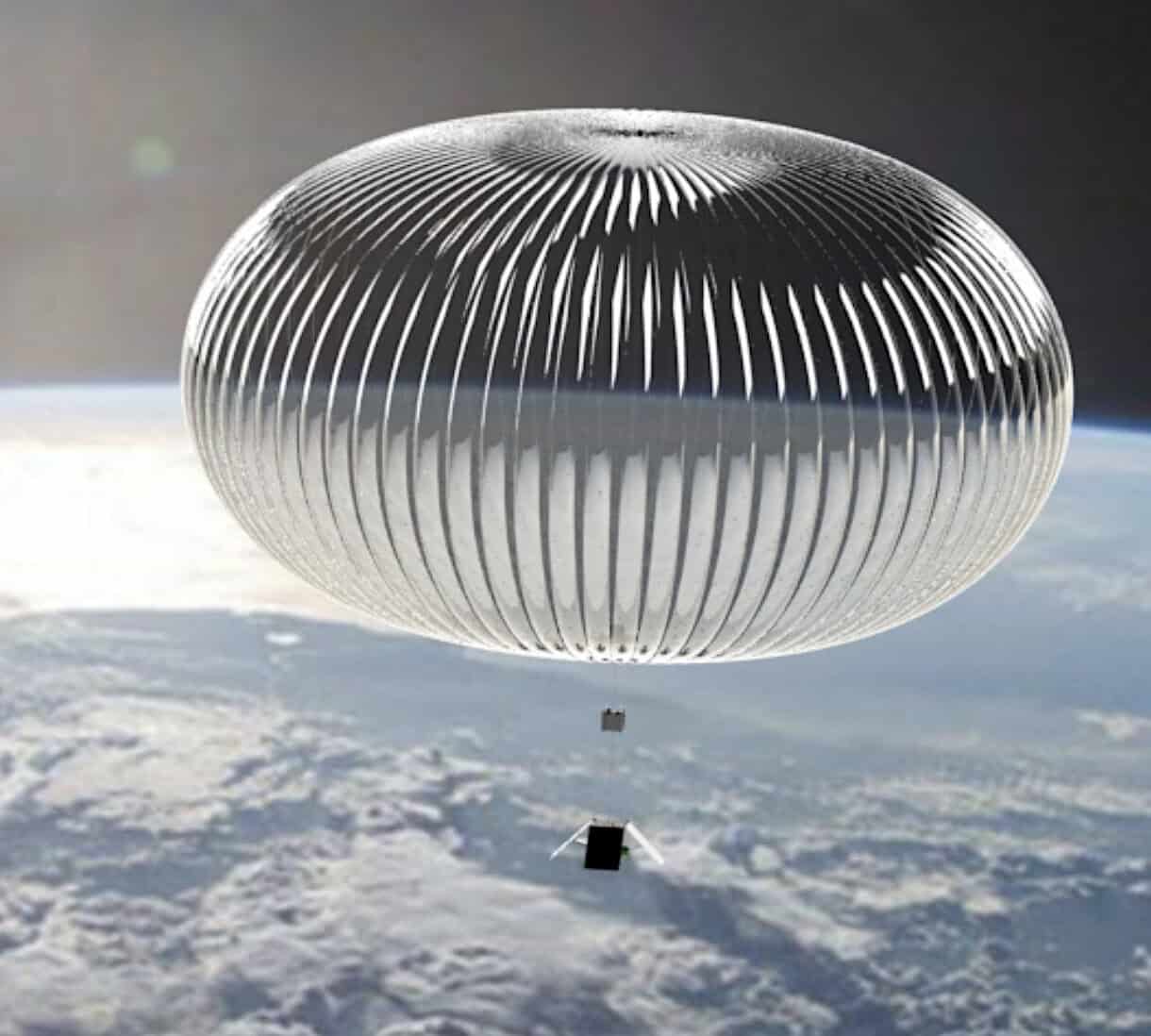
BalMan. Credit: Hemeria
The CNES-overseen, Hemeria-built BalMan maneuvering high-altitude platform designed to remain stationary in the stratosphere for “pseudo-satellite” missions including Earth observation and communications, suffered a setback in late 2025 during its second test flight from the Guiana Space Center on South America’s northeast coast.
Jacq said the BalMan “exploded” in flight. Its inaugural test in October 2024, was judged a success, reaching an altitude of 22 kilometers for 15 minutes. The second flight was planned to test its maneuvering capability at altitude.

The second test flight of the BalMan maneuverable high-altitude ‘pseudo satellite’ platform in October ‘ended in failure when it collapsed during flight from Europe’s Guiana Space Center . Credit: CNES
“We are investigating the problem with the second flight,” Suchet said. “We are starting to understand what happened and we hope to return to flight this year.”
Preparing for arrival of mini-launchers at refurbished launch pad
A key event for CNES in 2026 will be terminating its work refurbishing a long-retired launch pad at the Guiana Space Center to prepare for the arrival of several micro-launchers.
PLD Space of Spain had secured promises from CNES that PLD would be allowed access to the site to prepare its first flight even if CNES’s work was not fully complete. It is still not clear when that will be.
Carine Leveau, CNES director of space transportation, said delivery of the basic launch pad infrastructure, which will be shared by all the micro-launchers, is expected early in the second half of the year.
During the briefing, Leveau referenced PLD Space’s determination to conduct its first orbital flight in 2026. “PLD has begun work on its own infrastructure, which is not shared by others, so this is advancing very well.”