
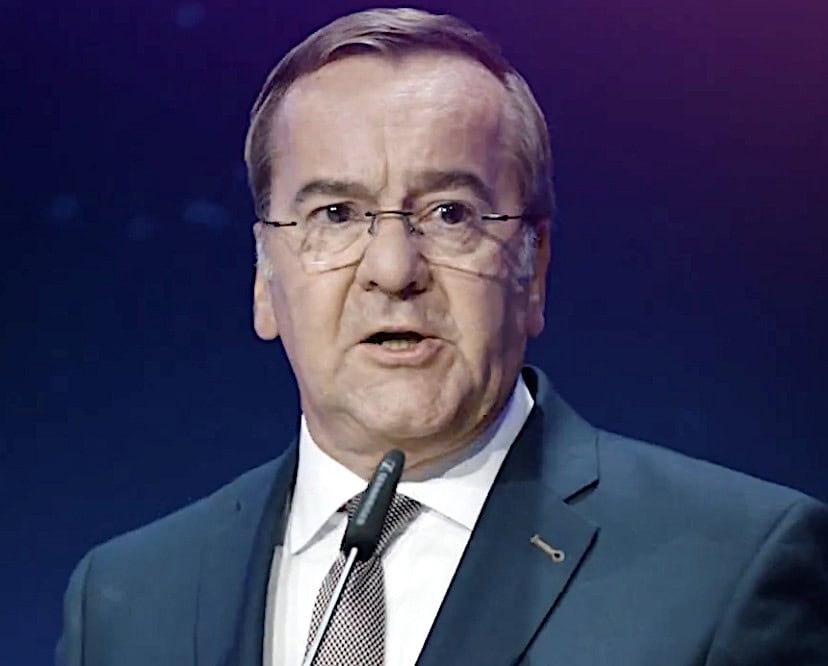
German Defense Minister Boris Pistorius. Credit: BDI video
WASHINGTON — Germany plans to spend about 35 billion euros ($41 billion) on space-based security programs in the next five years, with investments including space situational awareness, a military space operations center and constellations for reconnaissance, early warning and communications, German Defense Minister Boris Pistorius said.
Pistorius did not detail how this money would be ventilated into European Space Agency (ESA) or European Union space programs, and how much would be reserved for German national civilian or military efforts.
But in a Sept. 25 speech to the 3rd Space Congress in Berlin, organized by the Federation of German Industries (BDI), Pistorius sought to convey his determination that Germany was breaking with its past practice to invest heavily in security-related space efforts.
“Even as I am speaking to you, 39 Chinese and Russian reconnaissance satellites are flying over us. The observations are being relayed in real time,” Pistorius said.
“China conducts highly agile and dynamic approach maneuvers with its space systems. If we were to apply these tactical procedures to the air force, we could speak of air combat exercises.
“Russia is positioning its reconnaissance satellites in close proximity to space systems of the German Armed Forces and friendly nations. Currently, two Intelsat satellites, which are also used by the German Armed Forces, are being tracked by two Russian Luch-Olymp reconnaissance satellites.
“I would like to have the purely peaceful nature of this behavior explained to me again,” Pistorius said.
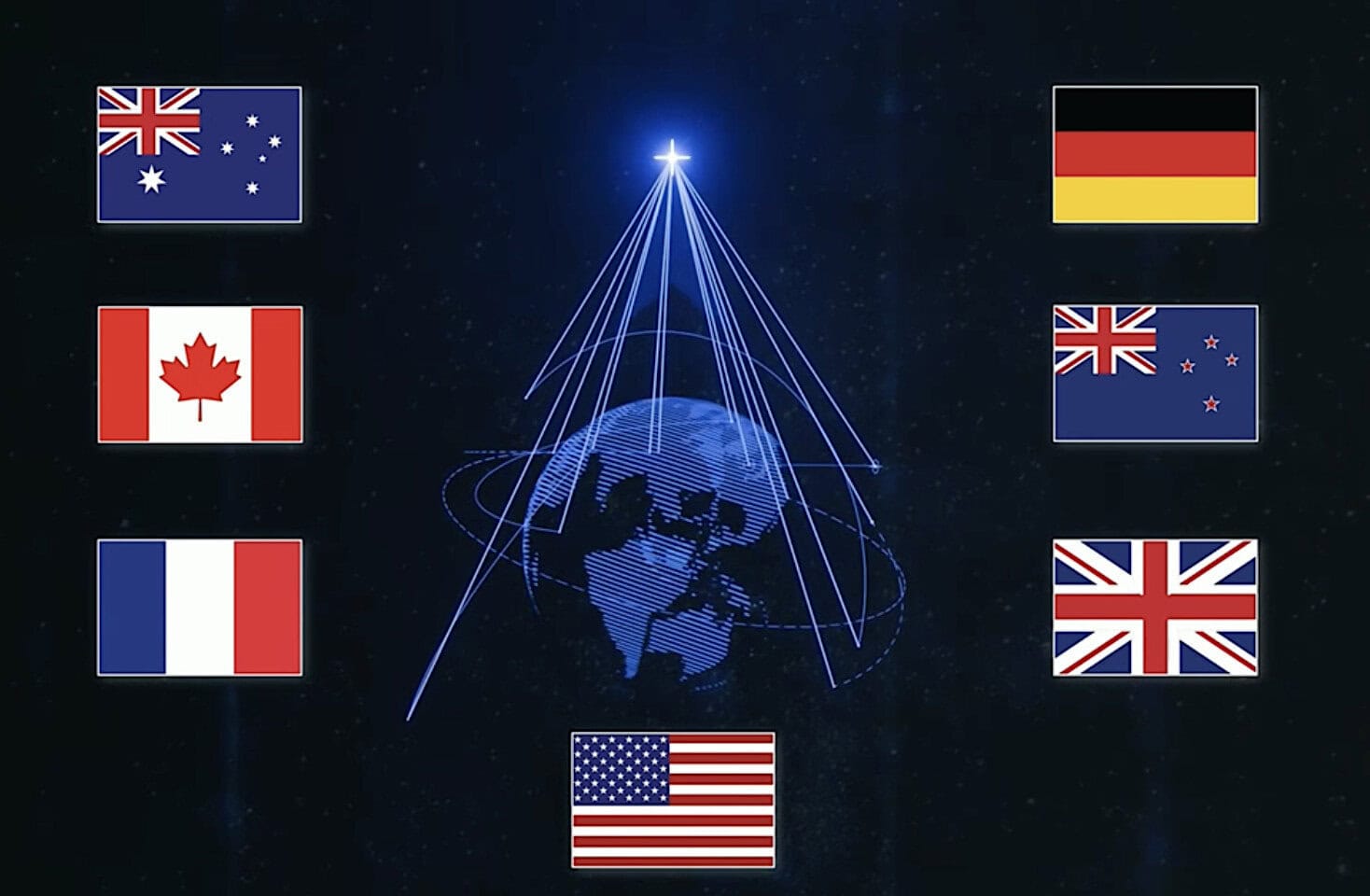
Operation Olympic Defender. Credit: US Space Force
Pistorius said Germany’s investments would be made in partnership with allies, notably in NATO and as part of the seven-nation Multinational Force Operation Olympic Defender, coordinated by US Space Command. Germany and France joined the formerly Five Eyes Only program in 2024.
He also said the European Union’s space program would be an important focus of investment, but he did not mention the EU’s Iris2 multi-orbit secure constellation or the proposed Earth Observation Governmental Service (EOGS) intelligence, surveillance and reconnaissance constellation the EU wants to fund starting in 2028.
To accelerate the program’s ramp, the 23-nation European Space Agency (ESA) will be asking its governments for up to 1 billion euros to start a precursor program that ESA calls European Resilience from Space (ERS).
German government and industry officials in recent months have said Germany is ready to build its own broadband constellation while being a customer of Iris2.
Whether the new government has a position on this is not clear.
“We plan to acquire new satellite constellations – for early warning, reconnaissance, and communications,” Pistorius said. “We will also utilize dual-use systems, meaning technologies that can be deployed for both civilian and military purposes.”
ESA Director-General Josef Aschbacher told the congress that ESA is counting on Germany to make a major commitment at the ministerial conference, scheduled Nov. 26-27 in Bremen, Germany.
“Germany’s recognition of space as a strategic priority must now translate into sustainable investment,” Ascbacher said. “Space is a long-term endeavor, and Europe must act decisively to compete with world leaders such as the US, China and India.
“[The November ministerial conference] is the right time to mobilise the financial resources commensurate with ambitions. Through massive investments and closer cooperation, Germany can contribute to the ESA 2040 strategy and thus secure Europe’s strategic independence and resilience. Let us seize this opportunity together.”

Peter Leibinger. Credit: BDI
BDI President Peter Leibinger said Germany, with Europe’s largest economy, “must significantly expand its leadership role within ESA. Germany should increase its participation in order to provide technological stimulus for industry – from 3.5 to 6 billion euros over the next three years,” Leibinger said.
The ESA ministerial sets the agency’s budget and program priorities for three years. At the last conference, in 2022, Germany committed to spending 3.5 billion euros over the next three years, an increase from its 2019 commitment of 3.29 billion euros.
The 2022 ministerial secured nearly 17 billion euros in total. Germany was the largest contributor followed by France, at 3.2 billion euros; and Italy, with 3.08 billion.
Leibinger also urged the German military to adopt a more flexible, faster-reaction approach to contracts, and to view NewSpace companies as an asset.
“This requires substantial reform of procurement processes,” Leibinger said. “The military’s procurement officers must adapt to the dynamics of the ecosystem, not the other way around.”
Pistorius gave at least a partial response in his speech.
“In the future, we will promote innovations from small and medium-sized enterprises in a non-bureaucratic and early manner. We want to use larger companies as system integrators that integrate small businesses, including start-ups, Pistorius said.
“But we’re also looking at solutions currently available on the market, specifically where this technological shortcut makes sense. Our aim is not to redevelop everything as a matter of principle, but rather to catch up on everything that has been neglected for too long.