
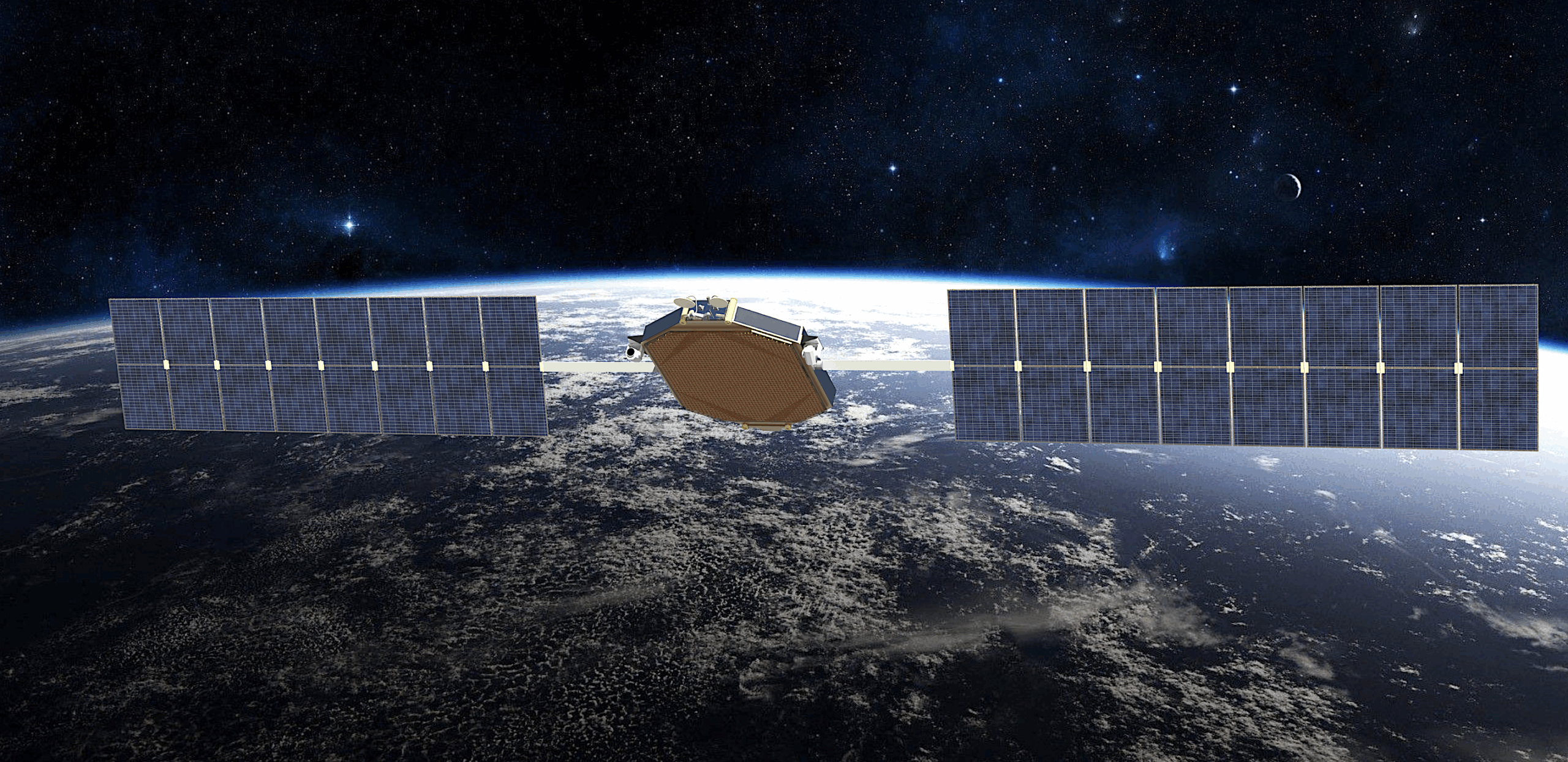
MDA Space’s Aurora D2D satellite platform. Credit: MDA
LA PLATA, Maryland — EchoStar’s $1.3-billion contract with MDA Space for a direct-to-device (D2D) satellite constellation, cancelled just five weeks after it was announced, allowed MDA to accelerate work on a 5G-compliant satellite design that improves its original Aurora D2D product, MDA Chief Executive Mike Greenley said.
In a Sept. 8 investor call hastily arranged to discuss the EchoStar move, Greenley said MDA’s bid for the EchoStar work forced an acceleration of its 5G-compatible design, which now can be used to win other business.
“A lot of work went into the competition for EchoStar,” Greenley said. “They would have been the anchor customer for that 5G variant. As a result, being in the market with a 3GPP 5G-compliant satellite that can talk directly to any 5G-compatible device on earth is a tremendous advancement in our MDA Aurora satellite product.
“We were doing it anyway but EchoStar was the first customer. Rushing toward a customer that is on a path to get to market quickly always helps accelerate these things, and so it did in this case. As a result, we are ready to go with a 5G-compliant design and product in the market. That is already in conversations with a number of folks in the pipeline.”
Canada-based MDA is also building a second-generation D2D constellation for Globalstar and its principal customer, Apple; and a third-generation Globalstar-Apple network that is entering critical design review this year. Judging from Greenley’s comments, neither is 5G compliant.
EchoStar had said in August that its MDA contract had to be signed before the company had lined up the full $5-billion in financing it needed for the full network because of the need to move quickly to capture the market opportunity.
But under pressure from the US Federal Communications Commission (FCC) to reduce its spectrum holdings to allow the assets to be deployed, EchoStar did an about-face. Instead of competing with SpaceX Starlink in broadband and D2D, EchoStar’s Boost Mobile customers will have access to a Gen 2 Starlink D2D offer that will be enhanced by the EchoStar spectrum.
EchoStar said it has “long-term commercial agreements” with SpaceX “that lets EchoStar refer existing HughesNet customers and new Starlink customers” to SpaceX. HughesNet is EchoStar’s broadband satellite service and hardware provider. HughesNet’s future is now a question mark.
‘No indication that EchoStar’s move will push prospective D2D constellation operators to reconsider’
Greenley said other prospective D2D and broadband constellation customers shared EchoStar’s sentiment that the opportunity window will not remain open forever. Whether EchoStar’s cancellation will cause future customers to think twice about the wisdom of competing with SpaceX, in satellite broadband or D2D, remains to be seen. Greenley said he has seen no indication of a decline in enthusiasm in the market.
“The EchoStar announcement in August caused a giddy-up kind of feeling in the market,” Greenley said. “People wanted to get moving quicker. I would expect that now that SpaceX has that spectrum and they are going to get on with building that same network that EchoStar was going to build, at least equally if not further adds to the giddy-up feeling in the market, which is a ‘We better get going.’ That’s the sense that we get.”
Greenley suggested that prospective D2D constellation customers that MDA is talking to already have satellite-reserved spectrum, which presumably would be in L- or S-band, and do not need to go to the market to purchase it, as SpaceX and, earlier this year, AST SpaceMobile have had to do.
“The other people in our pipeline, they have their spectrum and their business plans and they are continuing the dialogue with us,” Greenley said. “There will be multiple D2D space networks, just as there are multiple cellular networks.”
He said he expected at least one constellation deal to land at MDA within 12 months.
The EchoStar contract with MDA included the usual conditions that attach to a customer’s activating the termination-for-convenience clause. Greenley declined to specify how much this would be, but he said MDA had been particularly focused on protecting itself given EchoStar’s recent financial and FCC issues.
“We put extra effort into ensuring our protection in that contract, which is why we are comfortable we will be properly compensated,” he said. MDA issued its Q2 2025 earnings results and full-year forecast without including the EchoStar contract, which was announced Aug. 1, and is not changing it because of the contract cancellation.
MDA had expected “ a couple of hundred” million Canadian dollars (around $145 million) in 2026 revenue from the EchoStar contract but that a large majority of the company’s estimated 2026 revenue is already in contracted backlog.
Greenley made clear that the EchoStar decision, which EchoStar said came under FCC pressure, was as much of a surprise to MDA as to the wider public.
“EchoStar has completely changed their business plan,” Greenley said. “They were going to build a satellite D2D network and they suddenly decided not to do so and are selling the communications rights to operate such a network to SpaceX so SpaceX can operate a network. It’s a highly unusual situation.”