
Credit: APJII
JAKARTA — Indonesian government and industry officials repeatedly stressed the need for sovereign space capacity as part of a development plan to 2045 that they said should include Indonesia-built telecommunications and Earth observation satellites and a domestic launch service.
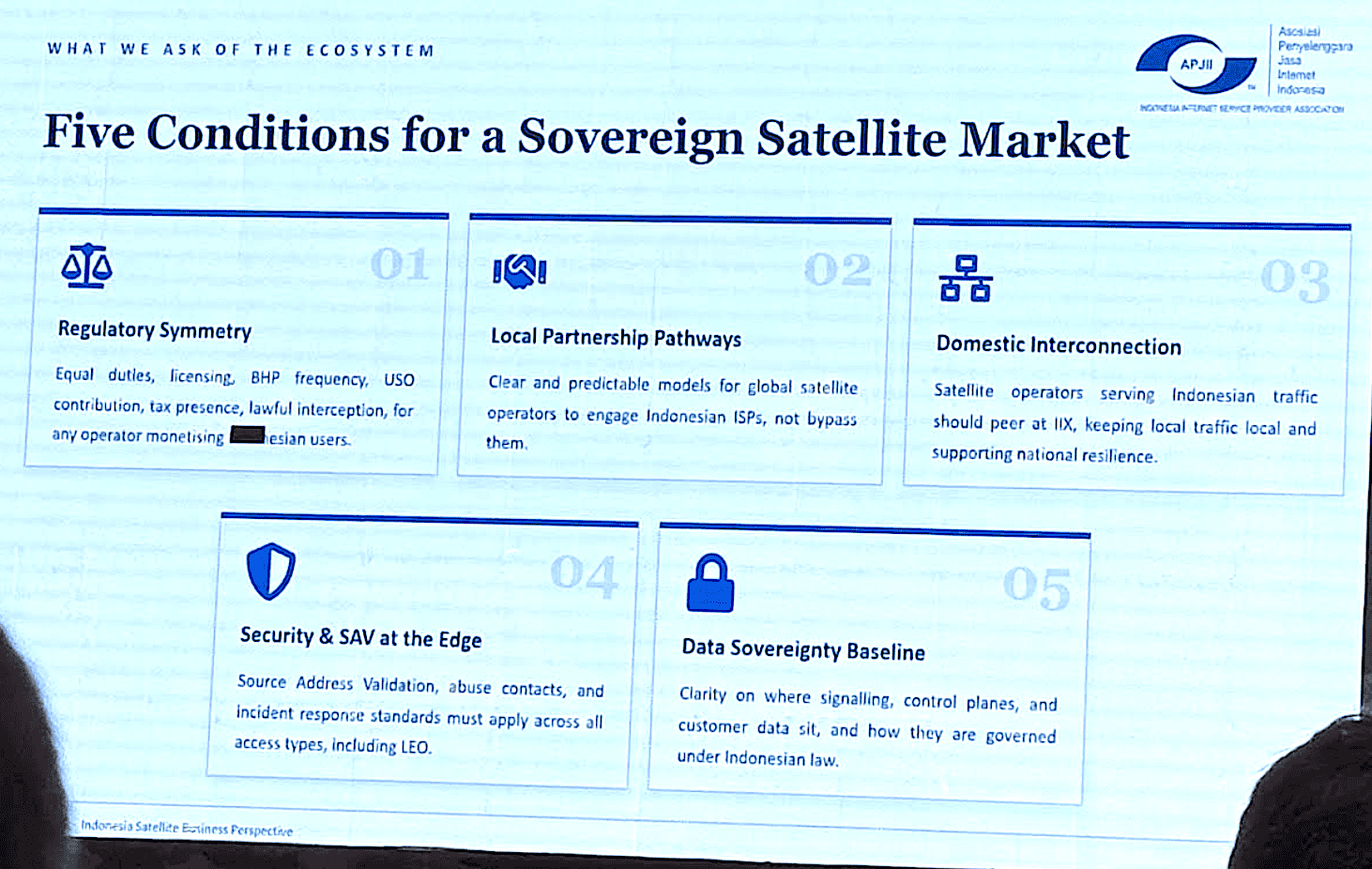
They also urged that a national consensus develop that requires global LEO operators to abide by the same regulations as those imposed on Indonesian companies.
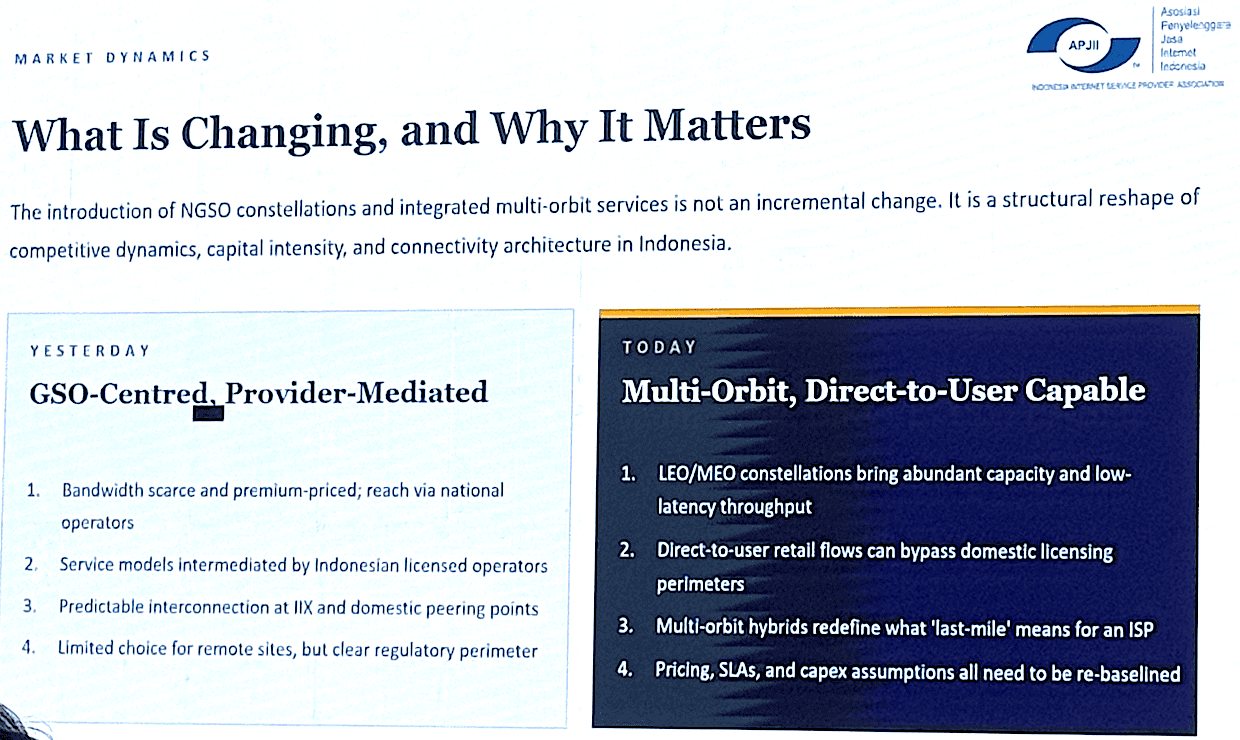
In telecommunications, Indonesian officials are preparing a national ecosystem to assure a domestic satellite manufacturing capability and to prevent Indonesia’s being overwhelmed by hyper-scalers like SpaceX and Amazon Leo.
Indonesia’s satellite association, ASSI, has said Starlink already dominates the 45% satellite connectivity market share held by non-GEO systems, with GEO satellites, including Indonesian, still accounting for 55%.
ASSI’s principal concern appears to be that global constellations will be able to offer lower connectivity prices than the domestic satellite providers, and will perform an end-run around local regulations for routing traffic through Indonesian gateways.
Credit: APJII
The promise of satellite direct-to-device carries with it the threat that global constellations, using satellite spectrum, will be able to access Indonesian smartphones directly, without going through national mobile network operators.
“For a nation like Indonesia, the need to maintain sovereignty in space services is no longer optional, ASSI Chairman Risdianto Yuli Hermansyah said here May 12 during the Apsat 2026 conference, which ASSI helped organize. “It is essential for nation in an increasingly digital world. It is precisely this question that brings us together here.”
Arif Satria, head of the Indonesian National Research and Innovation Agency BRIN, has held initial talks with Russian officials about providing technology for development of a spaceport in Biak Island. A formal decision by the government is expected this year on proceeding with development of the site.
Satria said a domestic launch service coupled with a satellite manufacturing industrial base should be the goals for Indonesia’s 2045 technology development plan.

“The geopolitics of space are shifting fast, with new technologies and new economic models,”Satria said. “The choices Indonesia makes in the next few years will determine whether we arrive in 2045 as a nation that participates in the space economy.”

Credit: APJII
Syarif Lumintarjo, head of Indonesian ISP IDNIC and also had of the Indonesian ISP association APJII, said the organization wants nothing more than a level playing field in Indonesia.
“We have the biggest internet exchange in Indonesia, with 20 Tbps on it. We need the same playing field for all operators — LEO, MEO and Geo,” Lumintario said. “Regulators must insist on obligations from the service provider.”
APJII has 1,500 Indonesian ISP members.
“We are the biggest internet exchange in Indonesia,” Lumintario said. “We want level playing fields. It is very easy to get in” with new global LEO systems. “Go to retail, buy the device and you are in.”
Adis Alifiawan, director of spectrum planning, satellite orbit and digital infrastructure standardization at Indonesia’s KOMDIGI agency, said the growth of Starlink in Indonesia “is quite amazing. Last year they asked for more spectrum to go through the gateway.
“The new services — from NGSO to GEO and for D2D: When the services come into our country they need approval from us. We want to take care our sovereignty. Several countries are having security issues. We want to ensure that the global players, when they operate in Indonesia, need to have that authorization.”
Anggoro K. Widiawan, chief develpment officer at satellite communications service provider Telcomsat, which currently partners with several satelite operators to provide broadband service in Indonesia, is also an authorized Starlink service provider.
“We force all the traffic down to our gateway. We want them to bring everything into Telcomsat view,” he said.
Widiawan said some of his customers became so worried about data security “that they have wanted to change their Ku-band service and go back to to C-band, for sovereignty reasons.”