

Uganda Communications Commission (UCC)
LA PLATA, Maryland — It took the Ugandan government 24 hours to get Starlink to disable terminals illegally operating on its territory. The Iranian government has been trying for more than two years to achieve the same result at the International Telecommunication Union (ITU), to no effect.
In Iran’s case, the Norwegian and US regulatory agencies first pleaded to the ITU that Starlink might not be capable of geo-fencing its operations, and that this was a matter for Iranian border authorities, not the ITU.
In Uganda, where Starlink already has a service representative in hopes of getting a license, Starlink Global Internet Services Uganda Ltd. said it did not condone, and was not responsible for, Starlink use on Ugandan soil.
But unlike Iran, Starlink reacted with lightning speed to a Jan. 1 letter from the Uganda Communications Commission (UCC) saying that Starlink terminals registered in other nations had made their way into Uganda.
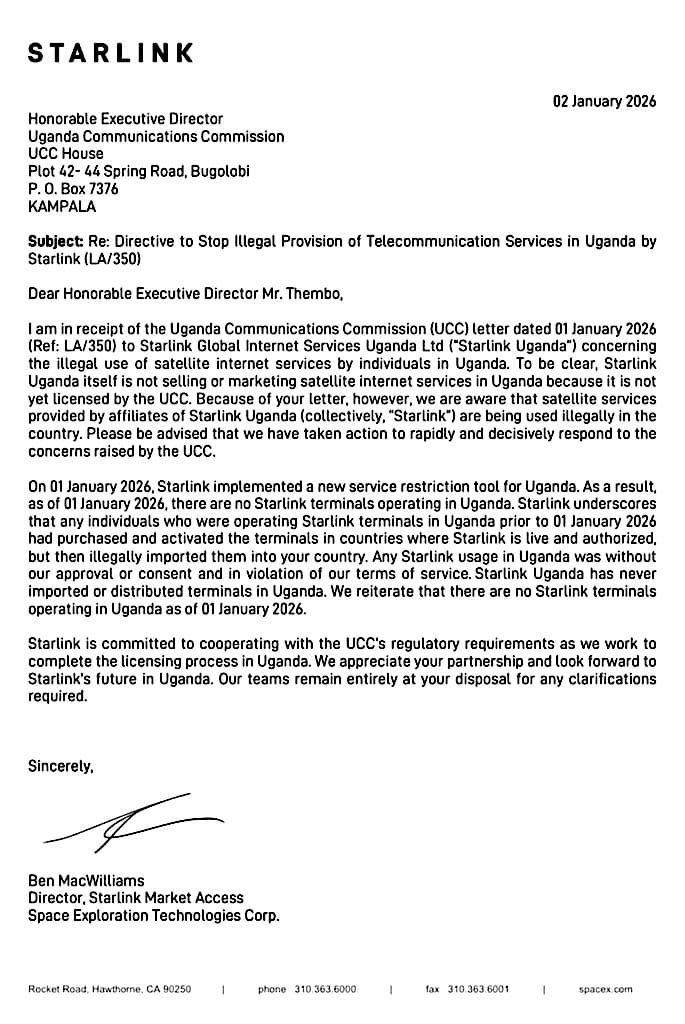
Starlink Jan 2,, 2026, letter to Uganda Communications Commission (UCC).
“Please be advised that we have taken action to rapidly and decisively respond to the concerns raised by the UCC,” Starlink responded in a Jan. 2 letter to the Commission.
“On 01 January 2026, Starlink implemented a new service restriction tool for Uganda. As a result, as of 01 January 2026, there are no Starlink terminals operating in Uganda.
“Starlink is committed to cooperating with the UCC’s regulatory requirements as we work to complete the licensing process in Uganda. We appreciate your partnership and look forward to Starling’s future in Uganda.”
The UCC complaint to Starlink comes as Uganda prepares for national elections on Jan. 15. President Yoweri Museveni is running for a seventh term of office.


Opposition leader Bobi Wine has accused the Museveni government of planning to shut off internet access during the elections, and appealed to Elon Musk to restore access.
“Please reactivate Starlink internet access in Uganda so that citizens can be able to communicate and stand a fair chance at shaping their destiny. Democracy dies in darkness!” Wine said in a Jan. 4 posting on X.
Iran has won the support of the ITU Radio Regulations Board (RRB) in its attempt to prod SpaceX licensing authorities in Norway — where the service was first registered — and the United States for force SpaceX to act.
Iranian officials submitted documentation that satellite broadband providers Eutelsat OneWeb, a LEO constellation; and Luxembourg-based SES’s O3b mPower medium-Earth-orbit constellations both could accomplish this task, in some cases within 30 minutes.
The US Federal Communications Commission (FCC) and the US State Department at first responded to the ITU that they were unaware that SpaceX had the ability to geolocate and disable terminals in a given geographical area and that in any case the subject was not part of ITU’s authority.

Credit: LinkedIn
Norwegian officials said that the ability of Starlink to switch off service in other regions “is outside the scope of the current RRB discussions,” and said the RRB had misinterpreted past ITU decisions as obliging administrations to do their utmost in switching off unauthorized service. “As the [ITU] text stands, we cannot see we are in a position to enforce upon Starlink to disable all terminals in a specific area,” the Norwegian Communications Authority said in a submission to the RRB’s Nov. 10-14 meeting.
The RRB, in its Nov. 14 decision, noted that Norway was “unwilling to enforce the Board’s prior decisions to immediately cease unauthorized transmissions of Starlink terminals” in Iran “in the absence of an explicit requirement in the regulatory framework.”
The Board said Starlink had “recently proactively identified and disabled over 2,500 terminals operating illegally in a given area,” proving its ability to do so.
The RRB acknowledged that there is “no explicit requirement” in ITU rules for administration’s like Iran “to identify and locate any and all unauthorized stations on its territory” before asking for help from the network operator. This would be “impossible to achieve and would be contrary to the objective of the resolution [Resolution 22 (Rev. WRC-23) to prevent unauthorized transmissions.”
The Board concluded with a weak request that Iran keep trying to locate and deactivate Starlink terminals on its territory. It also decided, again, to “strongly urge” Norway to “have the operator of the Starlink system immediately disable unauthorized transmissions of its terminals” in Iran.