
Teodoro Valente. Credit: La Tribune Space Forum video
BALTIMORE — The Italian government remains skeptical about whether satellite fleet operators SES, Eutelsat and Hispasat will live up to their promise of financing some 40% of the European Commission’s Iris2 multi-orbit secure communications constellation and is also seeking to increase Italian industry’s role in it, the president of the Italian Space Agency (ASI) said.
Teodoro Valente agreed that a satellite network assuring secure communications for European governments should be “a top priority for Europe.”
“We see what has happened in the past few months and is happening” with respect to Russia’s invasion of Ukraine, Valente said Sept. 9 at the Space Forum organized by France’s La Tribune.
But while the idea is good, Valente said Iris2 should be moving faster into development. The current schedule, which few think is credible, is for the entire network to be in service starting in 2030. Iris2 is being managed as a public-private partnership, with the three satellite operators, grouped into the SpaceRise consortium, will run as a 12-year concession.
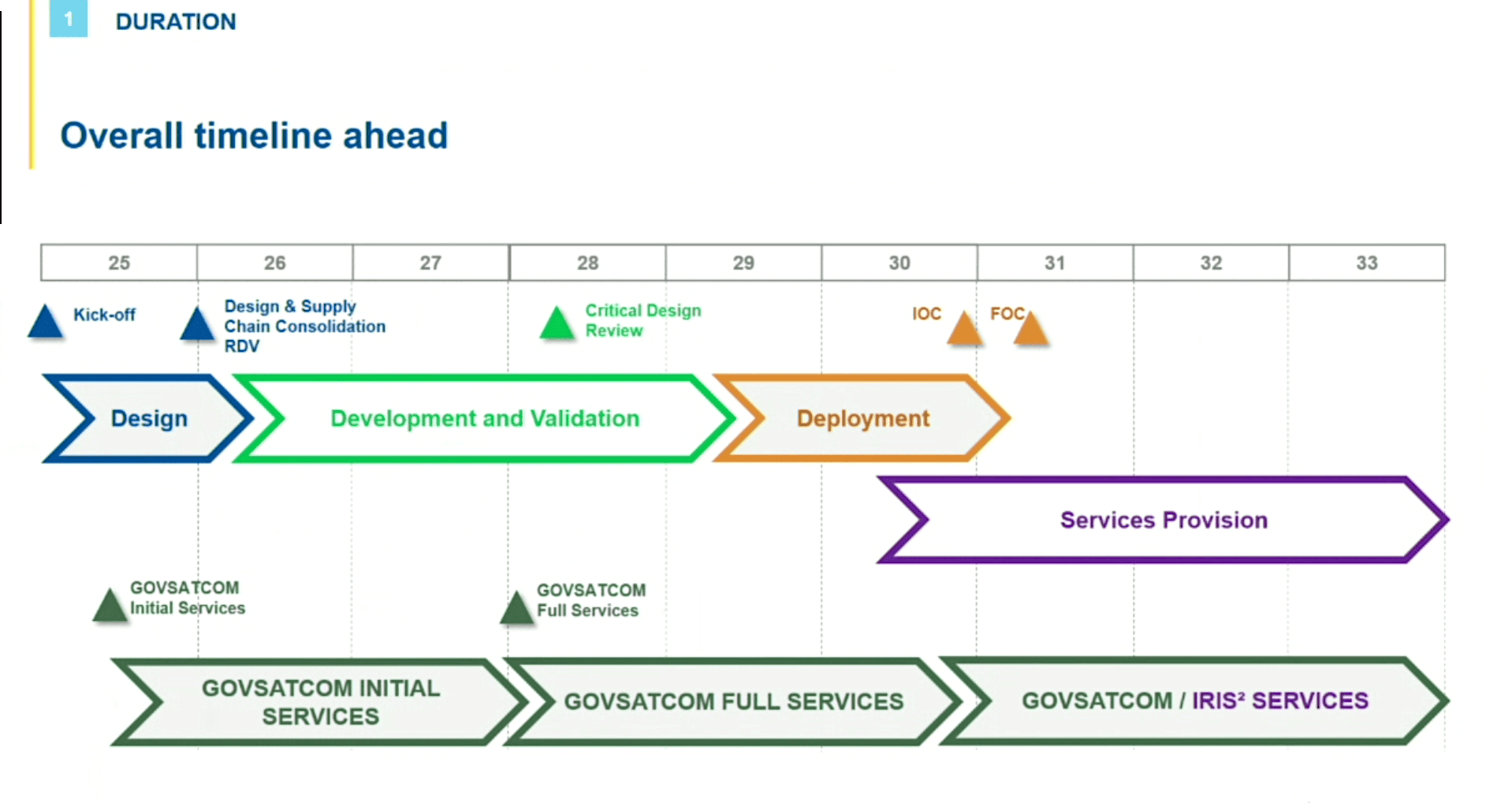
Now a 1-year PDR phase for Iris2 to secure costed commitments from suppliers, then a CDR and an aggressive goal of full service in 2030-31. Credit: European Commission
Pending a final review of the program’s schedule, cost and technical specifications, SpaceRise and the Commission are scheduled to make firm commitments to Iris2 late this year or early in 2026. SES has made clear that if the terms of the original Iris2 agreement are not met — including its expected internal rate of return to SES — then it is free to scrap its involvement.
“We have some concerns,” Valente said. “First is the on the possibility to really co-fund the program by industry. This is not quite clear today.”
European government officials have also questioned whether Eutelsat, despite fresh support from the French government, will be able to finance both a refresh of its first-generation OneWeb constellation of 650 satellites and also finance its share of Iris2.
Iris2 has also been criticized for appearing to select its main prime contractors — Airbus Defence and Space, Thales Alenia Space, OHB SE — in advance, before any real competitive bidding. Airbus is the assumed prime contractor for the Iris2 LEO constellation, with OHB and Thales Alenia Space dividing the work on the medium-Earth orbit (MEO) component.
“We are not satisfied with the upstream [components of the network],” Valente said. “We see many Italian companies outside it. This is the official position of my country. We are discussing with the Commission to understand if this is a recoverable issue.”
The Commission has imposed strict competition rules for the presumed prime contractors to select their subcontracting teams, including quotas on selecting small- and midsize companies, and restrictions on hiring subsidiaries of the prime contractors.
But because this is European Commission program, there is no geographic-return requirement. The European Space Agency (ESA), which does use geographic return as a selection criterion — meaning higher-contributing member states are assured of their national industry’s receipt of contracts in amounts equivalent to the government investment — is handling a separate Iris2 development.
ESA is focusing on low-TRL Iris2 components that will need special treatment to be ready in time for Iris2. ESA invested about 550 million euros ($640 million) in 2023 and is preparing to ask its governments for another 600 million euros for the coming three years.
Italy’s Leonardo Space, which 33% of Thales Alenia Space, with France-based Thales Group owning 67% the rest, has also voiced reservations about Iris2.
Asked about Iris2 in a separate panel discussion during the Space Forum, Leonardo Space Managing Director Massimo Comparini said:
“Iris2 has been mentioned more than once. To be politically correct, let’s say that we should improve the process,” Comparini said. “We should be faster and look to a final goal that is more than the classical stages of a contract, makes this investment step up to Copernicus and Galileo.”
The Copernicus environment-monitoring network and the Galileo positioning, navigation and timing constellation were both fully financed by the Commission, with ESA paying a share of Copernicus. There was no industrial ownership stake.
Credit: ESA
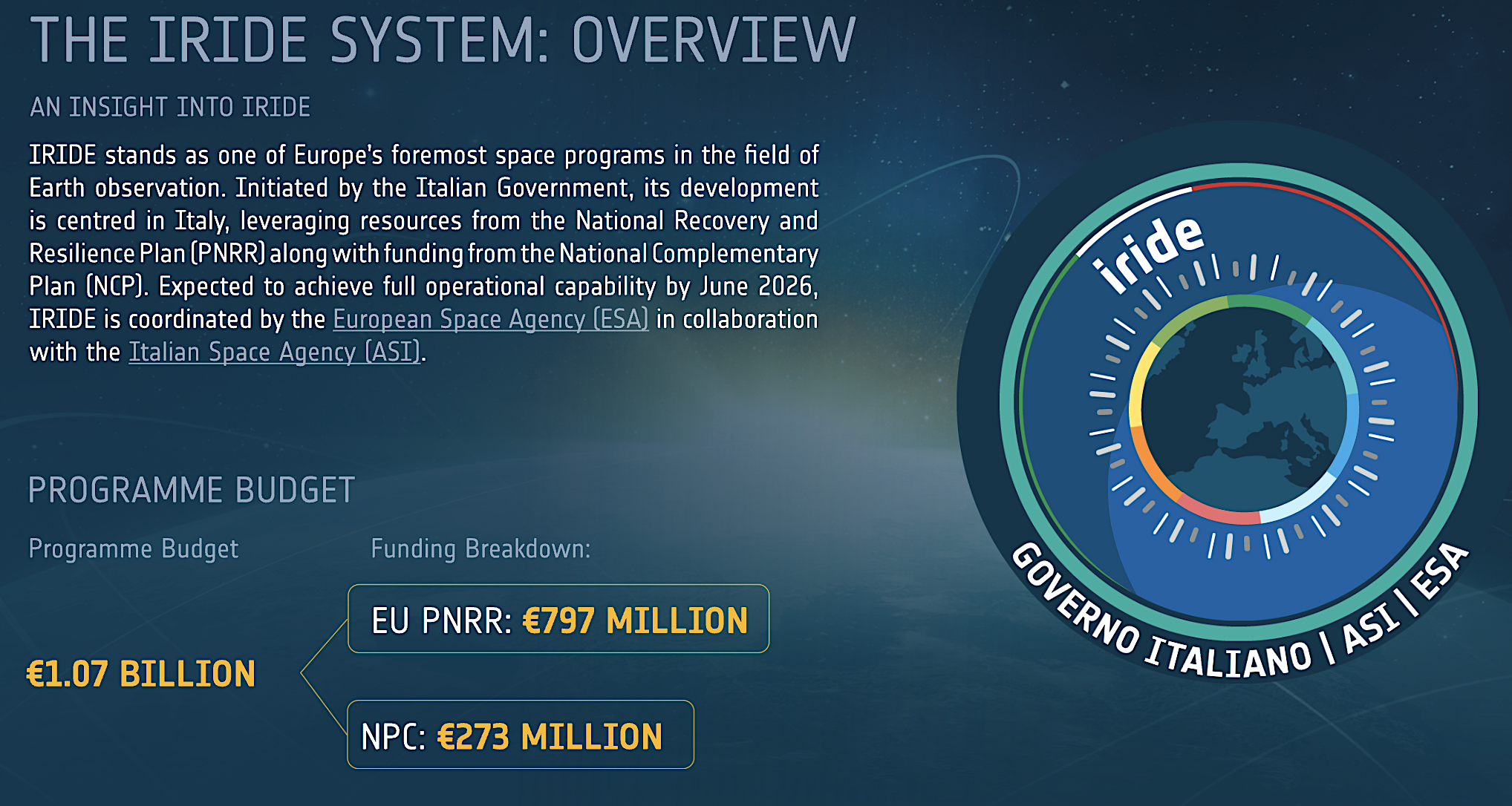
In a showcase example of Italy’s raising its profile in Europe’s space sector, the Italian government, using national funds and funding from the European Union’s Recovery and Resilience Plan (PNRR in Italian], is investing some 1.1 billion euros into a six-constellation network of multi-sensor Earth observation satellites, called Iride.
ESA has a technical management role in Iride, but Iride is not an ESA product.
Valente said the program development is meeting the EU-imposed deadlines of having two of the constellations operational by mid-2026.
The Hawk multispectral constellation, with Italy’s Argotec as prime contractor, launched its pathfinder satellite in January and seven fully operational satellites in June.
OHB Italy is building the Eagle-2 high-resolution multispectral constellation. Valente said a first batch of Eagle-2 spacecraft would be launched late this year, with the second batch in early 2026.
“With this we will have fulfilled the obligations a the EU level,” Valente said. He said the radar satellite constellation should be launched before the end of 20o26, followed by the remaining Iride satellites.
“Iride will double Italy’s Earth observation assets, with 65 new satellites. The six constellations will give us a very short revisit time — every 10-15 minutes, a kind of on-line monitoring.”