
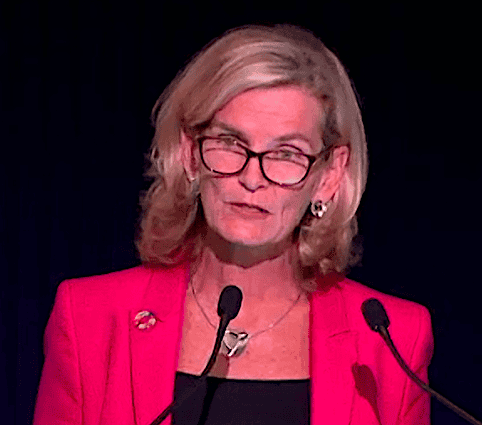
Doreen Bogdan-Martin. Credit: ITU video
LA PLATA, Maryland — It was not long after her election in 2023 as Secretary-General of the 194-nation International Telecommunication Union (ITU) that Doreen Bogdan-Martin began speaking out on the issue of orbital debris, the increased crowding of low Earth orbit and other topics related to space sustainability.
The question then was: Would this really be a priority of her term given that many large ITU members want the ITU to stick to its knitting and focus on radio spectrum?
More than two years later, the answer has to be a qualified yes. Knowing that while the ITU handles spectrum licensing, it’s the space agencies that know more about sustainability, she solicited advice from the European Space Agency (ESA) and NASA, among others. She attended industry-centered space conferences that were not accustomed to seeing ITU officials, and certainly not the secretary-general.
In 2024 the ITU organized its first Space Sustainability Forum. Using its UN imprimatur, ITU was able to attract Chinese, Russian and other nations that are often absent on the space conference circuit but indispensable to any global solution.
The forum held its second event Oct. 7-8 in Geneva and it was time for an initial assessment. Bogdan-Martin summarized the ITU’s space sustainability actions that were undertaken in response to requests made a year ago from industry and government.
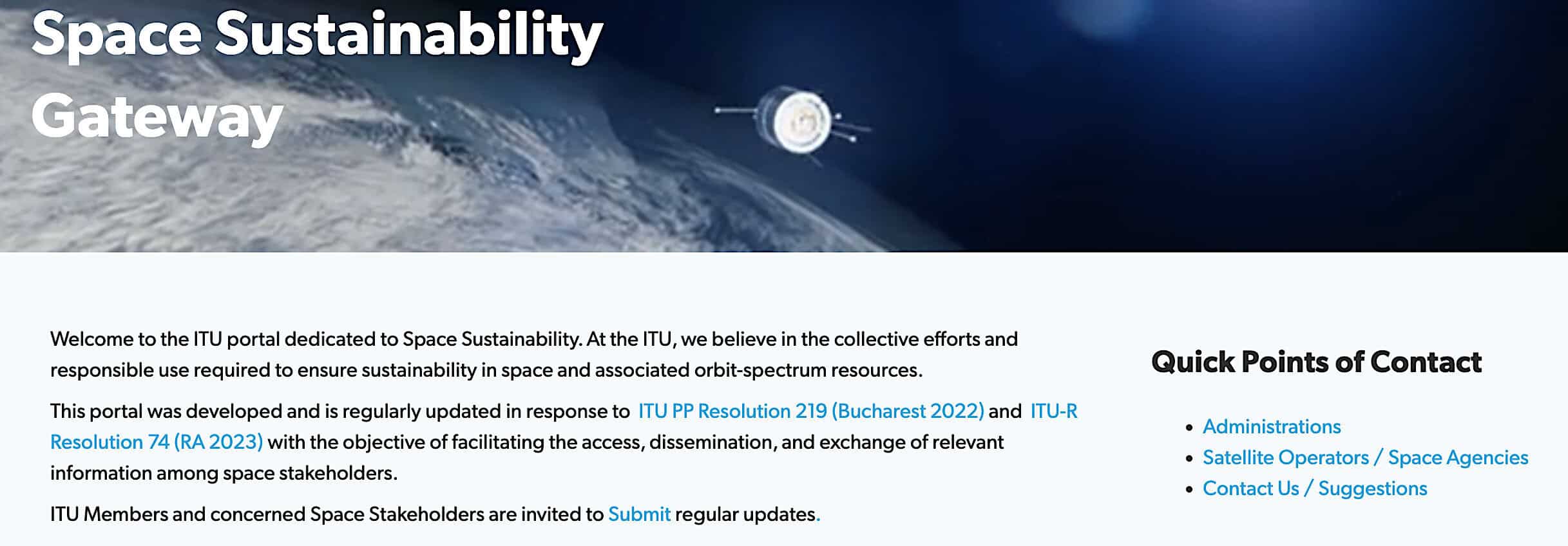
“You asked that it be easier to find people for information-sharing and practical tools for space sustainability,” Bogdan-Martin said. “We have delivered the ITU Space Sustainability Gateway, which is up and running on our website.
“We have also set up direct lines to the BR [Radiocommunications Bureau] Space Services Department, and resources relative to post-mission deorbit and post-mission disposal. We will continue to build on this repository to make it a wealth of information.
The ITU also started a series of on-line webinars, called Space Connect, to discuss LEO orbit, ground networks, licensing and the humanitarian impact of space technology. She said future webinars would touch on cislunar communications and space system resilience.
The United Nations in September 2024 adopted the UN Pact for the Future, which Bogdan-Martin said “calls for urgent and practical cooperation on space traffic coordination, debris and resource governance, and invites industry and other stakeholders to help us build solutions.”
The pact includes a Global Digital Compact, which identifies satellites as critical digital infrastructure, promotes equitable access to orbit and promotes public-service applications such as school connectivity.
While laudable, these actions are the easy part, like asking for voluntary contributions to the office Christmas fund.
It will be harder to enact regulations that will oblige all operators to do what some — SpaceX Starlink, Amazon Kuiper, Eutelsat OneWeb — are doing now as a matter of self-interest.
“If last year was about formulating practical tools, transparency and information-sharing, this year is all about action,” Bogdan-Martin said.
“For the first time we have piloted hands-on workshops, including a space sustainability primer, for our own ITU staff, and a capacity-building session for delegates, focused on regulatory issues.”
ITU governments meet every four years at the World Radiocommunication Conference (WRC). The next one is scheduled for late 2027 and its agenda is 80% space-related, a reflection of how space technology has spread well beyond the core group of space-faring nations.
Many of the topics related to ITU’s traditional area of managing the allocation of radio frequencies and mediating disputes rising from frequency interference.
But the rise of LEO constellations has forced the ITU to look at issues not directly related to spectrum. Again, how far its delegations will go in accepting what some might call “mission creep” has yet to be determined.
“Coordinated filings and interference mitigation matters more with each passing month,” Bogdan-Martin said. “We’re going to be candid about the challenges of space sustainability. Constellations at scale require coordination at scale.
“From disciplined [ITU license] submissions and early bilateral work [on frequency coordination], to credible follow-through, space and spectrum situational awareness is mission insurance. But it can only be as strong as its data, common formats, clear responsibility and a culture of sharing.
“Inside ITU, demand continues to surge. Requests for spectrum and orbit resources have multiplied by 5.5x over the past decade. We need to work together to keep the process fair and to keep the orbital and spectrum environment usable for all.”