
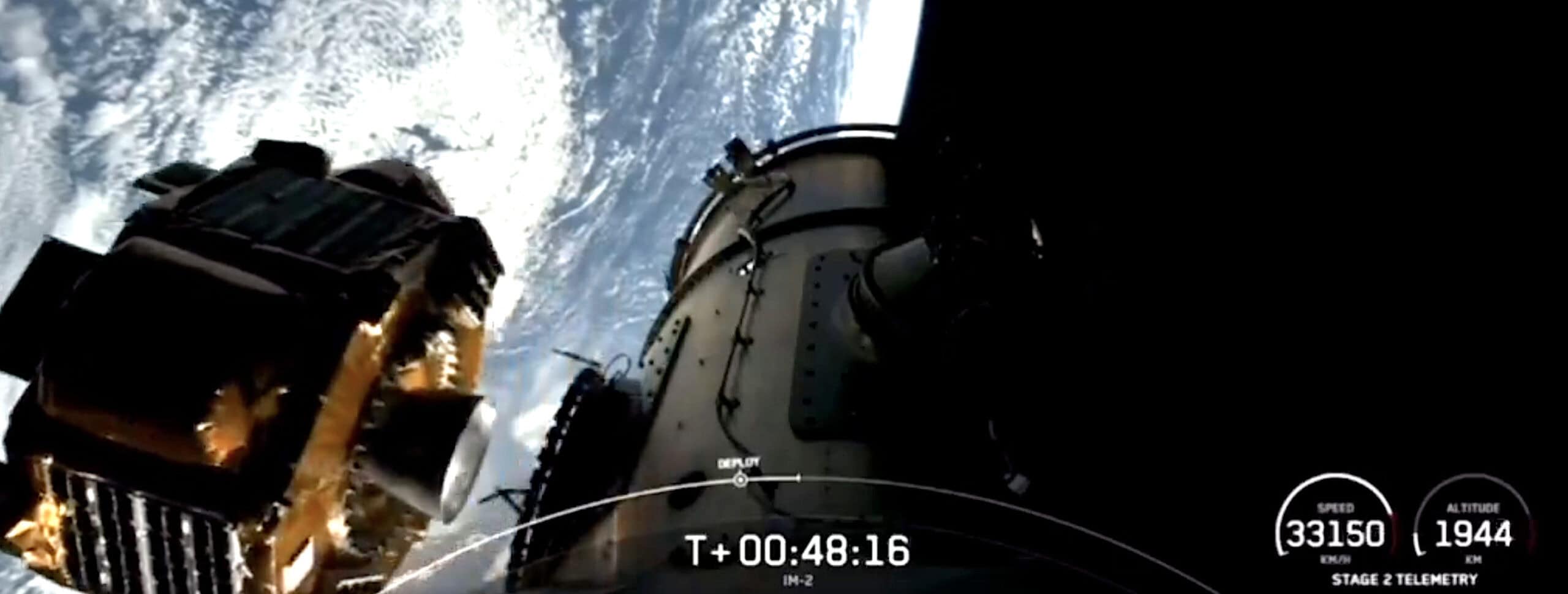
Image above shows EPIC Aerospace’s Chimera-GEO-1 orbital transfer vehicle separating from a SpaceX Falcon 9 rocket Feb. 26. The vehicle was intended to perform a trajectory correction maneuver from lunar orbit to carry the Sigma-Sat-1 satellite to geostationary orbit. A communications failure resulted in its heading into deep space. Credit: SpaceX
LA PLATA, Maryland — International regulators rejected Britain’s appeal to extend a deadline to register two Ku- and Ka-band GEO orbital positions after the in-orbit failure of an orbital transfer vehicle (OTV) carrying a satellite to register the slots, saying the UK should have known that using unproven technology was risky.
As a result, the failure of the OTV to deliver the satellite into GEO orbit cannot be called “force majeure,” the International Telecommunication Union (ITU) Radio Regulations Board (RRB) said Nov. 19.
The decision to use an unproven OTV “came with a higher risk that it would not complete its mission, [which] was known an accepted by the satellite operator,” the RRB said. “That could not be considered unforeseeable, inevitable or beyond the operator’s control.”
The decision means that GapSat Development Group Ltd.’s plans to “bring into use” orbital slots at 45 degrees was and 167 degrees west and to prepare the the launch of two full-size commercial satellites for customer Global Secure Communications Inc. (GSC) have been derailed.
The original regulatory filing for the two satellites, under the names GANTS-2 and GANTS-3, was made in 2018 by QBX Ltd., based in the Isle of Man. The deadline to being using the associated frequencies from both slots was July 26, 2025. GapSat purchased QBX in 2023.
The Sigma-Sat-1 satellite to be carried to its final destination on an OTV built by Reliant and Montero USA Inc., known as EPIC, based in Argentina. The satellite was built by Reliant Inc., formerly named QSTC Inc., of Canada.
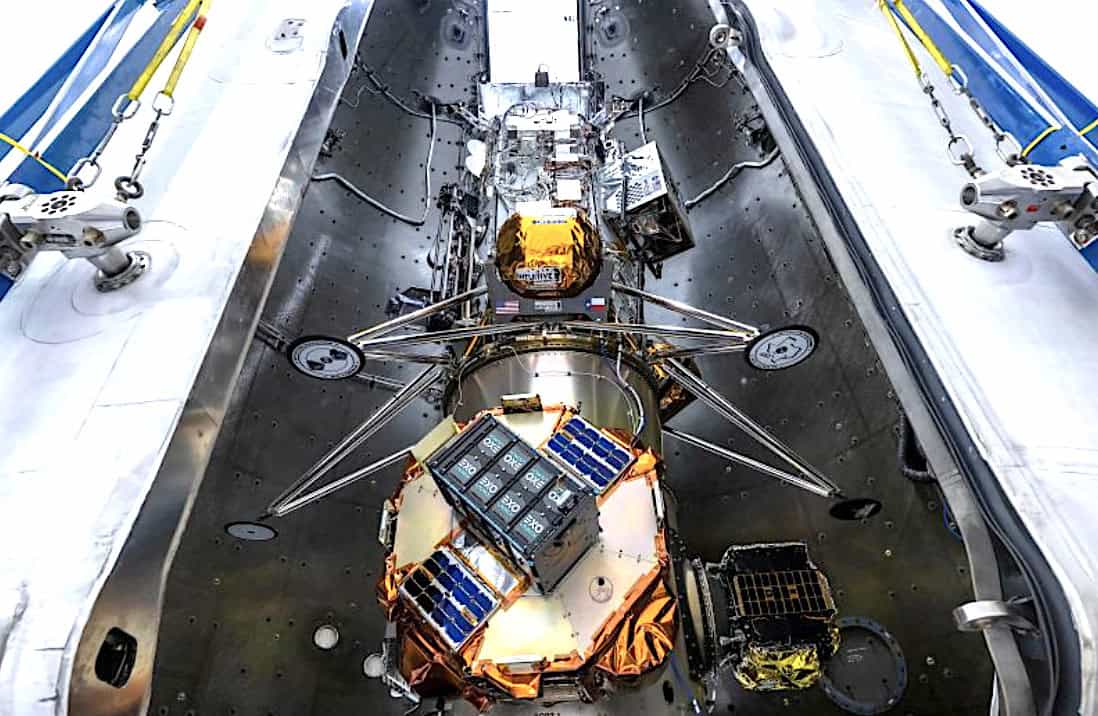
EPIC’s Chimera-GEO-1 OTV, with solar arrays, being readied for launch. Credit: SpaceX
EPIC’s Chimera-GEO-1 OTV was launched Feb. 26 aboard a SpaceX Falcon 9 IM-2 ride-share mission whose main payload was the Athena lunar lander from Intuitive Machines, built as part of NASA’s Commercial Lunar Payload Services (CLIPS) program.
The lander made it to the lunar surface but its mission ended when it was unable to replenish its power.
EPIC’s Chimera-GEO-1 was supposed to transfer from its lunar injection orbit and perform a lunar swing-by to return to GEO to deposit Sigma-Sat-1. The satellite would then migrate to the 45 degrees west slot and broadcast from there for 90 days before moving to 167 degrees west and doing the same thing. This would constitute “bringing into use” both satellite networks under ITU rules.
Instead, Chimera-GEO-1 suffered a communications failure and was unable to perform the planned trajectory correction maneuver from lunar orbit. Instead, it headed into deep space.
Communications failure leaves satellite in a deep space orbit 3.5 million km from Earth
Ofcom, Britain’s telecommunications regulator, told the ITU that as of July EPIC’s Chimera-GEO-1 and Sigma-Sat-1 was in “a highly eccentric Earth orbit some 3.5 million km from Earth.”
GapSat had been searching for alternatives and in July was in negotiations with Global Secure Communications Inc. (GSC), whose ownership and financial wherewithal are unknown, for two separate satellites to occupy the slots.
GSC selected startup GEO satellite manufacturer AscendArc of California as prime contractor, with a schedule calling for one satellite to arrive at 45 degrees west by the end of 2027, with the second to be delivered to 167 degrees west by June 2028.
Ofcom asked the RRB to extend the frequency registration deadline to Dec. 21, 2027 and June 30, 2028.
On Oct. 16, GSC Principal David Bruner said the company was completing negotiations with GapSat to purchase and operate satellites under the GANTS-2 and GANTS-3 filings, and that definitive agreement would be completed “as soon as practicable.”
AscendArc Chief Executive Chris McLain sent GapSat an email on Oct. 17 confirming that negotiations with GSC were under way for a two-satellite order with launches in 2027/2028. He also warned that “launch opportunities are in extremely high demand over the next 24 months” and that the satellites may need to be launched separately. The email was attached to Ofcom’s appeal to the RRB.
The RRB assessed the entire GANT-2/GANTS-3 history in its decision.
“The satellite operator had not initiated discussions for the development of long-term satellites until the first quarters of 2025, three years after a contract had been signed to build and launch a gap-filler satellite,” the RRB said. “There was no description of the satellite project itself, suggesting the intent was speculative.”