
Overstuffed? Maybe. Credit: ITU
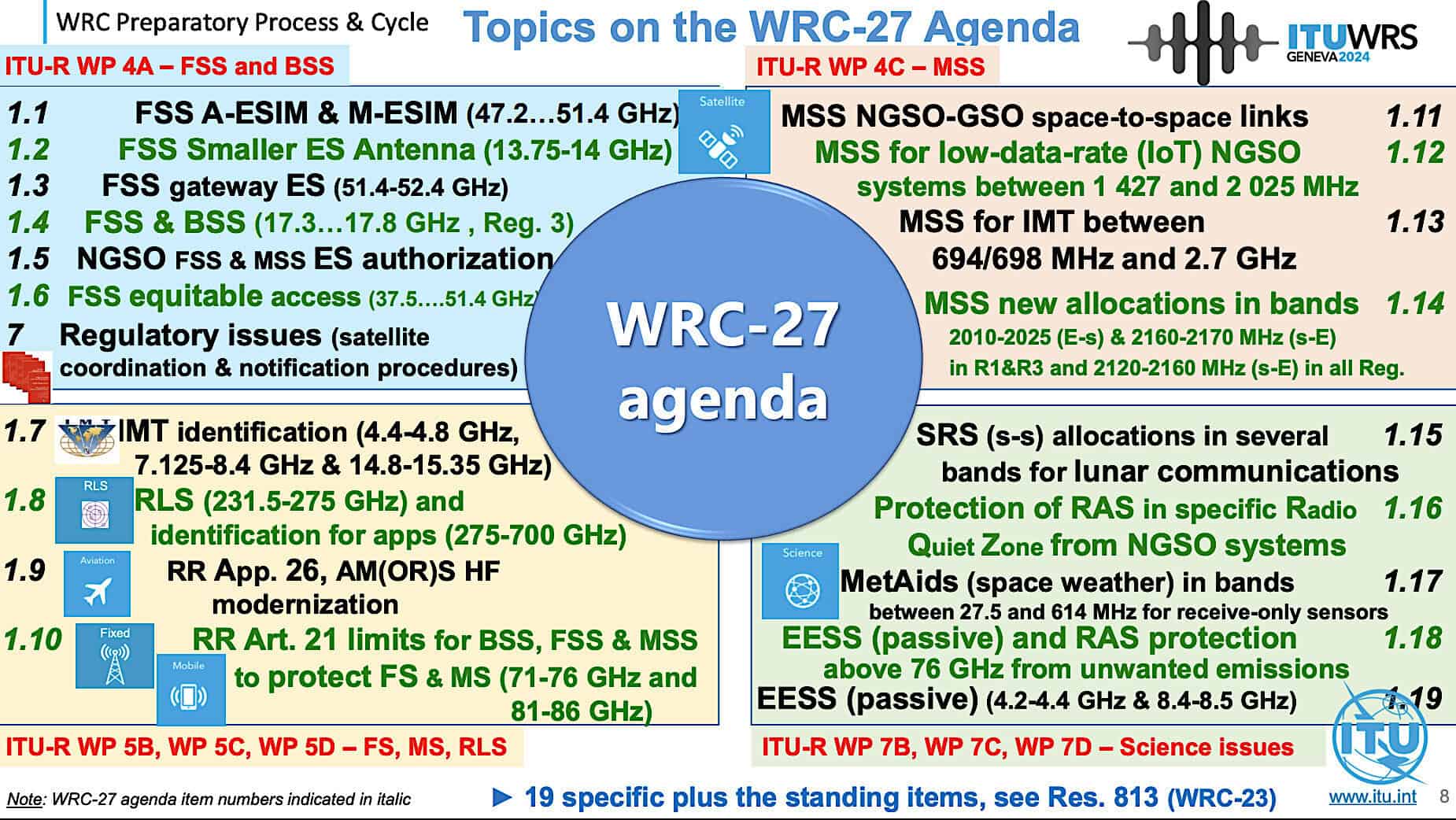
LA PLATA, Maryland — International Telecommunication Union (ITU) governments may have overloaded the space agenda for the next World Radiocommunication Conference (WRC-27), which could further delay radio-spectrum allocation , space-conduct rules and spectrum harmonization, ITU experts said.
The risk is that individual governments will allow their companies to develop without regard for international coordination.
WRC-27 is the 194-nation ITU’s quadrennial meeting to decided spectrum and related issues. Scheduled for Oct. 18- Nov. 11 in Shanghai, an estimated 80% of the conference is devoted to space-related issues.
Debris mitigation and removal, fair access to spectrum and orbital slots, affirming national sovereignty on access by satellite-linked devices, aggregate interference created by a half-dozen large constellations in low Earth orbit, keeping LEO constellations from interfering with GEO satellite spectrum — the meeting is freighted with complicated issues and so far has not been able to prioritize them.
Even with two years to go before the conference, some of those working on it fear that it will be unable to complete the work.

Revathi Manneppalli. Credit: ITU
Revathi Manneppalli, advisor in the Wireless Planning and Coordination Wing of India’s Ministry of Communications, said the “To Do” lists of WRC conferences have been growing for years and may now be a the breaking point.
“The WRC does great work during a period of four weeks,” Manneppalli said Oct. 8 at the ITU Space Sustainability Forum, held in Geneva. “But the Conference Preparatory Meeting (CPM) for 2015 was 800 pages. In 2019, it was around 900 pages and in 2023 about 1,100 pages.
“Is four weeks enough time? If you don’t address them in time, they will go beyond the ITU. The problems will not wait for a solution. There is technology innovation, and people want it.”
Manneppalli suggested that ITU governments meet, just to decide space issues, every two years or face the prospect of uncontrolled, and inefficient, spectrum use. But it’s too late for that this time around.
In addition to its 194 governments, the ITU counts about 1,000 “sector” members, mainly private-sector companies planning investments based on WRC decisions.
Christopher Murphy. Credit: ITU
Christopher Murphy, associated general counsel of fixed and mobile satellite hardware and service provider Viasat Inc., said the ITU should set clear priorities for the WRC-27 preparatory work so that at least the highest-impact items are settled.
Murphy said Viasat is particularly concerned with possible changes to regulations on frequency use by non-GEO networks. If the preparatory studies are not completed in time, companies will hesitate to commit to constellations.
“From our perspective, it is especially critical that NGSO aggregate EPFD [a measure assessing LEO communications constellations’ power output and setting limits to avoid interference with geostationary satellites] be resolved,” Murphy said. “That’s an equitable-sharing, space-sustainability issue.
“Unless it’s done at the conference, I don’t see how are going to have the solutions we need to adopt changes to the Radio Regulations,” Murphy said.
Viasat’s current fleet is mainly GEO satellites and wants to protect these satellites’ spectrum use. Viasat is also planning a LEO constellation for a global direct-to-device service with Space42 of the United Arab Emirates.

Elina Morozova. Credit: ITU video
Elina Morozova, executive director of the 24-nation Intersputnik organization, is assembling for WRC-27 a handbook on best practices for the sustainable use of radio frequency. She said she’s hopeful of getting it completed in time, but that the work is slowed by the diverse backgrounds of ITU members.
“Some governments are represented by telecom agencies, others by space agencies, and some by neither,” Morozova said. “Space sustainability as an issue has come from policymakers, lawyers and diplomats, who argue about concepts that cannot be measured.
“ITU community members and engineers would like a technical approach. The question is whether introducing sustainability language into the ITU requires a kind of shift. Do we need to add metrics to the provisions?”
On the WRC-27 agenda: Preventing constellations from operating where they are not licensed
Manneppalli said India is especially interested in WRC-27’s Agenda Item 1.5, which would attempt to eliminate unauthorized use of fixed and mobile satellite terminals in areas where the national government has not licensed them.
The issue was raised at WRC-23, which called for studies on what practicable regulations could be introduced to this end.
India in 2021 confronted illegal Starlink operations in its territory well before the service was licensed. Starlink’s inter-satellite links enable it to operate in territories far from gateway Earth stations and thus avoid having its signals monitored and filtered by government authorities.
Before backing down in the face of Indian government pressure, SpaceX’s Elon Musk had responded to India concerns by saying in a Tweet: “They can shake their fist at the sky.”
“All countries should have control over the devices being operated in their territory so that people will come together in a collaborative way,” Manneppalli said. “I am hopeful we will come up with a regulation at WRC-27.
Despite the volume, diversity and complexity of the issues stuffing the WRC-27 agenda, Murphy said there remains time to resolve the biggest issues.
“All is not lost,” Murphy said. “The spectrum and orbital resources and NGSO coexistence issues can still be resolved in a favorable way for all. This will allow the satellite industry, regulators and everyone concerned, particularly the users, to get the services they need and want.”