

Kevin Choi. Credit: WSBW video
PARIS — Regional satellite fleet operators KT Sat, Hispasat and Thaicom want to be called space technology providers now as they move away from their traditional businesses to capture new markets in geospatial imaging, the demand for sovereign networks in their home countries and other applications.
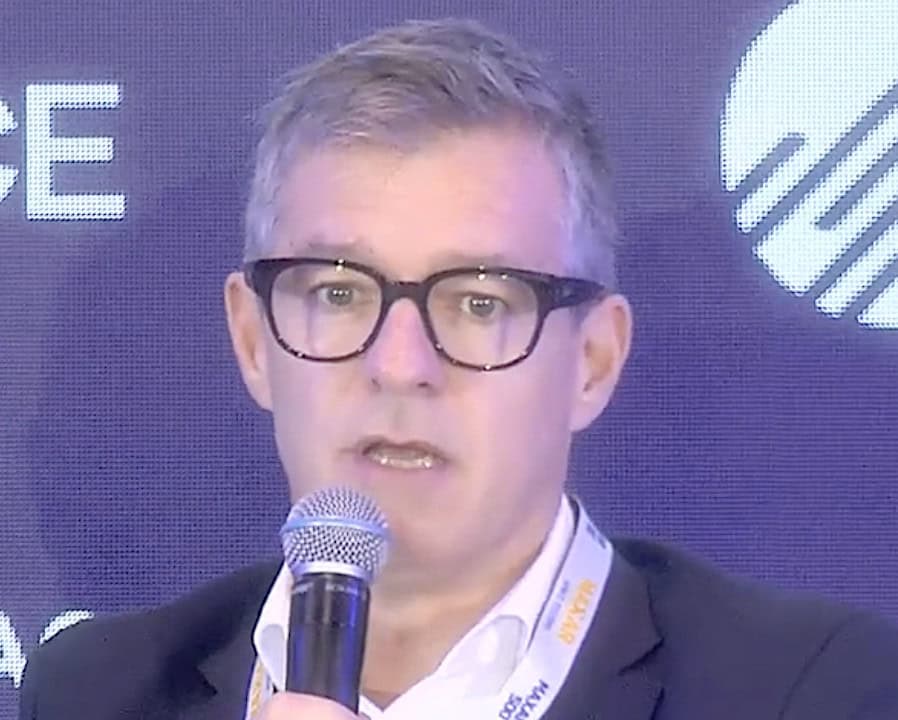
“Our focus is defense systems, mobility and integrating into the future 6G telecom infrastructure,” said Kevin Choi, chief technology officer of Korea’s KT Sat, which has modified its name so that the SAT does not mean satellite, but Space Advanced Technology. “We are to provide all the missing bits and pieces that terrestrial cannot provide.”
In a Sept. 16 presentation here during World Space Business Week (WSBW), organized by Novaspace, Choi said KT Sat believes it can withstand the pressure from global LEO constellations by providing multi-orbit LEO/GEO services using in partnership with the LEO operators, even as KT Sat remains the customer-facing entity.
“We will be able to collaborate with the mega-constellations to define additional value-added services, and we can assure that our government and military customers will continue to rely on our presence in installation and operations,” Choi said. “Our customers can build their businesses relying on our services.”
Korea is less susceptible to the arrival of mega-constellations because terrestrial broadband is already just about everywhere. “Starlink, [Amazon’s] Kuiper and Telesat [Lightspeed} combined will be less than 1% of the total telecom traffic,” Choi said.
KT Sat is also taking advantage of new options for GEO-orbit satellites, recently purchasing a software-defined broadband satellite from Ascend Arc, a startup satellite builder. Choi said one reason for the selection of a company that has never built a GEO-orbit satellite before is delivery time. The spacecraft is scheduled for launch in 2027.
Ignacio Sanchis. Credit: WSBW video
Hispasat of Spain has long had a diversified business base through its majority ownership of Hisdesat, which provides military satellites to the Spanish government. It would have been problematic for the government to select a non-European provider of military capacity.
“We will continue bringing new satellite infrastructure to the market that is competitive, regardless of the global mega-constellations,” Hispasat Chief Operating Officer Ignacio Sanchis said. “We expect to bring new GEO satellites into service as well, with partners or not.”
Sanchis conceded that the global LEO constellations have undeniable advantages over GEO, starting with latency. Nonetheless, the company current expects to continue using GEO satellites.
“But we will be more focused, for specific customers and specific partners, probably for the need for sovereign capacity, and not only for governments. But we will never go back to purchasing general-purpose satellites.”
Hispasat has found, through the digital-inclusion program in Spain, that many citizens cannot afford the monthly subscription prices charged by satellite broadband providers, despite the decline in some satellite broadband charges.
200 Mbps, $41 per month including tax: Can Starlink or Kuiper beat that?
Hispasat was selected by the government to offer retail service providers what Sanchis called “a regulated product at a regulated price.”
“In Spain, we have a 200 MB product sold to end customers for 35 euros ($41), including taxes. But this includes government funding. In Latin America, it is the same thing. There needs to be government cooperation to be able to reach people in a manner that is affordable for them.”

Patompob (Nile) Suwansiri. Credit: WSBW video
Thailand’s Thaicom, whose diversification into geospatial intelligence already accounts for nearly 5% of its annual revenue, expects this to reach 20% in the coming years.
Thaicom is active in selling broadband services in Thailand and in India through government digital inclusion plans. “It is now considered critical digital infrastructure for every country,” Thaicom Chief Executive Patompob (Nile) Suwansiri said. “This is an ongoing cash flow and our bread and butter at the moment.”
Suwansiri has been among the most open satellite executives in acknowledging the benefits of regulatory limits on foreign ownership of telecom assets. This has enabled Thaicom to negotiate terms of mega-constellations with a much stronger hand than it would have otherwise.
“With that [foreign-ownership] barrier we can create partnerships,” Suwansiri said. “You can get the best of both worlds: local partners plus a technology solution from the global players. There are synergies to be had there.”
He saidt the Thai national market is already full of affordable broadband offers from terrestrial providers, leaving not much left for satellite broadband, unless it can offer prices well below what SpaceX Starlink offers not.
In Thailand, a good 5G link, unlimited capacity, for $15 per month
“If you look at the total potential market for LEO, we estimate it at less than 1%, even half a percent,” Suwansiri said. “The price of a very good 5G link, with unlimited capacity, averages $15. If the LEOs come down to $15 then maybe it’s another story, but at the current price I don’t see how they can penetrate in a meaningful way.”
Thaicom has seen a new focus on space by the Thai military, especially since the conflict with Cambodia. “Talking to the heads of the armed forces in Thailand, I have seen a shift in their mindset,” Suwansiri said. “They want to know how they can upgrade their space-based technology, with drones and anti-drone technology and electronic warfare.
“We see this as an opportunity to upgrade the technology for the armed forces, focusing on what we can do in geospatial intelligence, border control and drones.”