
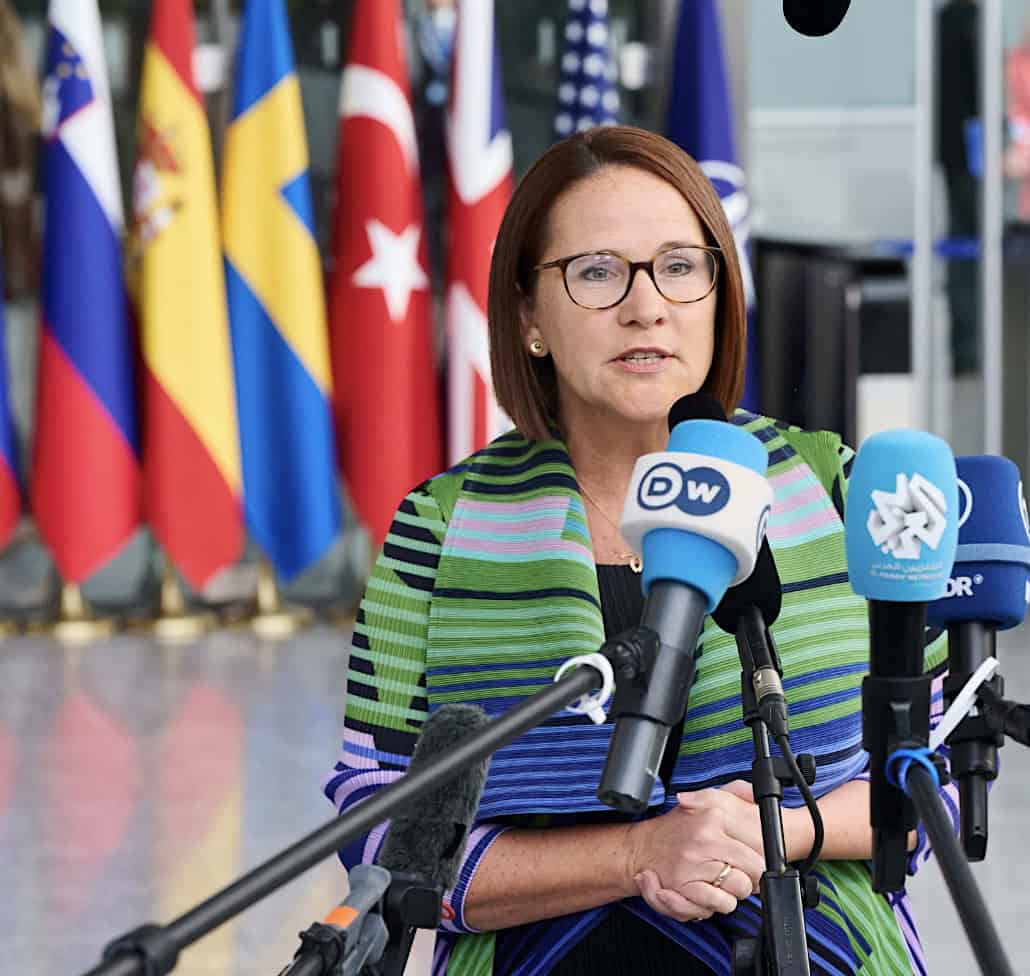
Luxembourg Defense Minister Yuriko Backes. Credit: NATO
LA PLATA, Maryland —The government of Luxembourg asked its parliament to commit 301 million euros ($350 million) to the GovSat-2 satellite project over 12 years as part of its 50/50 joint venture with SES that for a decade has managed the GovSat-1 satellite.
In addition to the committed amount, the government is proposing a “strategic reserve” of 200 million euros that could be used between 2025 and 2040 if geopolitical or other unforeseen operational needs arise.
The government submitted its proposed GovSat-2 financial plan to the parliament on July 30. With the proposal came a detailed summary of why Luxembourg, which has proved imaginative in combining commercial satellite procurements with government military needs. is proceeding this way.

GovSat-2. Credit: SES
SES has contracted the development of GovSat-2 with prime contractor Thales Alenia Space of France and Italy. The satellite, to be launched in 2028, will be fitted with broadband SHF capacity using military X- and Ka-band, as is GovSat-1. The new payload is a large UHF-band capacity for tactical communications.
In the documentation presented to parliament, the government said it and SES are each investing 101 million euros into the LuxGovSat SA joint venture as part of a capital raise — 41 million euros in 2026 and 60 million in 2027.
An additional 105 million euros will be spent pre-financing GovSat-2’s cost, with 80 million euros paid in 2026 and 25 million euros in 2027.
Finally, the government agreed to purchase 75 million euros of GovSat-2 capacity over 12 years, or 6.25 million per year, with the possibility of an increase to be drawn from the strategic fund.
If GovSat-2 is delayed, an additional purchase of GovSat-1 capacity of 10 million euros in 2028 and 10 million in 2029 would be authorized.
The Luxembourg-SES LuxGovSat SA venture, operational since 2018, has put some its capacity to use for NATO nations and other allies as part of a GovSatCom pooling and sharing arrangement. Five other nations — France, Italy, Spain, the United States and Britain — are also making their national capacity available in the pooling and sharing arrangement.
In 2023, the government entered into an arrangement with SES and with the US military under which it would finance, for the use of other nations, capacity from the SES O3b mPower medium-Earth-orbit constellation. For Luxembourg, it’s more convenient to fulfill part of its NATO obligations with satellite capacity than to invest in military hardware.
Luxembourg Defense Minister Yuriko Backes the GovSat-2 decision “is testimony to the success of the GovSat public-private partnership, which provides to Luxembourg, to our allies and partners secure military satellite communications services to service a wide variety of critical applications for the armed forces and civil security.”

Patrick Biewer, CEO, GovSat. Credit: GovSat 2023 video
GovSat Chief Executive Patrick Biewer said the program demonstrates the strong demand for military satcom whose new frequencies will help NATO “meet the challenges of future connectivity.”
For GovSat-2, the government said it “foresees the inclusion of Luxembourg industry in the construction of the satellite system and ground segment.”
GovSat-2’s UHF-band capacity of 10-12 channels will complement the strategic and tactical satcom offered by GovSat-1. Its SHF-band frequencies will cover military-X and military-Ka for high-volume capacity to fixed stations. It will have double the SHF capacity of GovSat-1.
GovSat-1 has enough service life left to maintain operations at least until 2038, meaning the satellites will be used in tandem for perhaps 10 years. The government said one option would be to co-locate GovSat-2 at the 21.5 degrees east but that it’s “very likely” that GovSat-2 will be placed there and GovSat-1 moved a nearly slot.