

A Starlink antenna being prepared for a maritime customer. Credit: KVH
LA PLATA, Maryland — Maritime connectivity provider KVH Industries Inc., which has overhauled its business to accommodate the market pull of Starlink and the challenges of geostationary-orbit-satellite broadband services, may have found a way to balance both.
Revenues are still down from where they were a year ago as customers move of GEO-based capacity in favor of LEO. But KVH in September 2023 KVH began and authorized Starlink hardware and airtime reseller. In June 2024 it paid Starlink $17 million for a bulk capacity purchase at favorable rates, giving KVH flexibility to tailor airtime plans using Starlink Global Priority serve.
At the same time it began a restructuring that will shut down its manufacturing plant and result in a 20% reduction in staff.
In January of this year, it entered a relationship with Eutelsat OneWeb to offer OneWeb to KVH’s maritime customers, bundling the OneWeb capacity into KVH’s AgilePlans package to allow customers to rent the OneWeb terminals instead of purchasing them.
KVH also began expanding its reach to fixed land applications including schools and other corporate and government sites in Latin America.
In Q2, LEO revenue surpassed the decline in VSAT’
In an Aug. 7 call on KVH’s performance for the first six months of 2025, Chief Executive Brent Bruun told investors: So far, so good.
“For the first time, the increase in our LEO revenue more than offset the decline in revenue from our legacy VSAT terminals,” Bruun said. “Starlink demand remained strong across the commercial maritime and leisure marine markets in Q2. And we’re rapidly expanding our Starlink land sales, especially in Latin America.
“We believe we have reached an inflection point in our transition from a GEO-based hardware and services company to a multi-orbit, LE0-focused service provider,” he said.

An Intellian Eutelsat OneWeb antenna for maritime use. Credit: KVH
In January, KVH began offering OneWeb service. Customers hesitating to adopt OneWeb because the network is not yet fully global are offered GEO-based connectivity while waiting for OneWeb to complete the installation of gateway Earth stations that will enable full-global reach.
It’s still early in KVH’s use of OneWeb, but Bruun said KVH’s CommBox Edge communications gateway integrates easily with OneWeb as well as with Starlink and with KVH’s long-standing VSAT and cellular services.
“The network is performing well,” Bruun said of OneWeb. “They don’t have global coverage, so opens door to hybrid” packages.
‘Customers want diversity’
Bruun said that from a value-for-money perspective, OneWeb offers the same quality of service as Starlink, at equivalent pricing.
“There is no rhyme or reason for why [customers] would choose one or the other,” he said. “It’s more that customers want diversity from Starlink.”
KVH currently uses GEO satellite capacity from 182 Ku-band transponders — 138 of them on high-throughput satellites with spot beams —on 31 satellites. Most are owned by SES — the former Intelsat fleet — and Japan’s Sky Perfect JSat. KVH directly contracts for five of these transponders.
KVH’s main business is with commercial maritime fleets. Leisure vessels make up just 15% of its customer base. Many of these owners will opt for purchasing Starlink or OneWeb directly, bypassing the bundled service that KVH offers.
Vessel count now over 8,000
KVH said its maritime airtime subscriber count grew 8% in the three months ending June 30 compared to the previous quarter, raising KVH’s vessel count to slightly more than 8,000. Starlink is the main reason for the growth, but “we also saw increasing demand for our newly launched OneWeb service,” the company said.
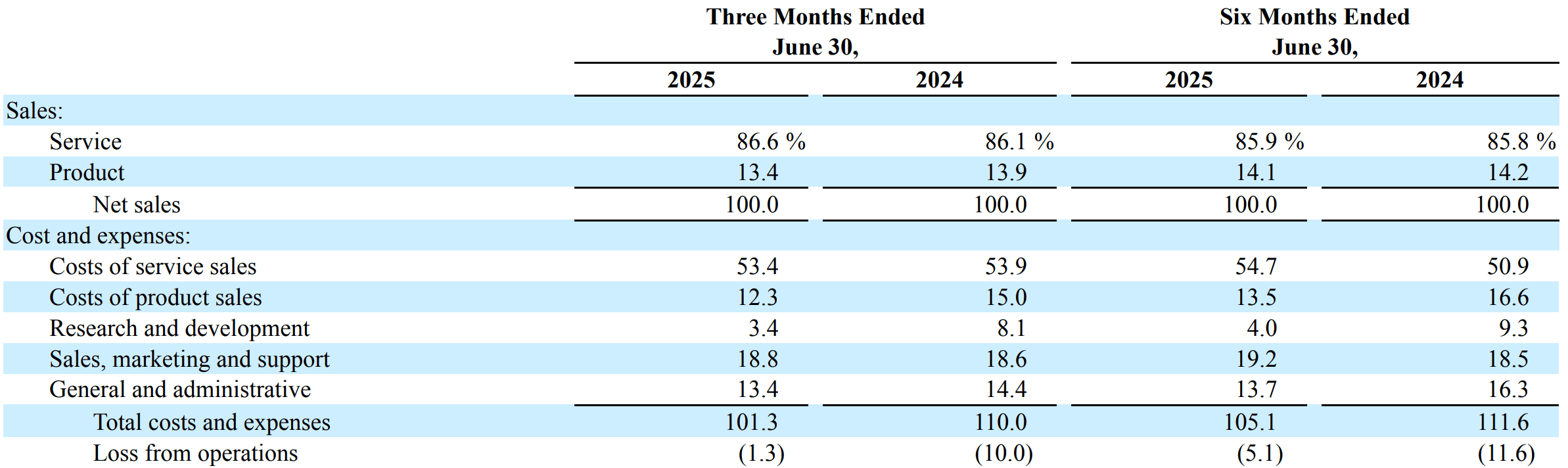
Credit: KVH August 2025 filing with the US Securities and Exchange Commission
KVH reported $52 million in revenue for the six months ending June 30, down 11% from the same period a year ago as the company absorbed the reduction in business from the US Coast Guard. But it reduced its operating loss in the six-month period to $2.6 million, compared to $6.7 million a year earlier.
Bruun said KVH was now confident it would sell all the Starlink capacity from its bulk purchase agreement and has begun negotiations on a renewal of the arrangement. The company said it is selling LEO capacity at higher margins than GEO capacity, which is helping overall profit as LEO increases and GEO decreases.

For Q2, LEO accounted for more than 30% of airtime services sales, compared to less than 10% for same period a year ago. This is both a function of increased LEO business and declining GEO revenue.
With most of its customers free to quit the service when they want without penalty, KVH will have to adapt more quickly to market shifts than service providers insisting on firm contract durations. For AgilePlans customers, the commitment is month to month. For now, the company sees its commercial maritime customers reducing, but not eliminating, their GEO capacity purchasES.
“While we are seeing overall reductions in the level of GEO services purchased, our commercial customers have historically preferred redundancy of communications to minimize potential disruptions and ensure that vessel-critical data is always available,” the company said in a filing with the US Securities and Exchange Commission.
“As such, we anticipate that a significant number of customers will continue to desire to maintain GEO connectivity, albeit at a reduced level, while LEO capacity is being increased.”