
Mike Greenley. Credit: World Space Business Week video
PARIS — Canada’s MDA Space early next year opens its large-volume satellite manufacturing plant to produce its Aurora software-defined digital satellites for the Telesat Lightspeed broadband constellation and the Globalstar/Apple direct to device (D2D) product.
Assuming the first satellites coming off the production line in 2026 work as intended, it will propel MDA to the front of the pack. The fact that it just lost a $1.3-billion contract with EchoStar for another D2D constellation just five weeks after the contract’s signing does not change that.
Any future broadband or D2D constellation operator that surfaces will know that it can make an order from an existing product line and receive product in short order. The plant is designed to produce two satellites per day.
In addition to this showcase feature, MDA also has four industrial sites in Britain, including the Satixfy teams that built the Aurora satellites’ digital chip. MDA now owns Satixfy.
Britain is the fourth-biggest contributor to the 23-nation European Space Agency (ESA) and the UK governments appetite for space spending will be tested in late November at ESA’s triennial ministerial conference, which will set the agency’s mid-term budget and program priorities.
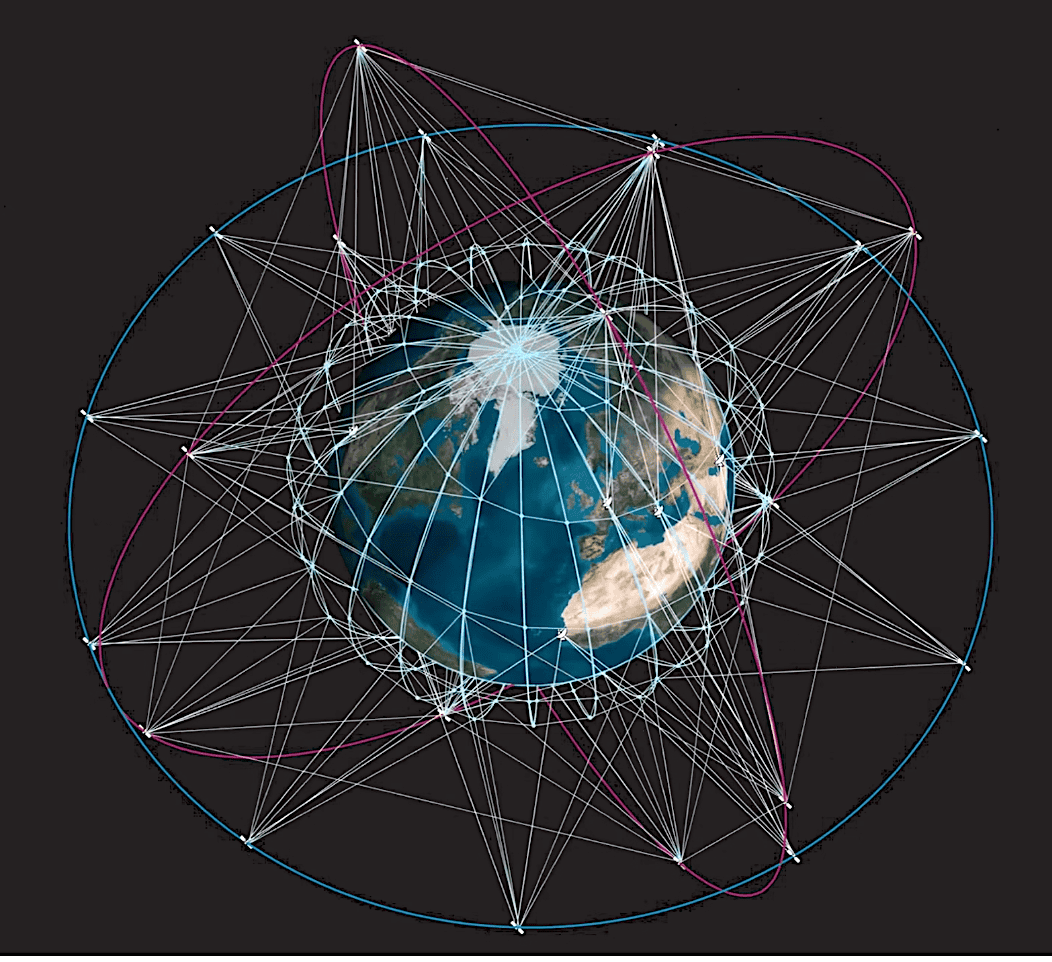
At that conference, ESA will be asking its governments for some 600 million euros ($710 million) in fresh support for technologies needed for the European Commission’s Iris2 multi-orbit secure communications constellation.
Iris2 is under a tight self-imposed deadline to produce an operational system by 2030 and budget ceiling imposed by the fact that the Commission will require funds that will be available only after it approves its next seven-year budgeting 2028.

Telesat Lightspeed. Credit:Telesat
That being the case, Iris2 may need help early on, and one logical place to look for it is the Telesat Lightspeed infrastructure, scheduled to be in service in late 2027.
The French government, a major Iris2 backer, is publicly looking for Iris2 support beyond the European Union. Canada is already a contributing state to ESA.
A cooperation agreement between Iris2 and Lightspeed, in which the Canadian government is a major investor, would seem the make sense.
Telesat Chief Executive Dan Goldberg said here Sept. 15 that he would support a coordination between Iris2 and Lightspeed, if only to assure that the two constellations can be interoperable.
In a Sept. 17 interview here during World Satellite Business Week (WSBW), organized by Novaspace, MDA Chief Executive Mike Greenley gave an update on the new satellite factory, the status of an earlier Globalstar order of 17 satellites, and whether MDA’s position in the UK might expand in Europe.
Where are you and your subcontractor, Rocket Lab, on the 17-satellite contract for Globalstar replacement satellites, signed in 2022?
I am delivering satellites this fall into their schedule. We are working hard as a team to get that done. Throughout 2025 there have been some delays here and there but we are finishing satellites now.
So the first batch should be delivered this year and the final batch early in 2026?
Yes, that’s a fact.
The Telesat Lightspeed broadband and Globalstar/Apple D2D constellations are counting on your Aurora design working immediately, on first launches in 2026, coming out of a new factory. How much of a risk factor is that?
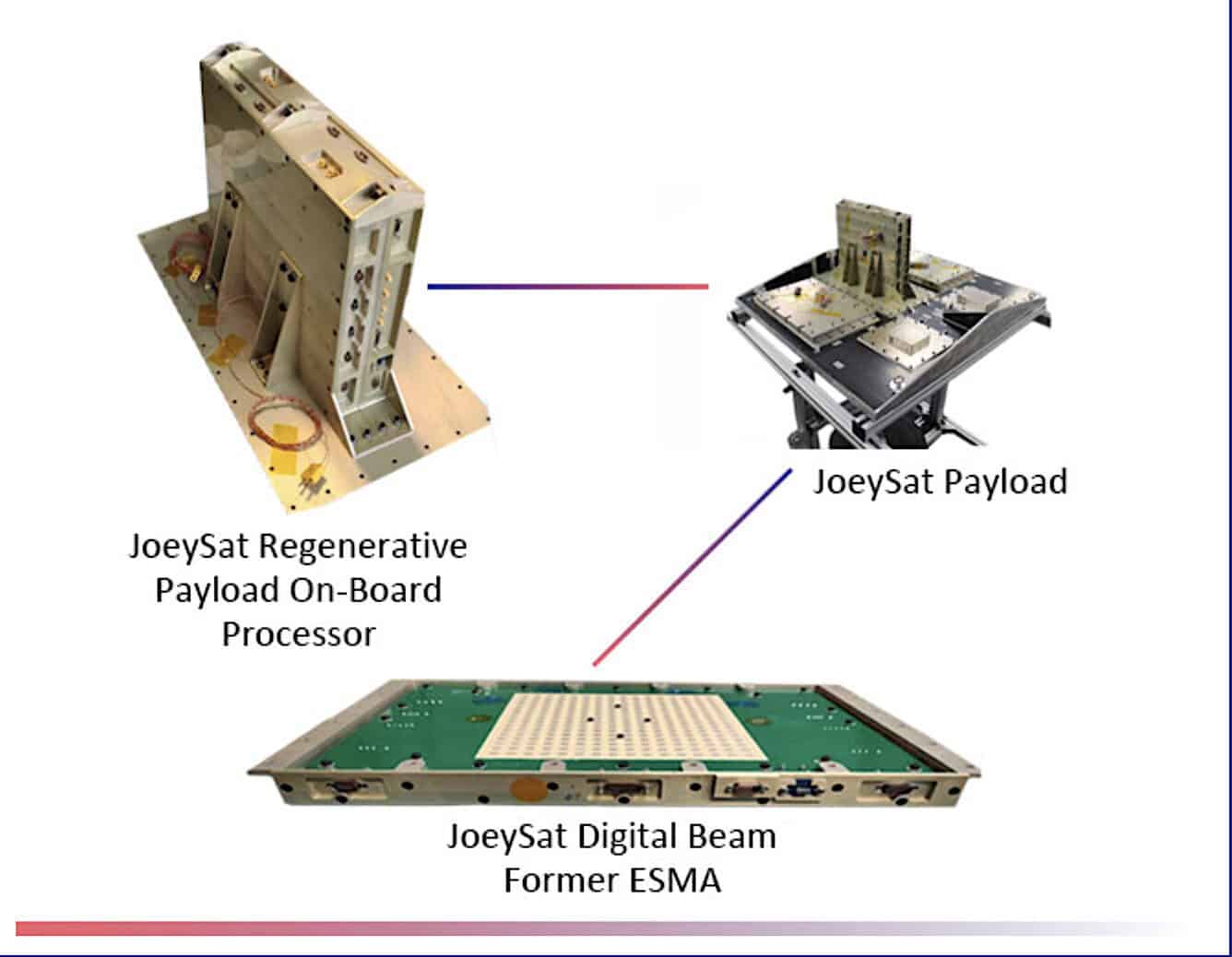
There is a satellite called JoeySat [built with UK Space Agency and OneWeb support], which is our digital technology chip-proving satellites. It has done testing at 600 km and then was moved up for more testing at 1,200 km. That’s an important milestone.
Credit: Satixfy
That tested the operations of the digital chip. On the ground, in the laboratory, we have created a demonstration facility so that customers could come in and see dynamic beam-forming. That’s a second big milestone.
So it’s all being demonstrated on the ground. And we have a 55-year legacy. The people running the testing protocols to deliver a satellite that’s going to work has a history of missions that work, including at the full satellite level. We have our Radarsat history, a heritage of building and operating satellites. And we’ve got the digital technology on JoeySat at 600 km and 1,200 km.
Who did that testing on JoeySat?
I say “we” because we acquired Satixfy, which provided the hardware for the test.
So you at MDA have transparency as to what went on there?
Yes, we do. So that plus the dynamic beam forming on the ground helps us put the puzzle together to be as confident as we can be that we’re going to be successful.
You are comfortable with the number of things that have to be proved in orbit?
Yes we are.
You have said you see several other credible constellations for broadband and D2D out there as possible customers. Won’t the $17-billion sale of EchoStar mobile satellite spectrum to SpaceX discourage potential competitors from putting up their own systems?
All I can say is what I’ve seen. Credible folks around the world are looking at direct-to-device networks. We continue to talk with them. If anything, the EchoStar announcement of a contract award with us picked up the pace of conversations with us.
And then the SpaceX announcement [and EchoStar contract cancellation] caused them to want to move faster — not run away. It has accelerated people’s desire to move. They want to operate networks. Geopolitically, the international trend is for countries and companies within countries to have independence and sovereignty. It’s a real thing right now. The global market does not want to rely on one vendor.
Let’s say there are several hundred mobile network operators around the world, and we are going to have 5G compatible networks. I don’t see a world where you do that with just one player, especially not in the current customer set, where folks want to find sovereignty, in defense and security and also economic sovereignty. So what we feel is hustle: People want to make sure they get their D2D networks sorted out in space.
So it looks like the United States is taken care of with the SpaceX spectrum purchase. What about the rest of the world? What are you going to do? That is the vibe we get in our conversations.
This could be especially the case now since, fortified with EchoStar’s S-band mobile satellite spectrum, SpaceX can go over the heads of the mobile network operators. Not all regulators will like that.
All of that is driving pretty aggressive behavior to get things done.
The Iris2 constellation. Credit: SpaceRise
Telesat Lightspeed will be in service, assuming you’re on time, starting in 2027, which is at least three years before Europe’s Iris2 multi-orbit secure constellation is operational. Are you seeing anything from your customer or from the Canadian government to leave open at least some interoperability with Lightspeed, like standards on laser links? Are you hearing anything from the Canadian government or from London about this?
It is difficult to reach any conclusions about this now. All the different countries are trying to figure out what their play is. I do feel a general pull from Europe with the geopolitical shift, asking what could I do to be helpful. Because of our UK operation, people are asking whether I could show up in some other European country and make friends and build Auroras.
People talk about wanting to be operational in the next thee years, both for broadband and D2D. We have a product. For D2D, it’s a 5G standards-compliant product, with a 5G processor and everything. And it’s going into production. It’s a slow ramp in 2026 but it’s going into production.
So all the conversations that say, We want a software-defined, digital, standards-based satellite, available in 36 months — we are a legitimate answer to those questions in the market. I don’t know of any other companies that have a legitimate answer to that question. Everyone can say they can develop something. But we can add you to an existing production.
As a result of that, people say, How European could you become? What is the European content in your bill of materials? Could you partner? Our core digital technology, the Satixfy chip, was funded by the UK government. They provided solid funding into Satixfy before we acquired it. We know have four sites in the UK and core elements of our digital satellite are coming out of that UK tech base. So that’s there.
We would be open to conversations through M&A or other business arrangements to become more present in the European market. We could definitely be helpful in delivering satellites within three years.
So we are in a good spot to be helpful. For now, for me it’s all just conversation about what is the art of the possible. We’ll have to wait and see how this shakes out.