
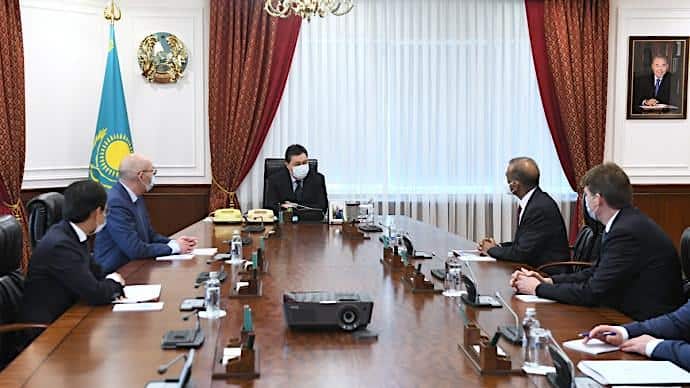
Kazakh Prime Minister Askar Mamin, center, during discussions April 9 with OneWeb Chairman Sunil Bharti Mittal, second from right, and Chief Executive Neil Masterson. Credit: Kazakh Prime Minister’s office.
PARIS — Kazakhstan is perhaps most open of the ex-Soviet states to the idea of partnering with non-geostationary-orbit satellite fleet operators and has gone so far as to scrap a planned national geostationary satellite in favor of striking agreements with one or more NGSO players.
So it’s only to be expected that in the past two weeks alone, Kazakh authorities have signed MoUs with both LEO constellation operator OneWeb and medium-Earth-orbit mPower constellation of operator SES Networks.
Both companies hope to create in Kazakhstan a Central Asian hub from which they can secure landing rights elsewhere in the region.
On April 12, OneWeb Chairman Sunil Bharti Mittal and Chief Executive Neil Masterson were in Kazakhstan to speak with Prime Minister Askar Mamin and inaugurate a OneWeb trading subsidiary.
OneWeb is holding out the promise of building a gateway Earth station on Kazakh territory that would cover much of Central Asia and also contracting Kazakh industry to build OneWeb satellite components.
OneWeb had been close to signing a joint-venture agreement with Kazakhstan in early 2020 — http://bit.ly/38fdK1Q — before its Chapter 11 bankruptcy restructuring put the deal on hold.
The idea was to create a joint venture in Kazakhstan that would purchase OneWeb capacity over Kazakh territory — 2.7 million square kilometers — and then sell it to Kazakh users.
Now out of bankruptcy, recapitalized and deploying its satellite constellation with planned monthly launches — some from the Russia-run Baikonur Cosmodrome in Kazakhstan — OneWeb is ready to restart its Kazakh play.
OneWeb said it will begin demonstrating OneWeb’s performance in Kazakhstan starting this June.
OneWeb said it had recently incorporated OneWeb Kazakhstan Ltd. at the Astana International Finance Centre to prepare for OneWeb service delivery in Kazakhstan and the surrounding region.
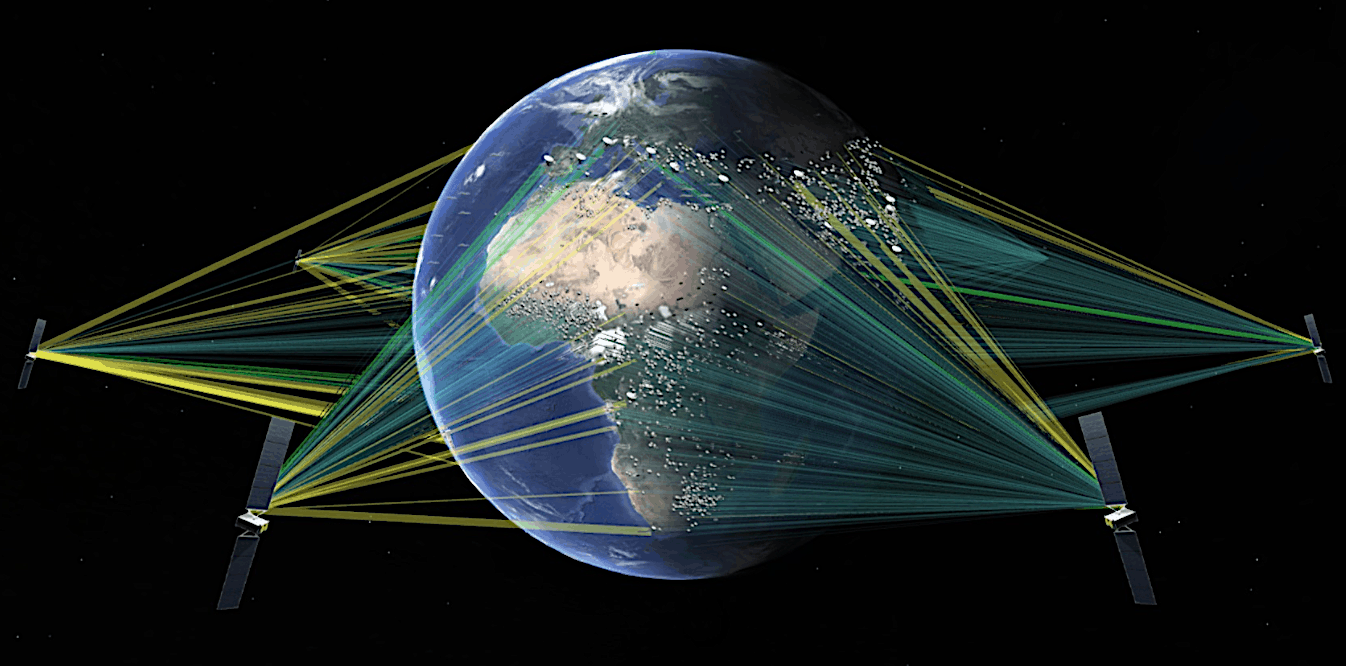
The 11 Boeing-built second-generation O3b mPower satellites in medium-Earth orbit are scheduled to launch starting in Q3 2021. Credit: SES
One April 19, it was the turn of Luxembourg-based SES, whose 11 high-throughput O3b mPower satellites, under construction at Boeing Satellite Systems International, are scheduled for launch on SpaceX Falcon 9 rockets starting in Q3 this year.
SES signed its MoU with the Republican Center for Space Communications, RCSC, part of the Ministry of Digital Development, Innovation and Aerospace Industry.
SES said it had conducted a demonstration in Kazakhstan of the current-generation O3b satellites, providing 730 mbps of conncectivy to a mobile tower for regional Wi-Fi access.
SES said it will consider an mPower gateway Earth station in Kazakhstan and, with RCSC, will look to enlist other nations in the region. SES said it established a Kazakh presence in 2020 “and will be making a direct in-country investment.”
RCSC operates the KazSat national satellite system, now consisting of two telecommunications satellites, KazSat 2, launched in July 2011: and KazSat 3, launched in April 2014. Both were built by ISS Reshetnev of Russia with payloads from Thales Alenia Space.
The Kazakh government in February announced that a planned replacement for KazSat 2 would not be built, despite the government’s desire to maintain its rights to the 86.5 degrees East orbital slot. KazSat 3 is at 58.5 degrees east.
KazSat said a request for bids for a KazSat 2R did not turn up financially satisfactory offers. Instead, RSCS will investigate NGSO constellations.
“One of the key activities of our company is to establish cooperation with providers of non-GSO systems and the use of these systems in the interests of the Republic of Kazakhstan,” RCSC said.
“RCSC is working with providers of non-GSO systems to deploy communication channels in Kazakhstan, build the necessary ground infrastructure manufacture components nd conduct assembly and testing act the Assembly and Testing Complex for SpaceCraft in Nur-Sultan.”