

Credit: Omansat
LA PLATA, Maryland — The Sultanate of Oman, in an effort to keep rights to the 73.5 degrees east orbital slot, has promised regulators to launch a temporary satellite there by December and contract a full Ka-band high-throughput satellite by the end of this year, to be launched in 2028.
Oman has been working on its first telecommunications satellite, Omansat-1, since 2018. It suffered multiple delays, of its own making, until 2024. A pubic tender for a temporary satellite was issued in October 2024.
After canvassing 26 potential providers of a satellite to occupy the slot for 90 days, and thus securing it for three years, Oman settled on Infinite Orbits of France, whose Orbit Guard-2 cubesat is scheduled for launch in August aboard the SpaceX Bandwagon-4 mission.
Infinite Orbits was “the only service provider capable of fulfilling the regulatory requirements within the regulatory timeframe,” Oman’s Ministry of Transport, Communications and Information Technology (MTCIT) said in documentation provided to the International Telecommunication Union (ITU).
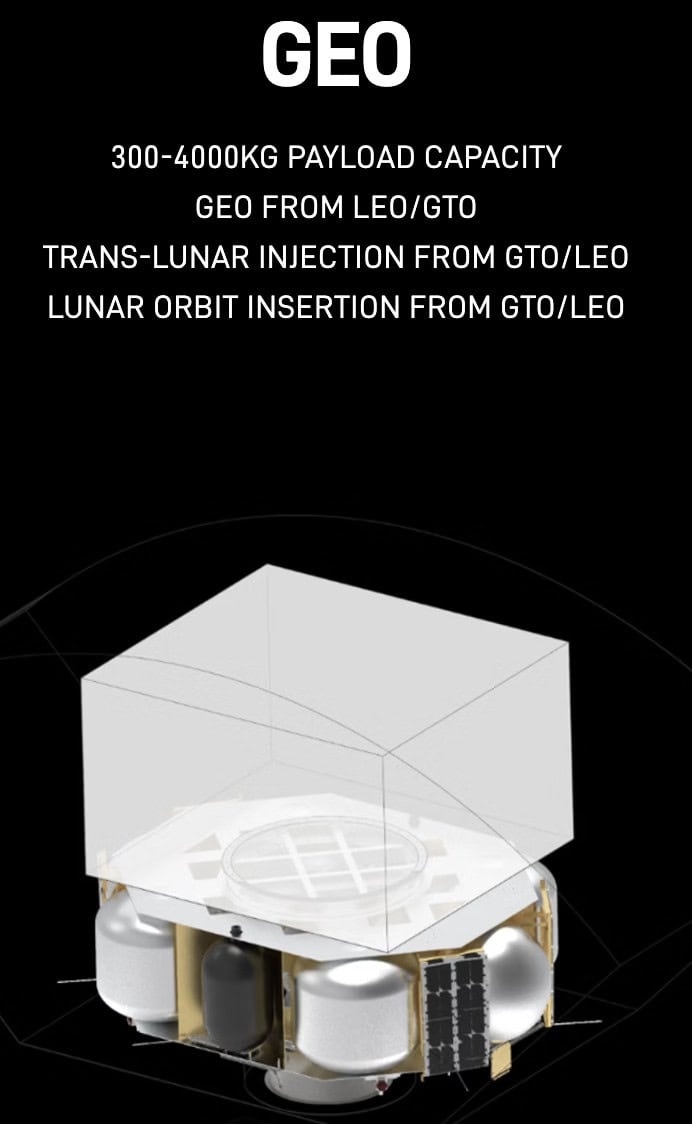
Epic Aerospace’s Chimera GEO orbital transfer vehicle. Credit: Epic Aerospace
Orbit Guard-2 will be carried to GEO orbit aboard the Chimera GEO-2 transfer vehicle from Epic Aerospace of Argentina. Chimera GEO uses chemical propulsion, not electric, to speed delivery.
The mission had been planned for earlier this year, in time to meet Oman’s in-service deadline of June 7, but was postponed for multiple reasons.
In parallel with the search for a satellite to occupy the 73.5 deg east slot for 90 days, Oman issued an invitation to tender to satellite manufacturers for a large HTS satellite, saying only those that have built at least three Ka-band HTS satellites will be considered. The tender was first issued in mid-2021 before being suspended as Oman resolved issues internal to its government.
It has now narrowed the search to three finalists: Airbus Defence and Space, China Great Wall Industry Corp. (CGWIC) and Thales Alenia Space. All three have sent” best and final” offers. A contract award is expected by year’s end, with the satellite to be launched in 2028 with Space Communication Technologies, SCT, the company managing the Omansat-1 program.
The ITU Radio Regulations Board (RRB), after rejecting Oman’s initial appeal to waive the in-service date of June 7 to Dec. 31 pending more-detailed information on the project, granted its request for a six-month-plus extension, to Dec. 31, at the RRB’s July 14-18 meeting in Geneva.
“Based on the information and supporting evidence provided, and also taking into account that it was not uncommon for launch dates to be delayed by a few days, the board concluded that the case met all the conditions to qualify as a situation of force majeure, and decided to… [grant] an extension of the regulatory time limit for bringing into uses the frequency assignments of the Omansat-73.5E satellite network to 13 December 2025,” the RRB said in its decision.
Oman’s improbable path to success at the ITU
Oman’s long road to ITU approval offers lessons for any nation, particularly those just starting a space program, on how to deal with the regulator.
First, be transparent from the start, and proactive in communications with the RRB. Oman was open about its government disorganization that cause delays in the program, and acknowledged its own challenges in securing financing and regulatory authorizations.
“[D]ue to the fact that this was the Sultanate’s first satellite program, the project team faced a steep learning curve with technical, regulatory and contractual complexity” and was unable to secure the placeholder satellite in time, Oman said in its presentation to the RRB.
It was not until mid-2024 that Oman’s Finance Ministry approved the program budget.
Oman also spent months coordinating the satellite’s frequency plan with satellite networks nearby, to assure no interference. In Oman’s case that meant completing coordination with 16 governments. Fourteen of these have been completed.
Oman provided the RRB with documentation from Epic Aerospace, Infinite Orbits and the three finalists for the HTS satellite to demonstrate that the program is real and progressing. This also helped sway the RRB decision.
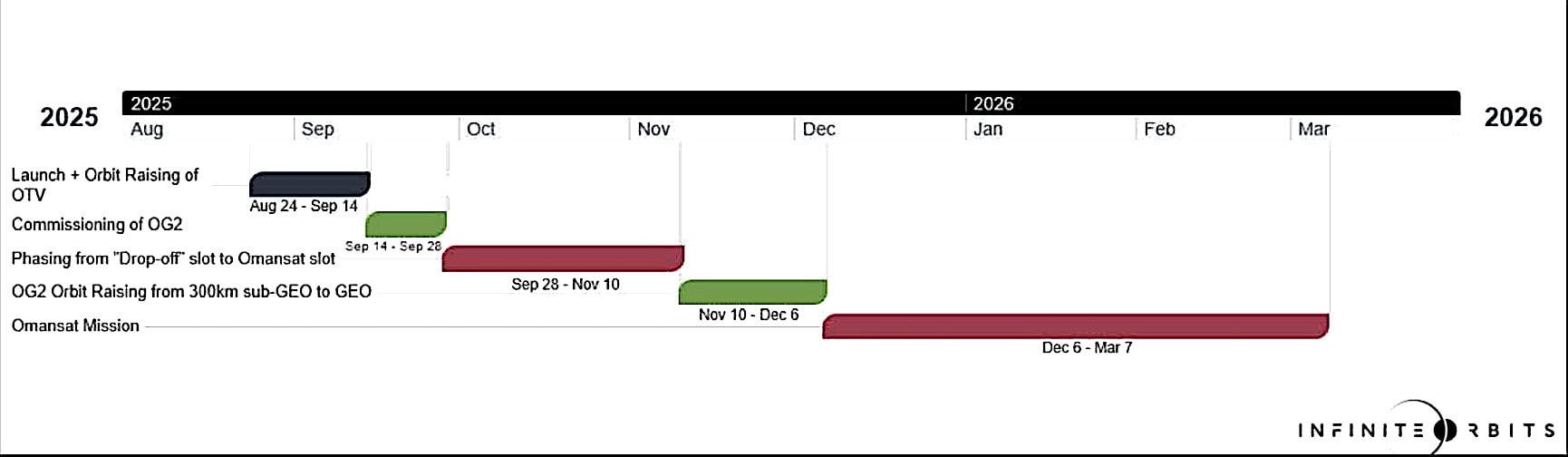
Credit: Oman ITU filing from Infinite Orbits
Oman originally expected Epic Aerospace’s Chimera GEO 2 transfer vehicle to travel to the region of 73.5 degrees east directly, and then to deploy Orbit Guard-2 300 km under the GEO arc.
But a higher-priority customer with another satellite means Chimera Geo 2 will stop at 27 degrees west and deploy its payloads 300 km below the geostationary arc.
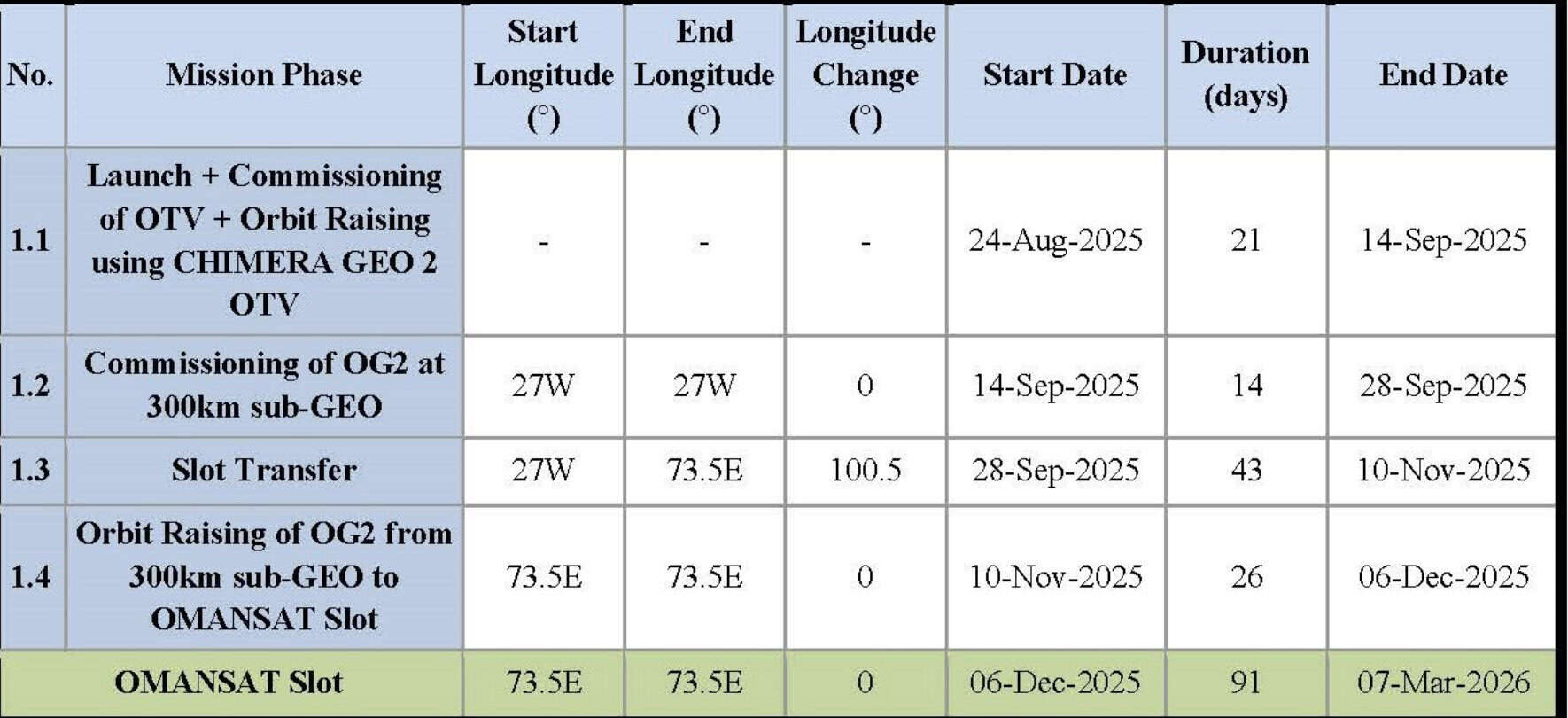
Credit: Oman ITU filing
Orbit Guard-2 will spend 14 days being commissioned there before using its electric propulsion to move to 73.5 east, a trip expected to last 43 days. It will take another 26 days to raise its orbit to its operating position, where it is expected to arrive in December. It must spend 90 days there before leaving to perform another “bringing into use” mission. Once done, the mission will provide Oman with three years’ rights to the slot, which the government hopes is long enough to get the larger satellite launched.