
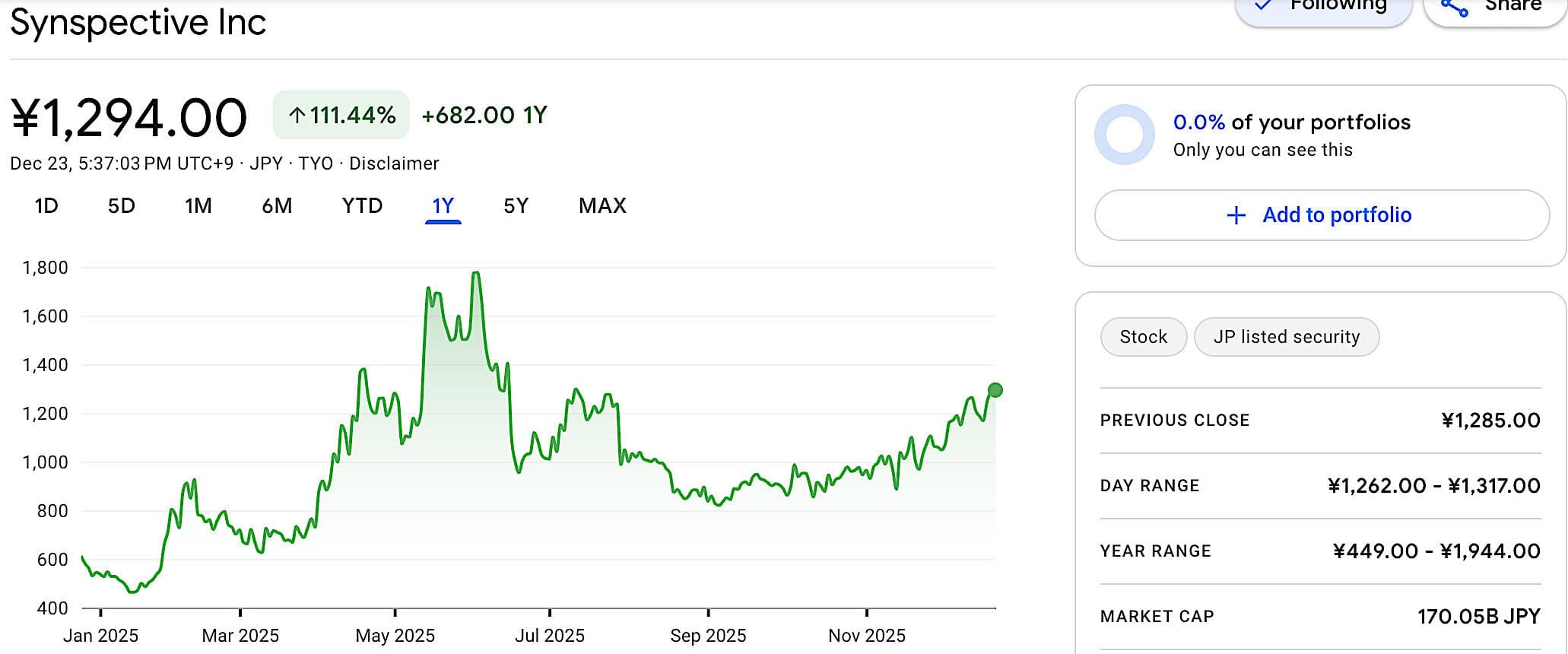
Synspective shares have doubled in the 12 months since its IPO despite a 15% dilution following the sale of new shares. Credit: Google Finance.
LA PLATA, Maryland — Radar satellite constellation operator Synspective Inc. of Japan reported a 4% increase in revenue for the three months ending Sept. 30 and a wider operating loss as the company focuses on expanding satellite production and growing its in-orbit fleet to 30 satellites by the end of the decade.
Synspective currently has four operational satellites in orbit, with its three first spacecraft been retired. Its current business is focused on the substantial expansion in Japanese government spending on satellites for security and military use.
Its government support includes not only purchasing radar imagery and funding R&D, but also substantial subsidies. Its Q3 3025 results include 278 million yen ($1.8 million) in subsidies. When these are included in the financial results, revenue for the quarter increased by 21.3%, to 1.95 billion yen.

Credit: Synspective December 2025 investor presentation
Its operating loss in the quarter widened to 3.46 billion yen, up 76% from a year ago. Backlog, at 21.63 billion yen, quadrupled from a year ago.
“Although subsidies are classified as non-operating income, they are financial significant in the short and medium term and serve as indicators of progress on technical initiatives such as constellation construction proposed in [Japan’s] Space Strategy Fund,” Synspective said in a December 2025 investor presentation. “The total revenue figure is a crucial metric as it remains important regardless of accounting classification.”
There’s much more business to come from the Japanese government, which in March approved a five-year, 283-billion-yen budget for procuring satellite imagery. Synspective expects to win a piece of this business. Winning bids are expected to be announced in the coming weeks.
In November 2024, just before the company’s initial public offering of stock on the Tokyo Stock Exchange, selected Synspective as one of four companies to accelerate Japan’s commercial constellation deployment as part of the Space Strategy Fund managed by Japan’s space agency, Jaxa.
The current revenue breakdown is about two-thirds from Japanese defense projects and one-third from elsewhere. that will rise to 80% before settling into a 60/40 split after 2028, according to company forecasts.
Credit: Synspective December 2025 investor presentation
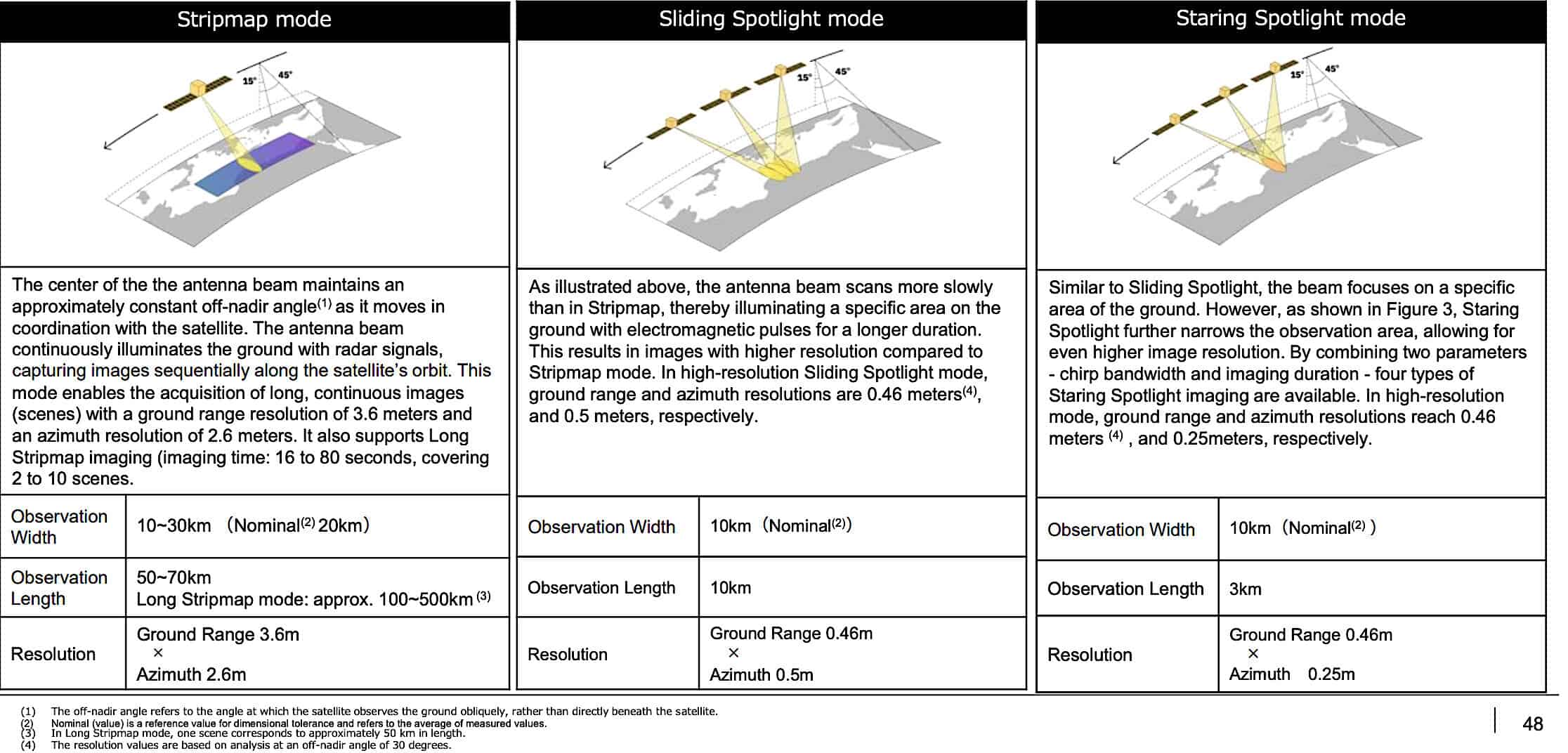
Synspective’s StriX satellites are 100-kg-class spacecraft whose sharpest images offer a 25-centimeter ground resolution at nadir and a swath of 10 km by 3 km.
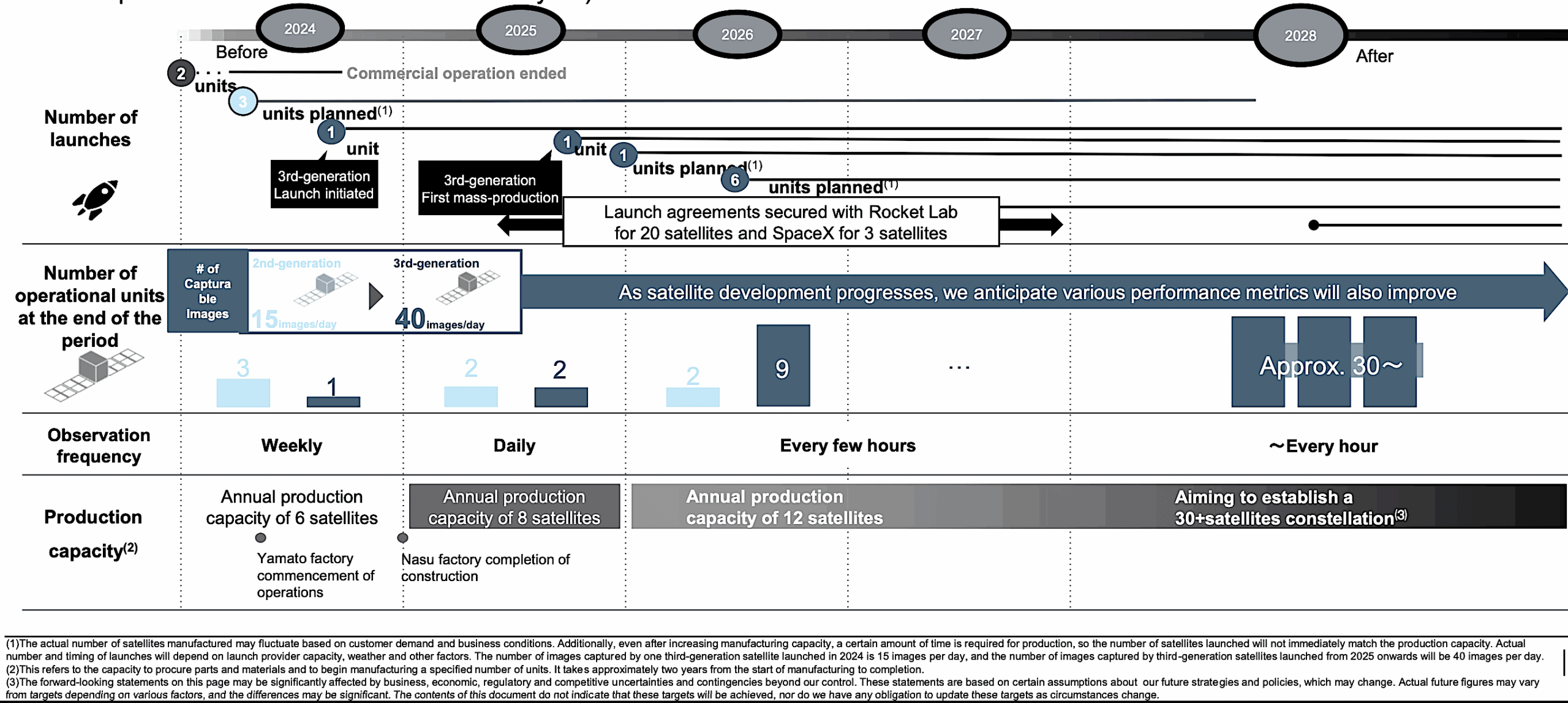
The company recently completed construction of its second satellite manufacturing facility that initially will bring annual production to eight satellites, growing to 12 satellites in the coming year.
Credit: Synspective December 2025 investor presentation
Synspective said it currently spends about 1.25 billion yen to build a satellite, which is depreciated over five years of in-orbit service life. It estimates a cost of 1.1 billion yen to purchase a dedicated small satellite launcher such as Rocket Lab’s Electron vehicle, with the cost dropping to 300 million yen for ride-share missions such as it has ordered from SpaceX.
The per-satellite construction costs are expected to drop with the increase in annual production rate.
The company has booked the launch of 23 more satellites with Rocket Lab and SpaceX, which with the new manufacturing facility will enable it to build an in-orbit fleet of 30 satellites in five years or less. Its eighth satellite launch is scheduled with Rocket Lab in Q1 2026.
The company contracted with ExoLaunch of Germany to manage the launch of 10 StriX satellites, three to be part of SpaceX ride-share missions.
Synspective raised 17.02 billion yen in a sale of acquisition rights to existing shareholders and the allotment of 4.9 million shares, at 916 yen per share, to Hulic Co. Ltd. a large Japanese real estate developer that is also an investor in satellite debris-removal and life-extension provider Astroscale.
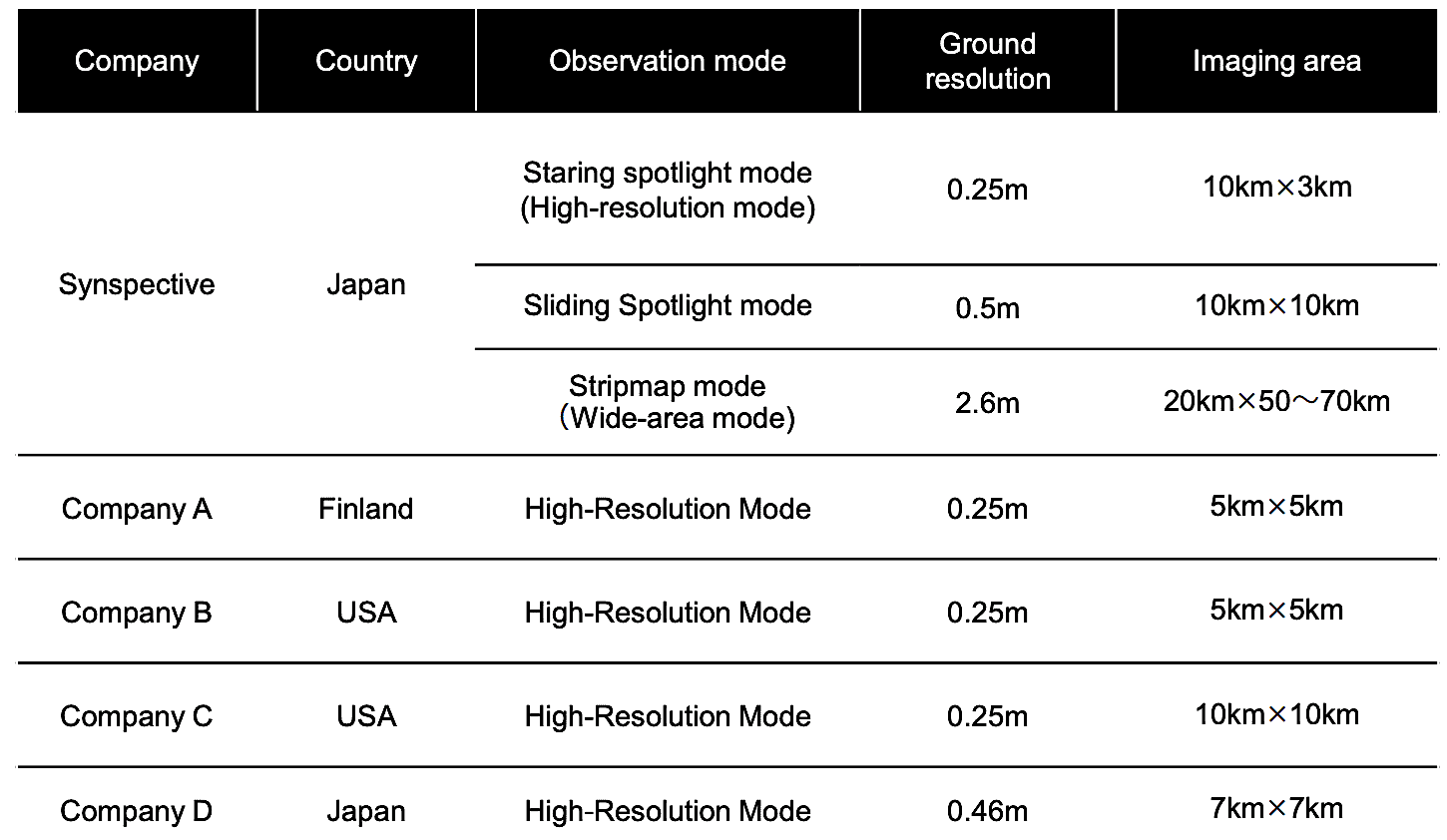
Company A is Iceye, Company B is Capella Space, Company C is Umbra and Company C is iQPS Inc. Credit: Synspective December 2025 investor presentation
Synspective has indirectly entered the US defense market via a contract with Ursa Space Systems for rapid delivery of wide-area imagery. Synspective said the contract’s terms called for data delivery within three hours.
“We successfully delivered the data within 1.5 hours,” Synspective said. “The project was related to the US military. Due to this delivery achievement, our chances of securing future projects have increased.”
Synspective said that with a fleet of 10 or more satellites it can generalize data delivery within 24 hours, dropping to less than one hour with 30 satellites in orbit. At this point, commercial markets including insurance are expected to open, as will demand from non-Japanese defense customers.
An October 2024 agreement with Mitsubishi Electric Corp. centers on sales to national security customers in Asia.