
Credit: Rocket Lab Nov. 10, 2025, investor presentation
LA PLATA, Maryland — Satellite and launch provider Rocket Lab Corp., whose ultimate goal is to be a vertically integrated space systems operator with its own constellation — the SpaceX model — is unlikely to make any advance purchases of radio spectrum or other assets to protect a future constellation business model for another three years or so, Chief Financial Officer Adam Spice said.
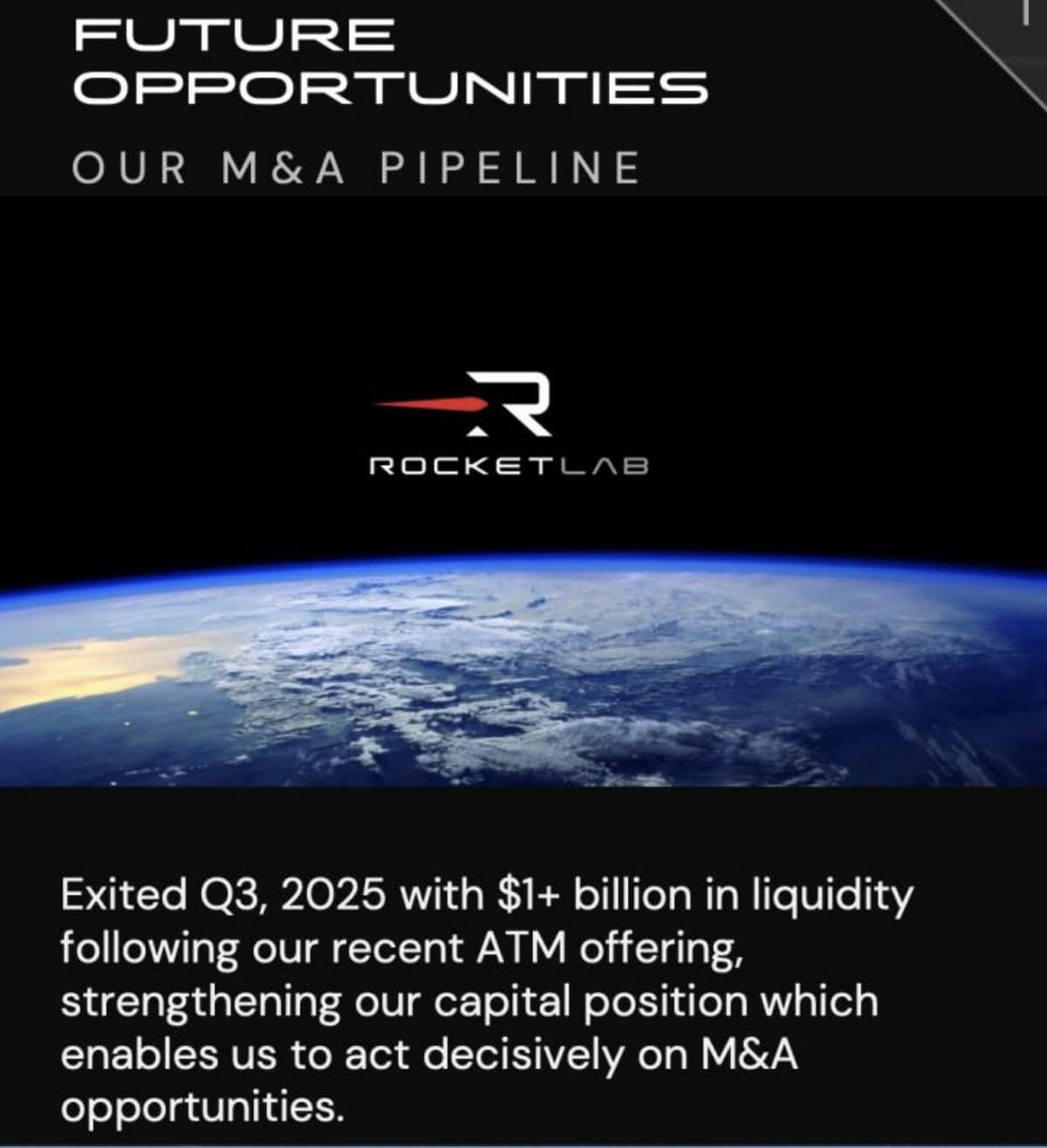
Despite the company’s $1 billion in liquidity, the increased pricing it can command for its Electron small-satellite rocket and the imminent arrival of its larger Neutron vehicle, Rocket Lab is likely to wait until Neutron is fully proved before making an acquisition to prepare for its constellation.
In a Dec. 4 presentation to a Goldman Sachs investor conference, Spice said the company would wait until Neutron has settled into its launch-and-reuse rhythm to bring down the cost of the vehicle before moving on to whatever constellation-based business it decides to pursue.
“We do get questions like: Are you guys going to go out and buy spectrum to preserve your future constellation opportunities? The answer is, probably not,” Spice said. “We really need to dovetail very carefully to avoid investing in things that we ultimately need Neutron to deploy. Having incremental lift capacity available [beyond market demand] is, realistically, probably a three-year-away thing.
“Only once you get into the rapid-cadence, reusability model in a meaningful way can you get to those 10-20-30 launches per year that gives you that SpaceX-like internal capacity.”
Credit: Rocket Lab
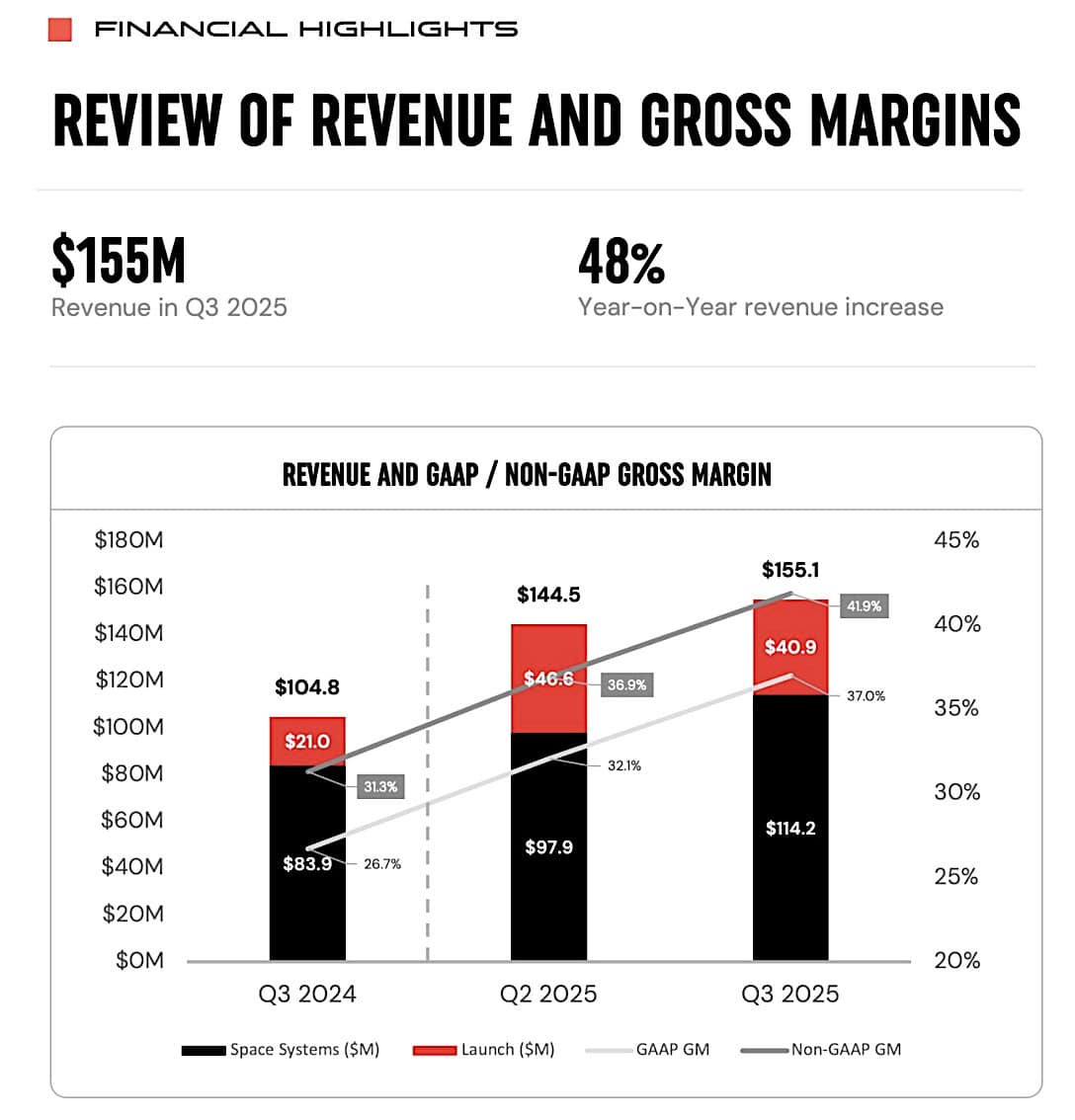
Rocket Lab’s stock has tripled in the past year in trading on the Nasdaq market, raising its market capitalization to $46.7 billion, an extraordinary figure that demonstrates how many investors believe the company can replicate, even if on a smaller scale, the SpaceX success.
21 Electron launches in 2025. At 24/year, ‘we hit the sweet spot’ for profit margin
Rocket Lab conducted a record 21 launches of its Electron vehicle in 2025. Spice said current production is at 24 per year, leaving room for an even higher cadence.
Electron’s fixed costs are about $40 million per year to maintain the launch facilities.
“If we get to 24 launches per year for Electron, that’s where we hit the sweet spot of our overhead absorption and non-GAAP gross margins in the 45-50-point range,” Spice said. “ASP [average selling price per vehicle] has been up and to the right in the last couple of years because of the lack of competition.”
Credit: Rocket Lab Nov. 10, 2025, investor presentation
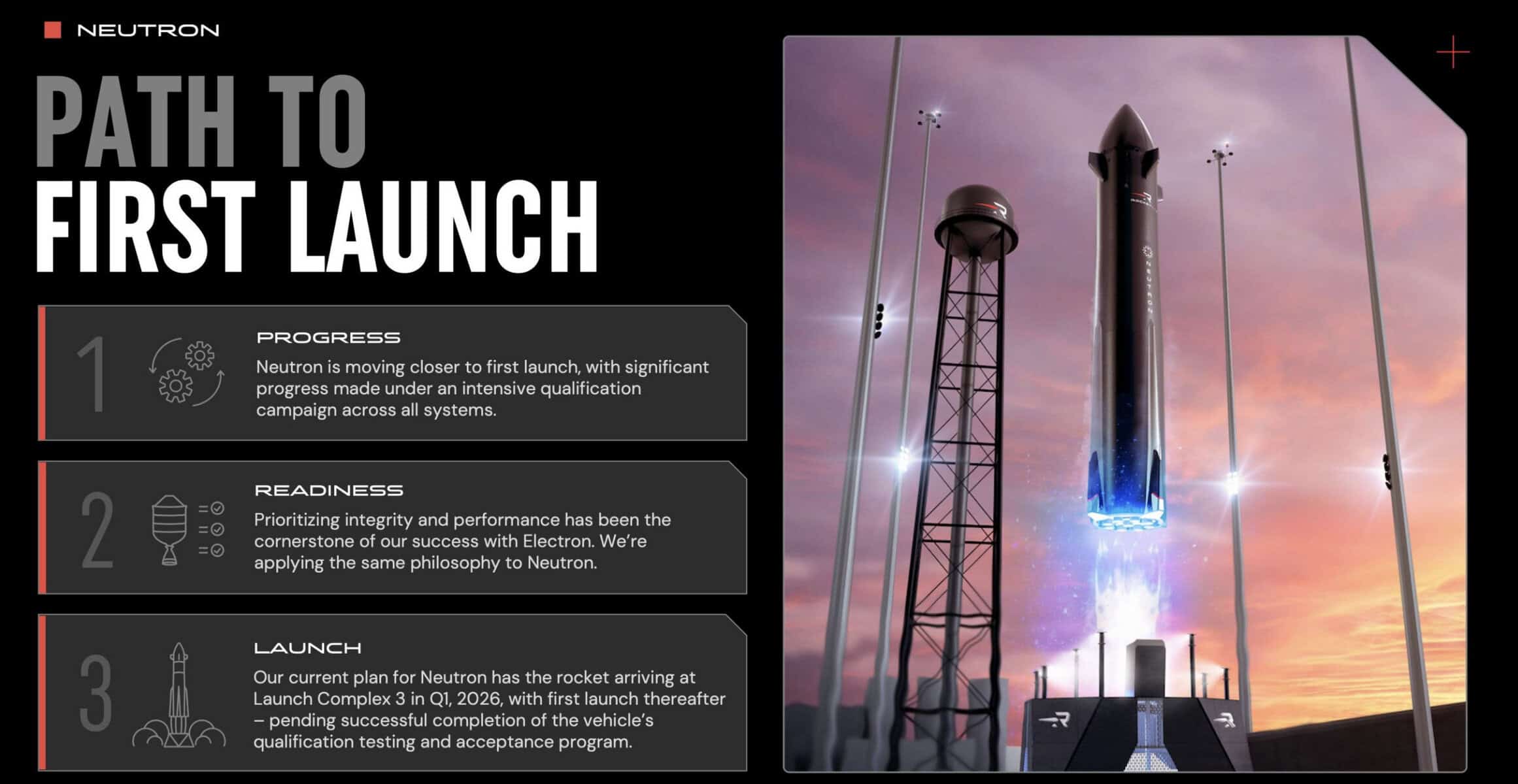
The larger Neutron vehicle, designed to launch larger satellites to geostationary and higher orbit as well as low-orbit constellations, is scheduled to be assembled on its launch pad by March. A first launch, without a paying customer, could occur by June, Spice said, with the rocket reentering for an ocean splashdown.
The second mission would include a barge landing, but the vehicle will be studied to assess degradation and would not itself be reused. Regular reuse would start with the third launch, and it’s here that Rocket Lab would see growing profit margins.
Neutron is designed to be reused 20 times, and Rocket Lab currently assumes it will take three months to get a just-launched vehicle ready for another flight. Spice said he understands SpaceX needs just 29 days between flights.
“Hopefully we could do it even better than that,” Spice said. “Our design criteria for Neutron was originally: Can we get the rocket back into position to relaunch within 24 hours? Not that we see demand driving you to that kind of a cadence, but it’s more about how do you constrain cost? The less time you need to refurb, the less money you are going to spend.”
‘Neutron development cost to end up at around $410M. Compare that to New Glenn, Vulcan, Ariane 6′
Spice said the company has spent some $360 million on Neutron as of Dec. 31, with an additional $40-$50 million expected between now and the completion of the first launch — a four-year program.

“That has gotten a brand-new pad and new integration facilities at Wallops [the Virginia launch site], a structures complex outside Baltimore and a test bed for the vehicle’s Archimedes engines at NASA’s Stennis Space Center in Mississippi.
The company’s original estimate was a $250-$300 million in development costs over three years.
“It has been a very efficient project,” Spice said, referring to lengthy development delays and multibillion-dollar costs of Blue Origin’s New Glenn, United Launch Alliance’s Vulcan and ArianeGroup’s Ariane 6.
A larger vehicle means higher fixed costs, with larger infrastructure. Spice said Neutron’s annual costs will be around $80 million.
Once proven, a four-rocket Neutron fleet produces 16 launches per year, assuming 3-month launch turnaround
Reusing each Neutron 20 times, with three months between launches of the same vehicle, means Rocket Lab could conduct 10 launches per year with just three Neutron rockets.
“My current assumption is that we’ll build out a fleet of four-ish vehicles over the course of the next couple of years,” Spice said. “At the relatively slow cadence of turning every quarter, you could be in a position of launching 16 launches per year off of that — a lot more if you can get your turnaround quicker.”
Rocket Lab looks at SpaceX’s recent launch performance — 165 Falcon 9 launches in 2025, two-thirds for the SpaceX Starlink broadband constellation — and concludes that market demand is around 90-100 missions per year open to competitive bidding.
The company’s business model for Neutron closes at 10 launches per year. “We think the opportunity is much, much larger than that,” Spice said. “On the commercial side, there’s lots of demand.”
He referenced Amazon Leo, whose constellation of some 3,240 satellites is being spread mainly across contracts with New Glenn, Vulcan and Ariane 6.
“Once that needs to be reconstituted, it will take many dozens of launches per year,” Spice said.
It’s not clear how he arrived at this figure. Even assuming only 40 Amazon Leo satellites per launch — it’s likely to be higher — it would take just 16 launches per year to maintain a constellation whose satellites have a five-year operational life.
Geopolitical trend toward national sovereignty means more US business, Rocket Lab predicts
Spice said the market does not yet understand the coming growth in international business. He said the current geopolitical trend is for less sharing of capability, and more spending on sovereign capability.
That much seems clear. But Rocket Lab concludes that this will mean more business, not less.
“We are moving from decades of efficient, concentrated spending by the US government to … a redundant spending model where people are going to be buying a lot of the same things, but in different parts of the world.
“Most of the industrial base for those kinds of capabilities is in the United States. As much as these other regions want to buy within their region, it’s going to take time to develop the flight heritage for a lot of these capabilities. I think there’s going to be disproportionate growth opportunities for well-positioned US assets.”
That counts as a contrarian bet these days.