
Credit: SES July 31, 2025, investor presentation
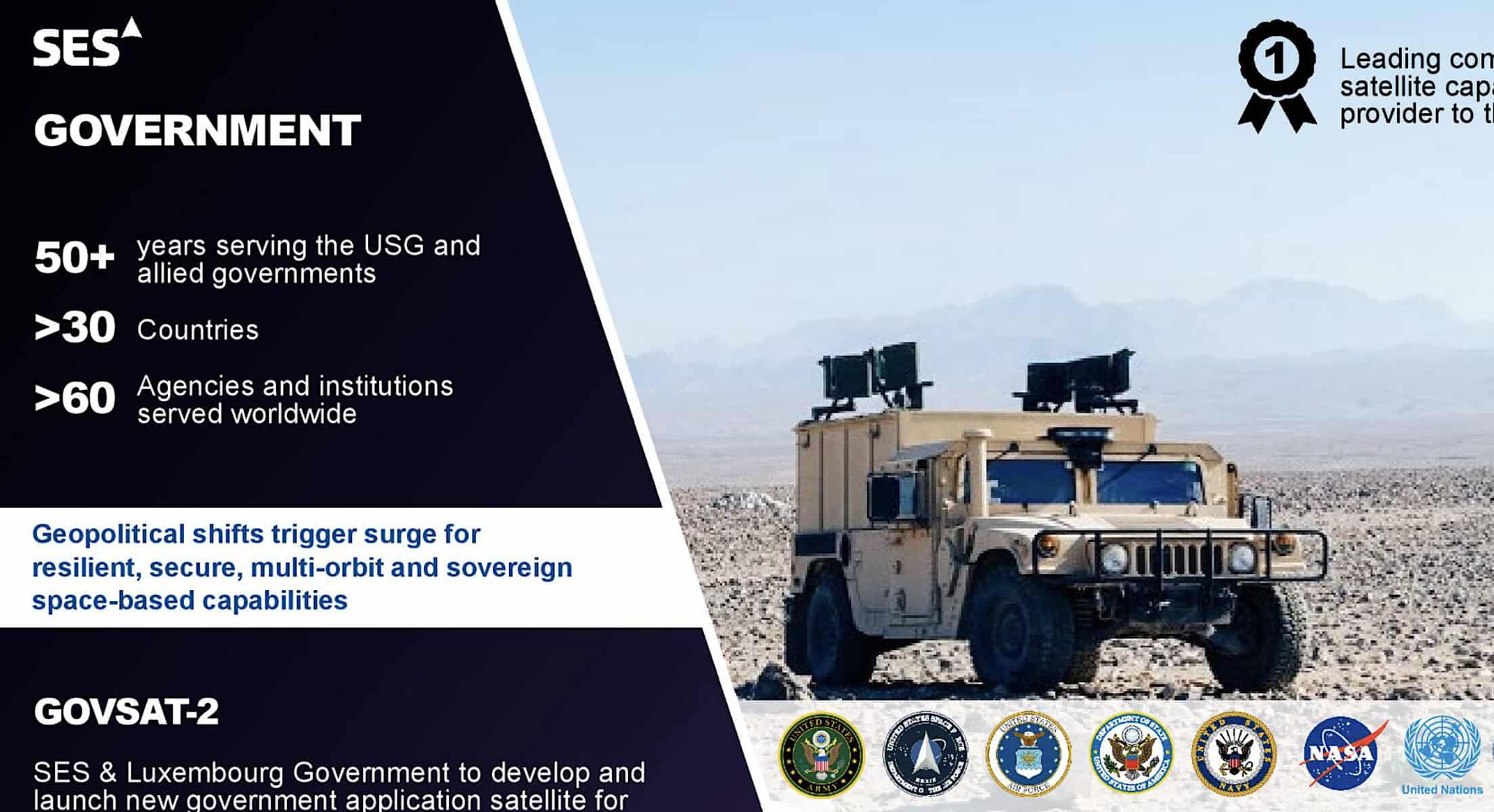
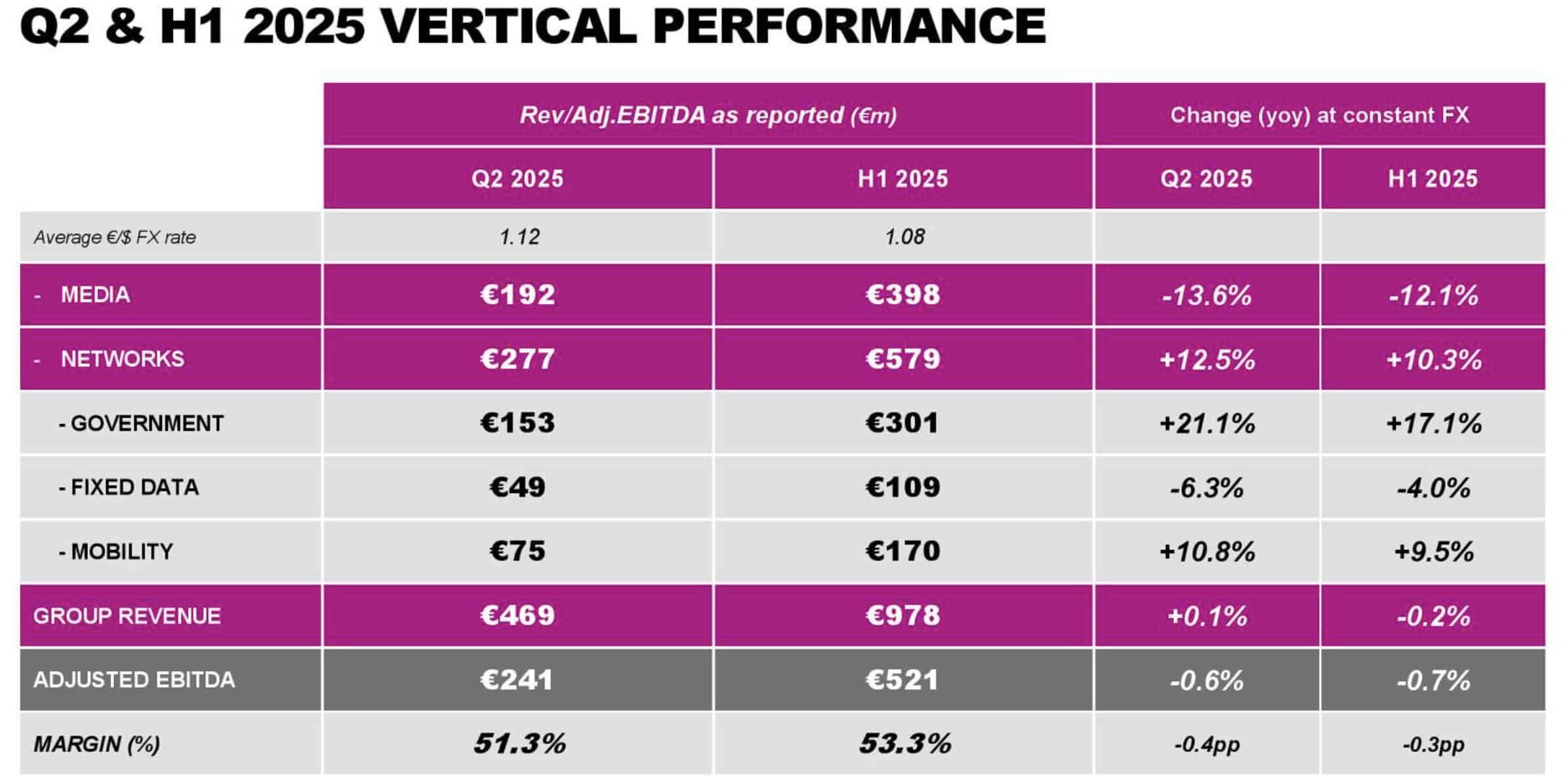
LA PLATA, Maryland — Satellite fleet operator SES said its government revenue rose 17% in the six months ending June 30 after a 21% increase in Q2.
Government is now clearly SES’s fastest-growing business and SES Chief Executive Adel Al-Saleh said growth would be continuing for the foreseeable future as the United States, Europe and other regions ratchet up spending on sovereign capacity.
When combined with Intelsat’s government business, SES expects annual government revenue to approach $1 billion in the coming years.
SES’s acquisition of Intelsat closed July 17 but Intelsat’s H1 results have not yet been published. Al-Saleh said SES has nonetheless reviewed them in detail and concluded that Intelsat’s business is on track to meet its published guidance.
Credit: SES July 31, 2025, investor presentation
For the six months ending June 30, SES’s government business totaled 301 million euros ($352) million.
“Government is our most attractive [business] and is quite stable,” Al-Saleh said in a July 31 investor call. “There is more demand. [T]here is not enough capacity in the market today, despite what everybody thinks, in the areas where our government customers really want it. So the price tends to be quite stable, with premium pricing for unique projects, such as R&D projects for advanced capabilities.”
SES and the Luxembourg government recently agreed to continue their 50/50 LuxGovSat joint venture with the purchase of a GovSat-2 satellite, to be built by Thales Alenia Space. The current JV using the GovSat-1 satellite reported a 23% increase in revenue in 2024, to 38 million euros.
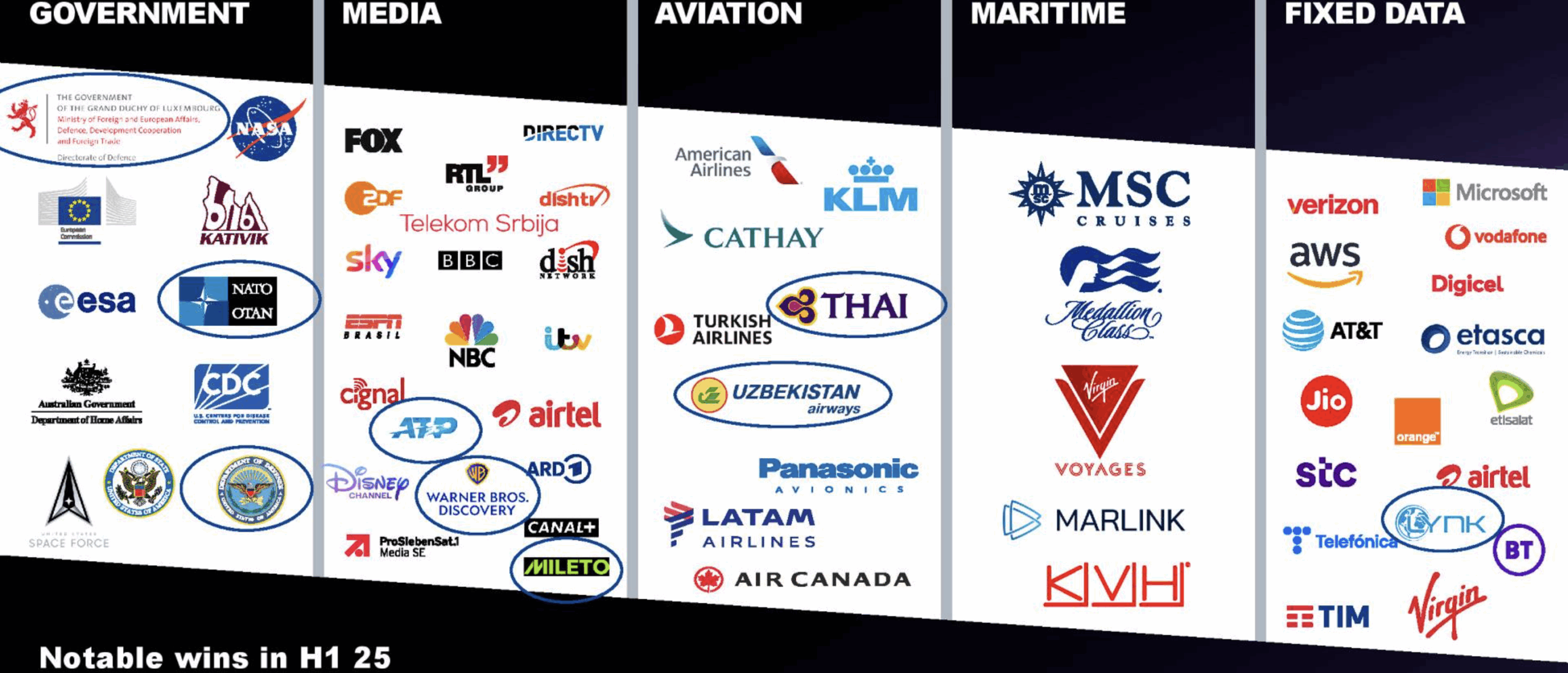
It services customers including European nations and NATO in addition to the Luxembourg government’s own requirements.
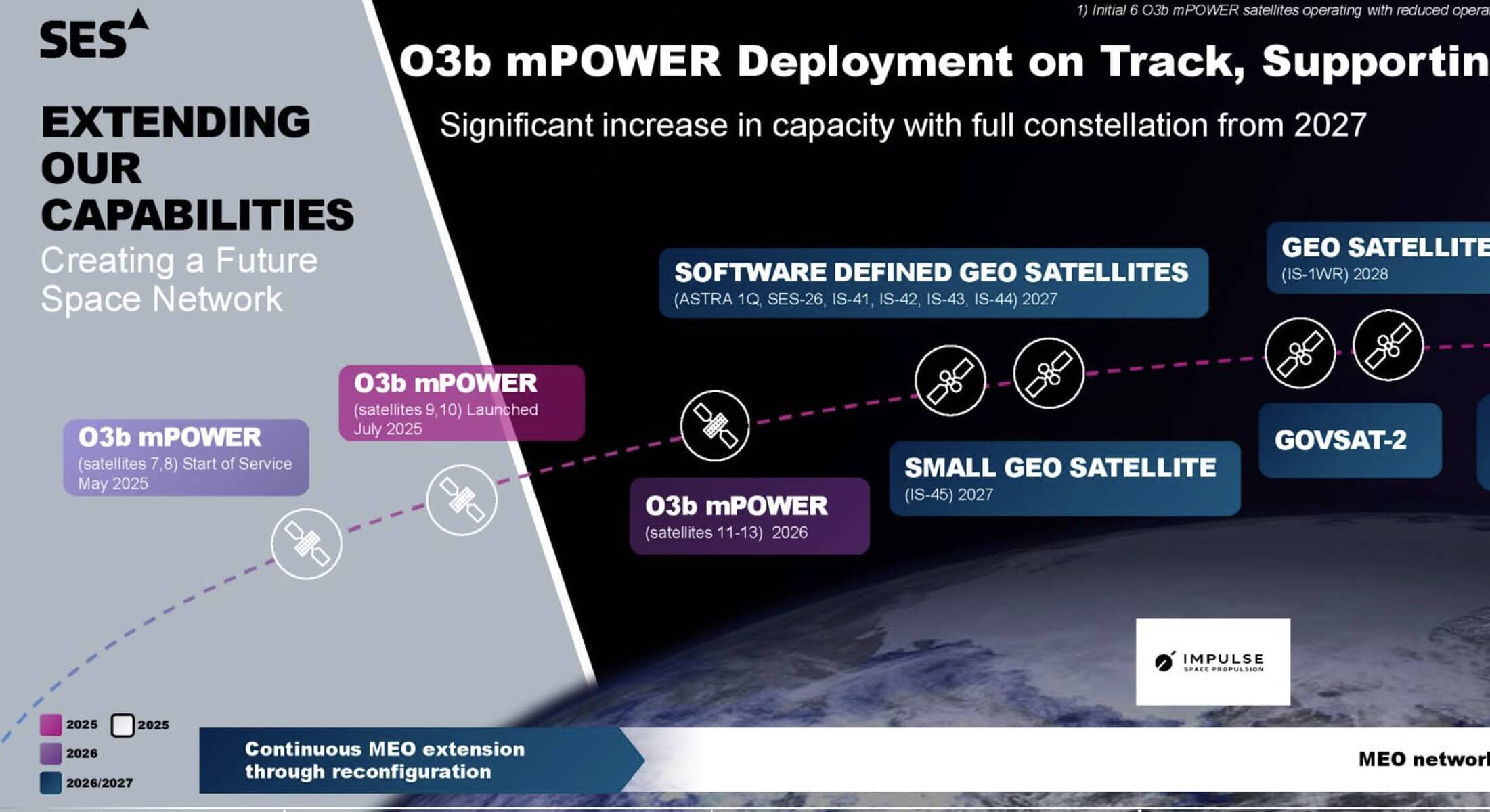
SES expects its government business to accelerate once its fully O3b mPower constellation of high-throughput satellites in medium-Earth orbit is fielded by late 2026.
Credit: SES July 31, 2025, investor presentation
Al-Saleh has said the full 13-satellite constellation, supported by capacity available as needed by the first six mPowers, which have a power module defect, will triple the constellation’s output compared to today.
SES in early 2024 filed a $472-million claim to its insurance underwriters, saying the equivalent of 70% of the first four satellites’ capacity was lost because of the power-module defect, which forced the company to use the satellites at less than full regime.
Many of the underwriters taking part in the coverage, particularly those with larger shares, have resisted paying, saying the SES claim is based on a forecasted loss of capacity and not on an observed loss: http://bit.ly/45e0EAq
SES said that as of June 30, $58 million had been received on the claim. It said it’s continuing to negotiate with its insurers. “We continue to make good progress on our settlement discussions,” the company said.
The GovSat-2 decision is proof of continued government demand for GEO-orbit satellites even as the market share of LEO and MEO constellations increases.
“Not everything is LEO,” Al-Saleh said. “GEO is still hugely demanded by our government customers. The use of Geo continues to be very robust on both sides of the Atlantic. GovSat-2 will be in service for 20 years. There is demand for ISR [intelligence, surveillance and reconnaissance] and drones.”
Credit: SES July 31, 2025, investor presentation
The non-government mobility market is SES’s other fast-growing vertical, growing 9.5%, to 170 million euros, in H1.
The company’s Open Orbits managed service offering to commercial airlines added customers, and the Intelsat acquisition is brining 3,000 commercial aircraft using Intelsat Commercial Aviation in-flight connectivity services. Intelsat has a long-term contract to use capacity from Eutelsat OneWeb’s LEO fleet.
SES has an agreement that pairs its GEO- and MEO-orbit maritime service with SpaceX Starlink capacity in LEO, called SES Cruise mPowered + Starlink.
SES, which was among the first commercial Western operators to use Russia’s Proton rocket in the 1990s and the first to fly to GEO orbit on a Falcon 9 with a previously flown Falcon 9 first stage, has not lost its taste for innovating on the launcher side.
Credit: Impulse Space
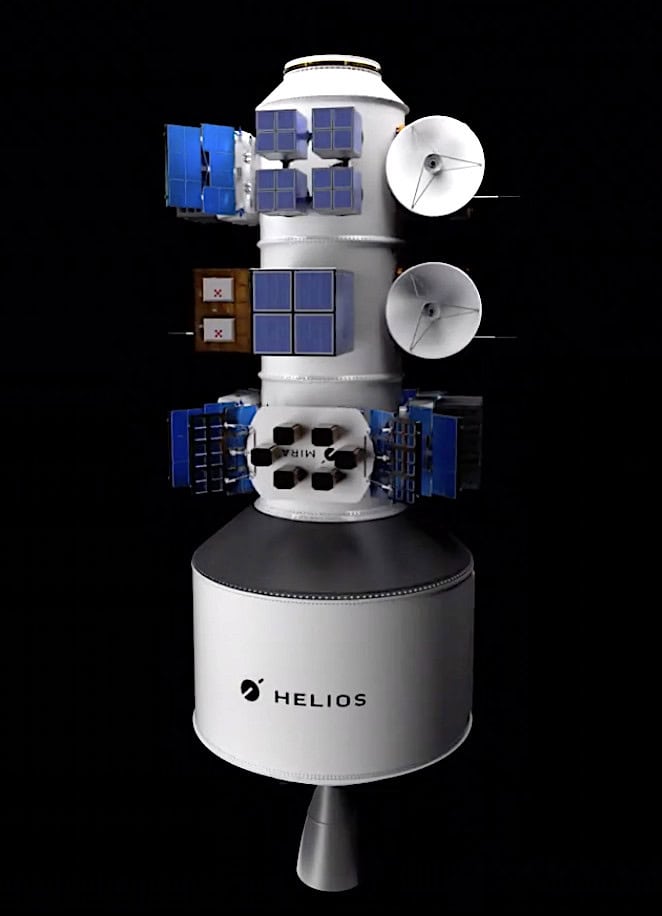
The company has signed a multi-launch agreement with California-based Impulse Space, founded by SpaceX founding team member Tom Mueller, to use Impulse’s Helios kick stage to carry a 4,000-kg SES satellite from LEO to GEO orbit in 2027.
Impulse’s LOx/Methane-powered Helios is billed as assuring delivery to GEO orbit within eight hours of separating in LEO orbit from a medium-lift rocket.
The increased use of electric propulsion for satellites small and large means a large savings in mass. Those savings can be used to reduce launch costs. The downside is that electric-propulsion satellites can take weeks to move from their drop-off points to their final destinations. SES and Impulse Space have said the satellite would be the sole payload on an undisclosed medium-lift rocket.