

Adel Al-Saleh. Credit: WSBW video
PARIS — Satellite fleet operator SES plans to revamp the way it purchases its future medium-Earth-orbit (MEO) satellites, moving toward an iterative design allowing regular technology refresh and avoiding the capex peaks of conventional procurement, SES Chief Executive Adel Al-Saleh said.
In a Sept. 16 address here to World Space Business Week (WSBW), organized by Novaspace, Al-Saleh said the new procurement will develop what SES is calling its MeoSphere network. The MeoSphere will extend SES’s current MEO constellation, in an 8,000-km equatorial orbit, to provide full global coverage, ultimately with dozens of satellites.
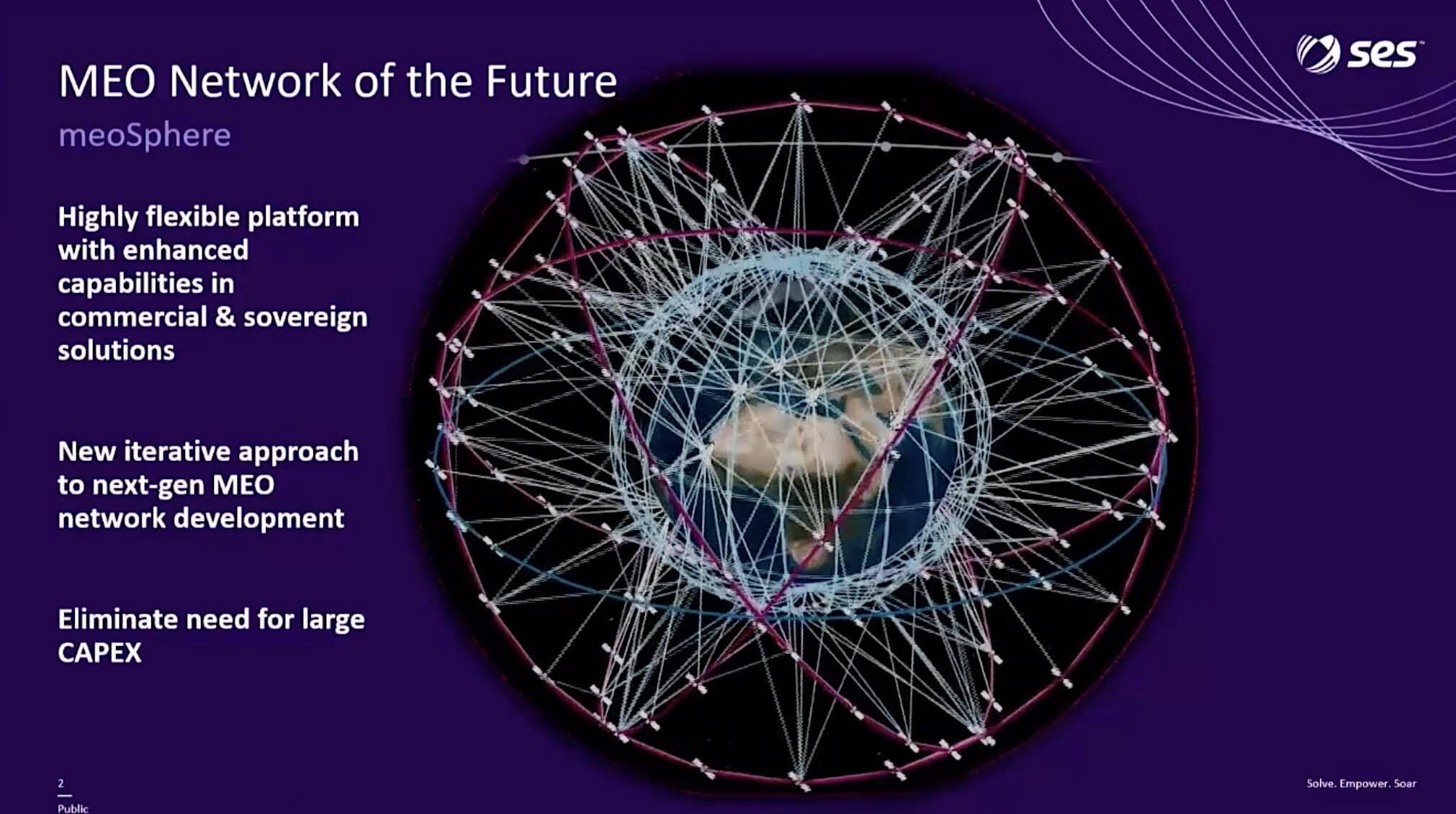
The future SES MeoSphere, a network that could include multiple slices serving different customer sets, such as Europe’s 18 Iris2 MEO satellites. Credit: SES
SES’s current MEO infrastructure is being refreshed with second-generation O3b mPower satellites built by Boeing. The last three of the 13 Boeing-built mPower spacecraft are scheduled to launch in 2026.
“We can’t wait, because the network is sold out,” Al-Saleh said. “Everything that we launch gets committed very quickly to one of our industries. We still believe that what we have built with Boeing is market-leading, the most advanced software-defined satellites that we have, generating 5,000-6,000 beams per satellite.
“But by the time we get to 2027, we are going to be full. That is our challenge. How do we continue to improve and how do we continue to build it?”
Credit: SES
Subject to a cost, schedule and technology review by early next year, SES has committed two invest 1.8 billion euros into Europe’s Iris2 multi-orbit secure communications network, with principal responsibility for the 18-satellite MEO component.
Boeing will not be eligible to provide its software-defined mPower payload for Iris2. Thales Alenia Space and OHB SE are currently expected to divide the MEO with, with Thales providing the payload.
The 23-nation European Space Agency (ESA) since 2023 has been funding investment in low-TRL technologies considered necessary for Iris2, including technologies relating to the payload. ESA is expected to ask its governments in late November for another tranche, of about 600 million euros, for the coming three years. The European Commission is financing abotu 60% of Iris2’s total estimated capex of 10.6 billion euros.
Al-Saleh said the MeoSphere network will include Iris2 as one of its components.
“We want to define this is just like a terrestrial network. You can create slices from the network to dedicate to sovereign solutions or to commercial use.
“One of the slices is going to be Iris2. This approach gives us the flexibility to react to the market, bring new technologies faster, and to adjust how much we need to build, how much do we need to launch every year, as well as how much to invest, depending on market needs,” he said.
SES’s plans after that are not entirely clear. The company is digesting its $4 billion purchase of Intelsat, which closed in July, and has said the transaction will result in 2.4 billion euros ($2.8 billion) in synergies, 70% of them realized by mid-2028.
SES has told investors it will limit capex to no more than 650 million euros per year between 2025 and 2028, not including any potential spending on Iris2.

K2 sees its satellite design, including a high-power Hall-effect electric thruster, used to launch in stacked groups of 10 satellites that, dropped off from a low-cost launch to LEO, would then make their way to MEO orbit. Credit: K2
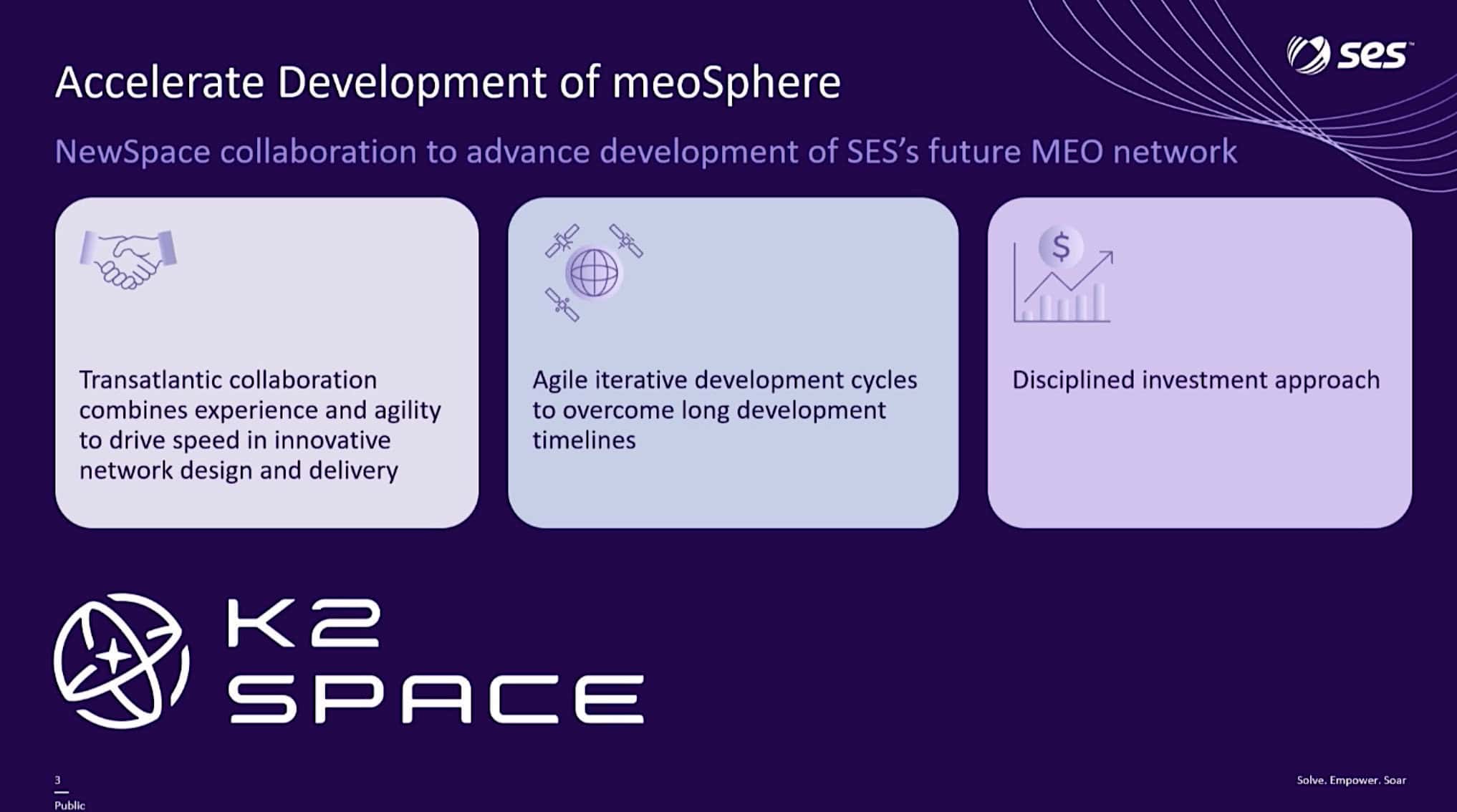
On Sept. 16, SES announced it had contracted with startup large-satellite manufacturer K2 Space Corp. of California to build and launch several pathfinder satellites to prove out technologies to be integrated into the future MEO constellation.
The first of these pathfinders will be launched in early 2026. “We have never done that before,” Al-Saleh said of the demonstration missions. K2 has scheduled to launch of its Gravitas satellite, which will be dropped off in LEO orbit and then use its on-board power to climb to MEO.
K2 has been developing a krypton-fueld Hall-Effect electric thruster designed to generate 20 kW of power to its satellites, which will carry payloads weighing up to 1,000 kilograms.

Credit: K2 Space Corp.
The company envisions using the coming crop of heavy-lift launchers, starting with the SpaceX Starship, to launch 10 K2 satellites in stacked position to deploy to LEO on a single launch and operate there for 10 years.
“K2 Space has revolutionized how you design satellites,” Al-Saleh said. “They bring a different way of thinking of how you develop a satellite. We are going to do multiple of these pathfinder missions in 2026 and 2027 before we come to the end of design of a satellite we will be launching” for the MeoSphere.
Al-Saleh said all MeoSphere satellites will be forward- and backward compatible.
“We will make those things talk to each other and make them connected in the sense of a network structure. We’re going to think much broader than one constellation. We think about MeoSphere as a network that will live for decades. As we scale it, the satellites will come to end of life and we’ll do it every year. And yes, the payload will have to evolve.”