
Credit: Sky Perfect JSat August 2025 investor presentation
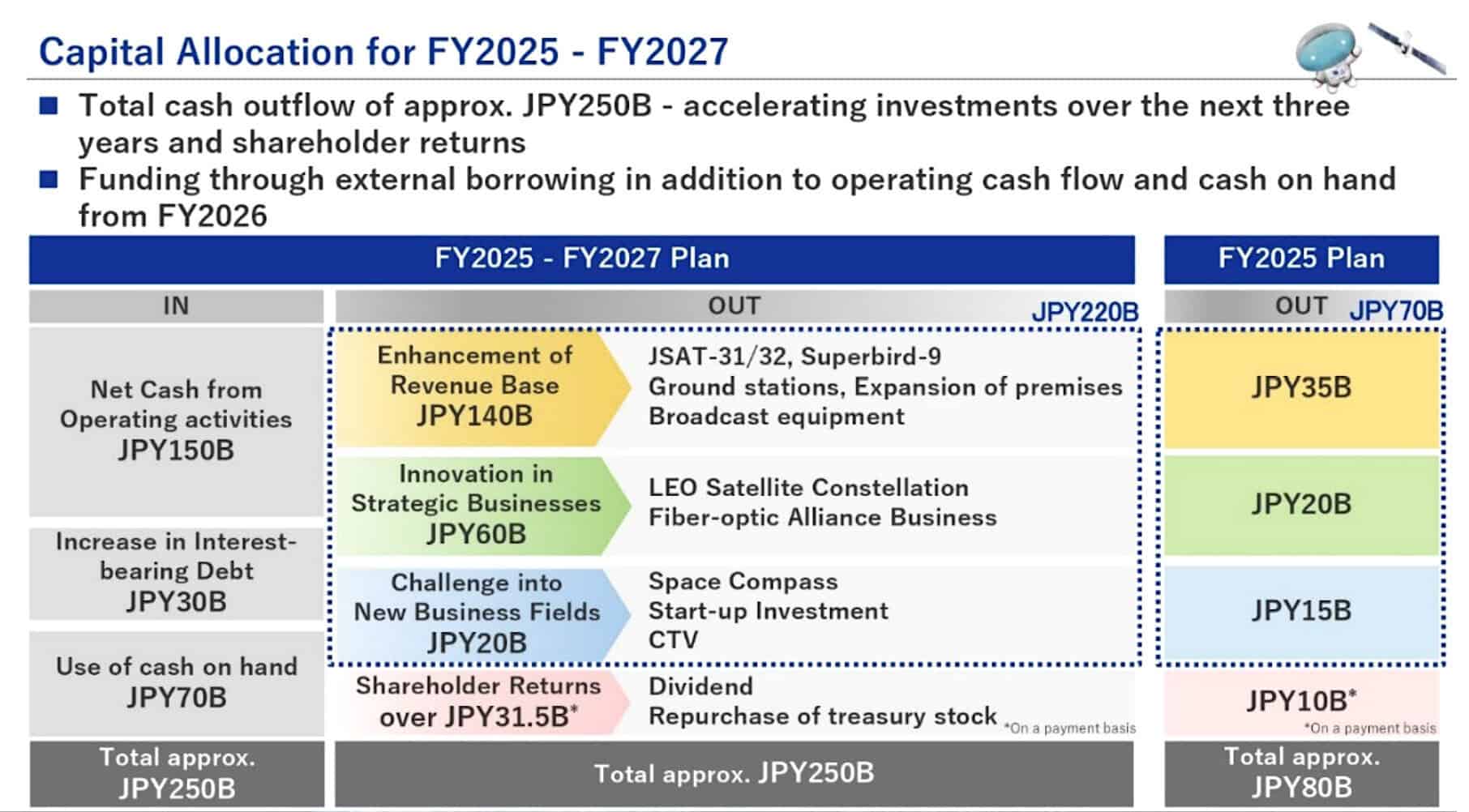
LA PLATA, Maryland — Satellite fleet operator Sky Perfect JSat of Japan, which in the past three years has invested modestly in diversifying its portfolio beyond geostationary-orbit broadcast satellites, plans to nearly triple spending in the coming three years as it doubles down on optical and radar observation satellites from low Earth orbit, space-based laser-optical communications and new geostationary satellites.
Sky Perfect JSat Chief Financial Officer Isao Kubo said that the company has invested 72 billion yen ($489 million) over the past three years and plans to nearly match that in FY 2025 alone and maintain the level through 2027.
The total capex for 2025-2030 will exceed 300 billion yen, Kubo said in an Aug. 7 investor call on the company’s FY 2025 Q1 results.
“Specifically, we will steadily procure the next-generation satellites and low-Earth-orbit constellations that have already been ordered, expand our space business base and make solid investments in new fields such as [space laser startup] Space Compass,” Kubo said. “By steadily implementing business initiatives and investing in growth, we have raised our net income target for FY 2030 to over 28 billion yen from over 25 billion yen.”
Credit: Sky Perfect JSat August 2025 investor presentation
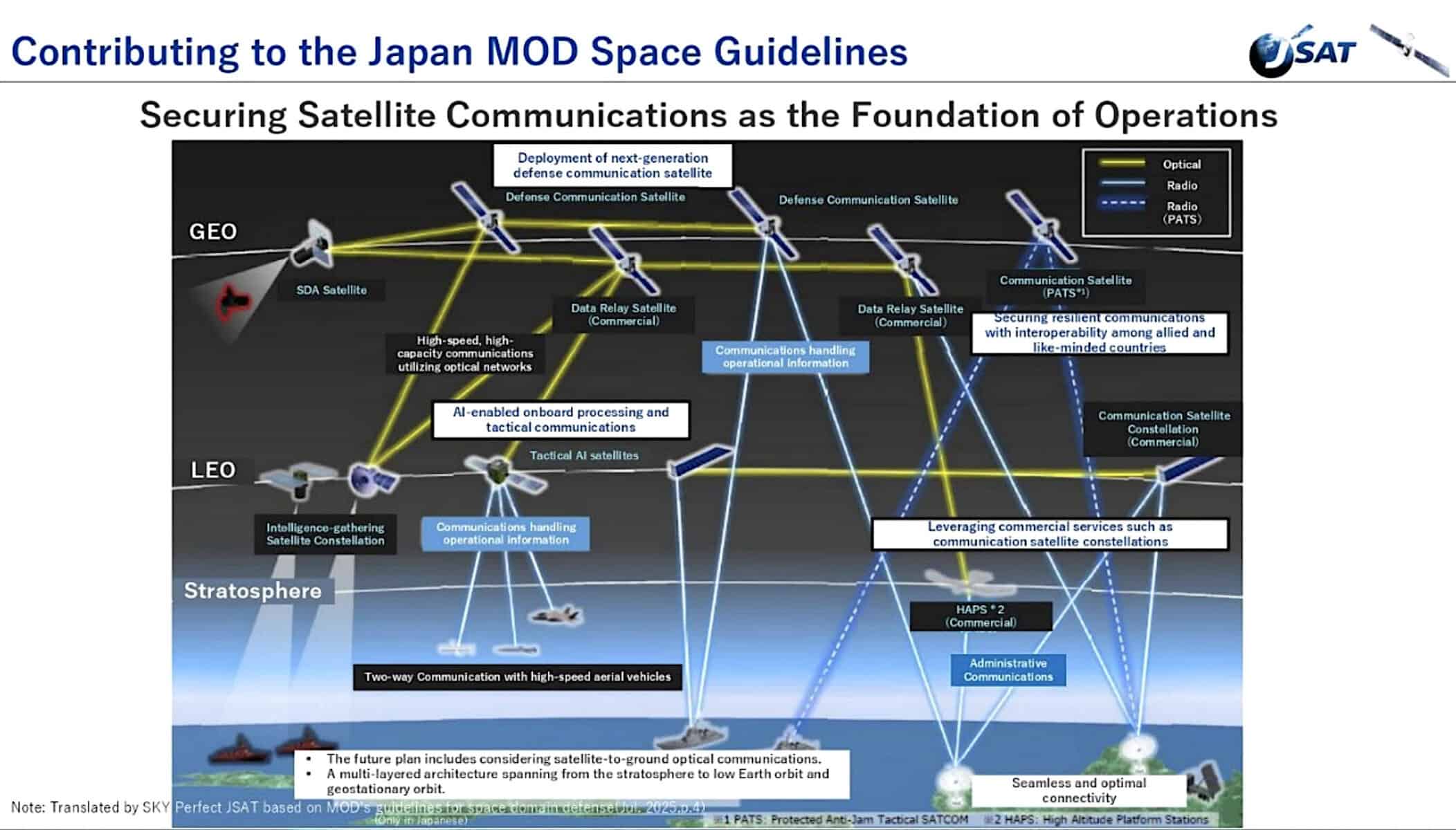
A key element in the growth is the Japanese Defense Ministry’s new space focus. The ministry on July 28 published its Space Domain Defense Guideline that include plans for a LEO constellation and a space domain awareness capability.
Sky Perfect JSat is also beginning work on a Quantum Key Distribution program and commercializing a high-altitude platform (HAPS) service.
Credit: Sky Perfect JSat August 2025 investor presentation
Teruo Yamashita, head of the company’s space division, said the military strategy includes “a policy for promoting investment i related technologies by private companies. They emphasize the need for public-private partnerships i the space domain. As a space industry company, we are promoting multiple initiatives in line with these guidelines.”
Notably, the Defense Ministry guidelines cite initiatives that Sky Perfect JSat has already identified for its own investment — next-generation military satcom, space situational awareness, optical data relay satellites. “These are directly linked to our efforts,”Yamashita said.
Credit: Sky Perfect JSat August 2025 investor presentation
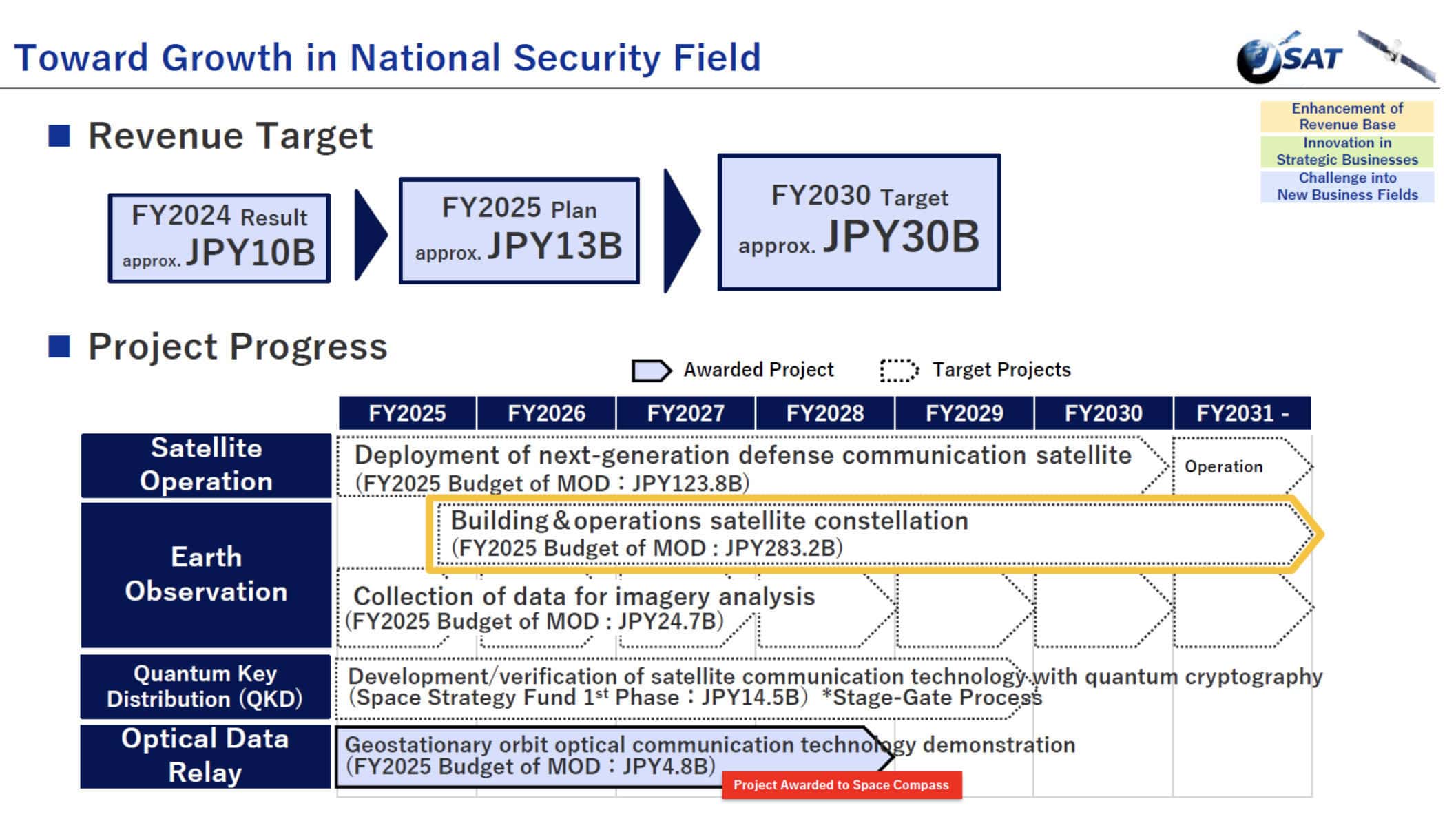
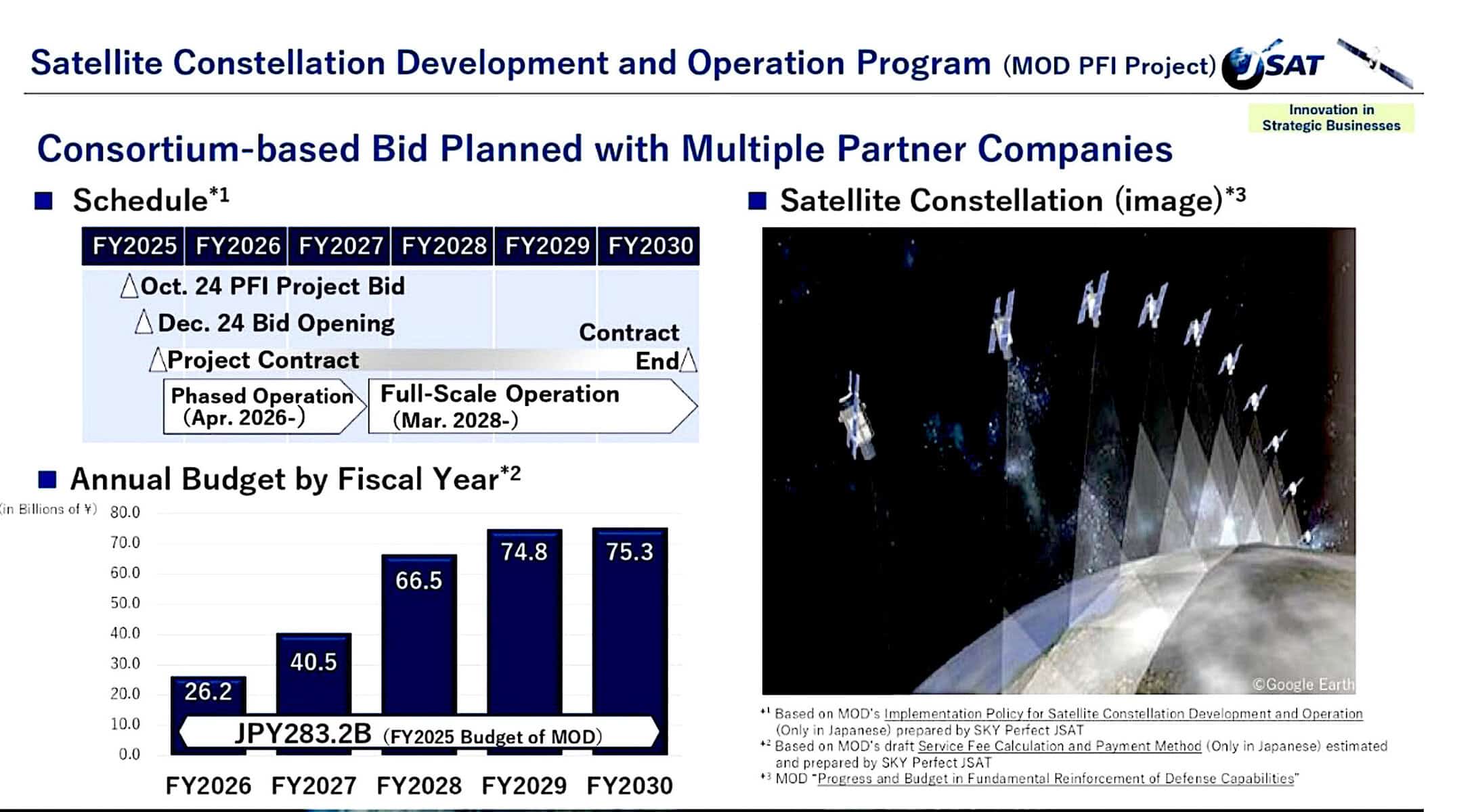
He said a bidding process for the military satellite constellation to be run as a Private Finance Initiative (PFI) is expected in October, with bids to be opened in December. MHI is preparing a bid that will include a consortium of multiple companies.
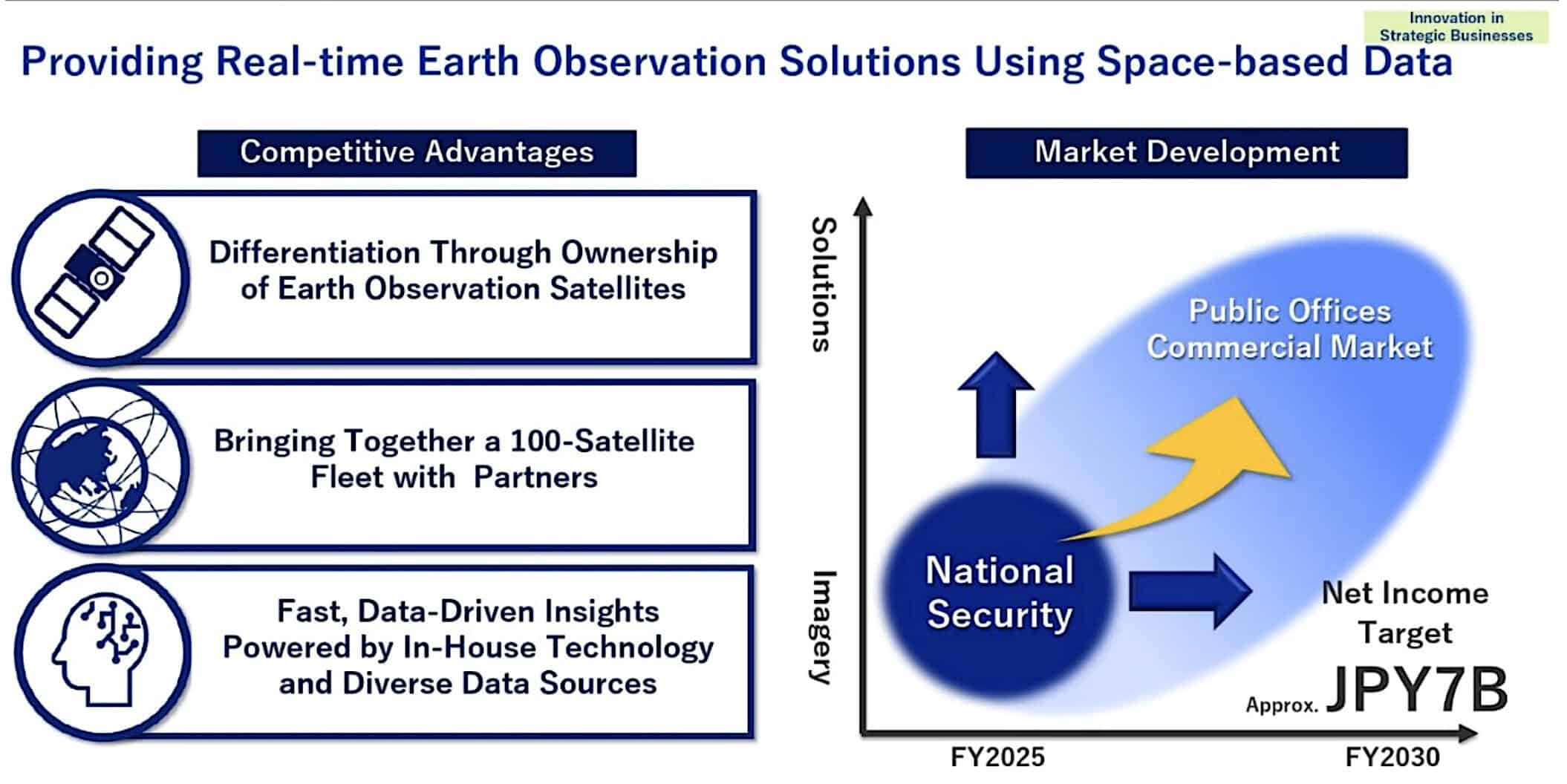
Security-based revenue at Sky Perfect JSat totaled 13 billion yen in in FY 24 and are expected to reach 13 billion yen this year and grow to 30 billion yen by FY 2030, Yamashita said.
Sky Perfect JSat is already the lead partner in the three-satellite Kirameki military satcom program and will attempt to repeat that role in the Kirameki-2 program.
Credit: Sky Perfect JSat August 2025 investor presentation
Yamashita said the Defense Ministry’s constellation project stipulates that the satellites must be built in Japan, so the $230-million, seven-year purchase of dedicated capacity over Japan from Planet Labs using 10 30-centimeter-resolution Pelican satellites will not be part of the PFI. That capacity will only be used when domestically built capacity is unavailable.
Yamashita said there may be a role for Sky Perfect JSat as a partner with Europe’s Iris2 multi-orbit secure communications constellation. SES is leading an industrial consortium that will operate Iris2 under a 12-year concession pending a final review by early 2026.
“We have adopted a multi-orbit strategy,” Yamashita said. “Regarding our involvement in Iris2, we are working on LEO and MEO orbit in addition to GEO and are exploring areas in which we can be involved through virus discussions with SES. We are currently working on participating in the project, if there is an opportunity.”
Space Compass and the 23-nation European Space Agency (ESA) in March signed a memorandum of intent to assess the feasibility if having interoperable optical links for ESA’s HydRON demonstrator and Japan’s Laiden project. Japan has agreed to adopt the ESA Specification for Terabit-per-second Optical Links, ESTOL, for the trials.
Sky Perfect JSat’s Orbital Lasers subsidiary is developing satellite-based lasers for us in space debris removal.
Credit: Sky Perfect JSat August 2025 investor presentation
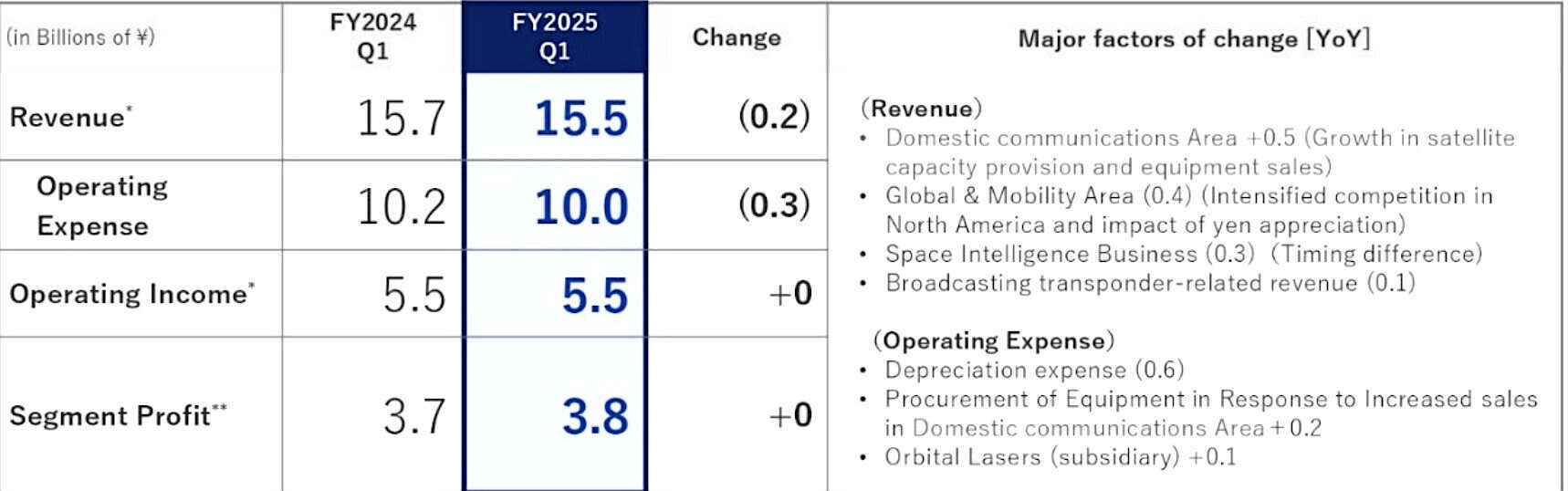
For the three months ending June 30, the company reported space sector revenue of 15.5 billion yen, down 1.3% from the same period a year go, but operating income was stable at 5.5 billion yen and the division’s profit was slightly up, at 3.8 billion yen.
Kubo said he expected continued decline in the satellite broadcasting business, but that revenue and profit is growing in the provision of in-flight connectivity services to aircraft. He said the North American business includes Asia and Oceania, where price competition remains fierce and revenue has declined.