

SpaceX Starlink satellites performed 148,696 collision-avoidance maneuvers for the six months ending Nov 20, 2025. Listed above are the satellites that caused the maneuver, and the number of maneuvers conducted during the period. Credit: SpaceX Dec. 31, 2025, FCC filing.
LA PLATA, Maryland — SpaceX’s Starlink constellation performed 148,696 collision-avoidance maneuvers in the six months ending Nov. 30 and continues to confront operational challenges from operators that report erroneous satellite location data or report nothing at all, the company said in a filing with the US Federal Communications Commission (FCC).
At more than 9,000 satellites, Starlink accounts for most of the operational satellites in orbit. But large constellations in low Earth orbit are coming from at least two Chinese operators and from Amazon Leo, further testing the carrying capacity of orbital shells between 400 and 550 kilometers in altitude.
But as SpaceX’s semi-annual constellation status report to the FCC makes clear, the risk of satellite collision has at least as much to do with the constellation owner’s practices than with the number of satellites.
“The inconsistent availability of high-quality ephemerides, particularly from operators of maneuvering satellites, increases overall collision risk,” SpaceX said in its Dec. 31 update to the FCC. “SpaceX has observed prolonged ephemeris outages, where operators of maneuvering satellites fail to upload data to Space-Track.org for extended periods.
“Some operators only share ephemerides before planned maneuvers or after radar-based screenings identify high-probability conjunctions. Others provide data with insufficient lead time for effective screening.
“International coordination adds another layer of difficulty, especially with Chinese and Russian operators that often do not share ephemerides or contact information despite operating a significant portion of maneuverable satellites.”
As it has in the past, SpaceX asks US regulators to oblige any constellation operating in US territory to provide the same level of detail about their fleets as SpaceX has been doing. The FCC did not immediately respond to a request for comment on where it stood on this point.
The United Nations Office for Outer Space Affairs (UNOOSA) has confirmed that some operators are reluctant to contact a commercial company to share satellite location and maneuvering data and prefer to deal with a government organization.
This has led to UNOOSA’s acting as an intermediary for several conjunction events when owners of one of the concerned satellites declined to deal directly with private owner.
Just as bad as zero communications is inaccurate data.
“Unfortunately, SpaceX has encountered issues with poor-quality ephemerides from other operators,” SpaceX said. “Some include physically implausible trajectories, such as suborbital or highly eccentric paths for satellites that are actually in stable circular orbits. Other ephemerides diverge significantly from actual satellite paths. … Unreliable thrusters or poorly planned maneuvers often contribute to these inaccuracies.”
Chinese government officials have begun publicly commenting on the measures they’re taking on behalf of space safety, which suggests that things are moving. But there’s clearly a good distance to travel to get to the level of trust needed between operators.

Starlink Direct to Cell satellites in orbit. Credit: Starlink

The 148,696 maneuvers conducted between June and November 2025 is about 3% more than the 144,404 reported for the previous six-month period. SpaceX said that the latest figures show that 70% of the maneuvers were performed with Starlink Gen 2 satellites.
The company continues to perform maneuvers when the probability of collision is greater than 3 in 10 million, compared to the industry standard of 1 in 10,000.
The Honghu-2 technology demonstration satellite, operated by Hongqing Technology of China as part of a planned large constellation, was responsible for 1,143 Starlink maneuvers during the six-month period. The satellite was launched in August 2023.
SpaceX said it also removes its satellites from orbit “based on long-term reliability forecasts, rather than waiting for failure of critical systems.
“Practically speaking, this approach means that SpaceX may deorbit a considerable number of satellites that would never experience a failure. No other operator takes a similarly conservative approach,” the company said.
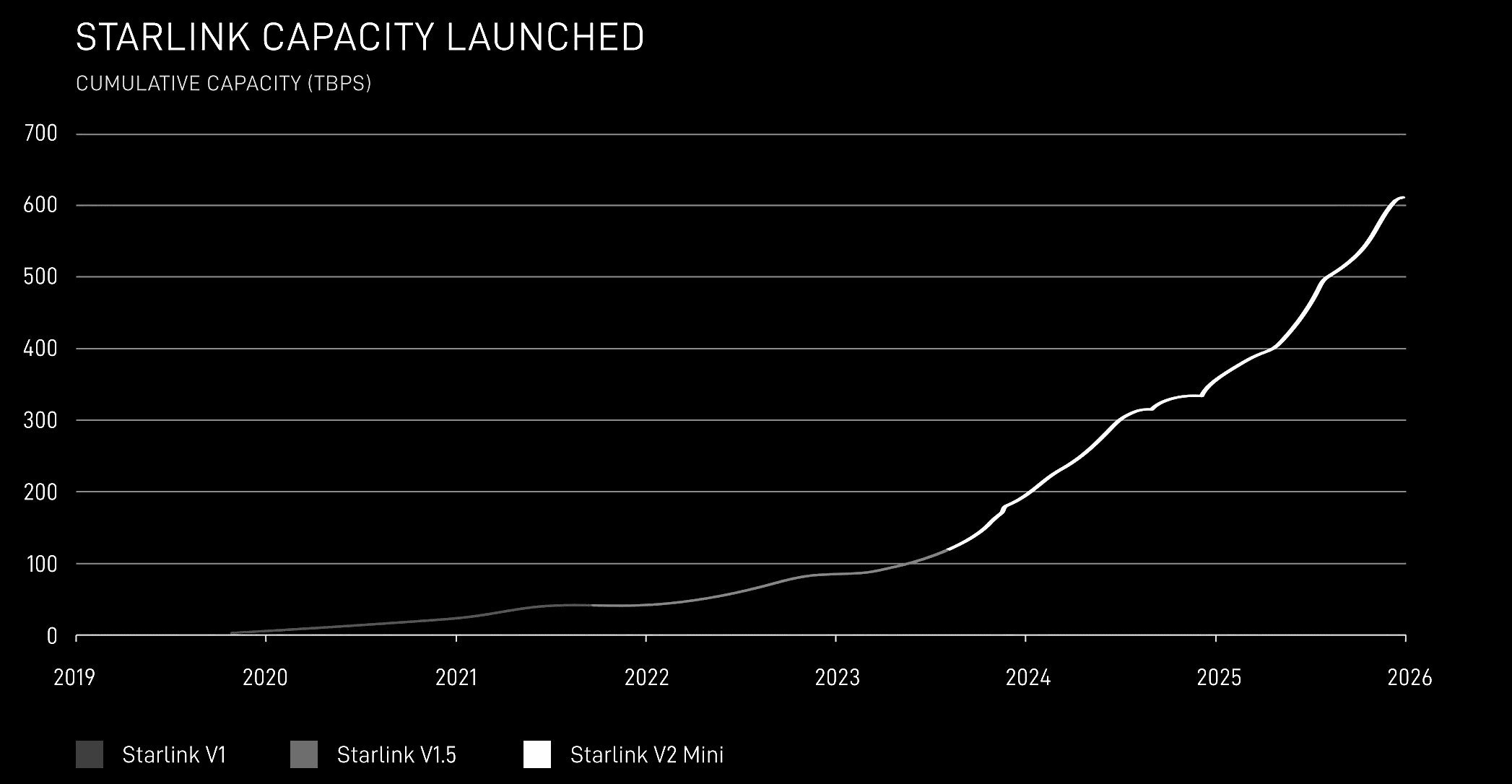
Credit: SpaceX
SpaceX recently announced that 4,400 Starlinks orbiting at 550 kilometers will be lowered to 480 kilometers in 2026. There are performance advantages to the lower orbit, but also costs in terms of a potentially reduced operational life. Starlinks now are expected to function for five years.
SpaceX characterized the decision to lower these satellites’ orbit as a way of reducing the time it takes a satellite to be disintegrated on reentering the Earth’s atmosphere now that the 11-year solar cycle is moving solar minimum, reducing the amount of atomic oxygen in low Earth orbit. Less time deorbiting means less time to encounter collision risks or other issues.
Effects on optical astronomy and alumina deposits in upper atmosphere
SpaceX’s semi-annual report also addresses environmental effects of its operations, including satellites’ reflecting sunlight and perturbing ground-based optical astronomy observatories.
SpaceX has reached an agreement with the US National Science Foundation to mutually address how the constellation can reduce its effects on the observatories. Lowering satellites’ orbital altitude will help, SpaceX said.
Astronomers attending the 76th International Astronautical Congress (IAC) in Sydney, Australia Sept. 29 Oct. 3, organized by the International Astronautical Federation (IAF), said SpaceX and Amazon Leo have been proactive in looking for ways to darken their satellite designs or warn observatories of coming satellite activity. But they said they were concerned that coming constellations will not be as accommodating.
SpaceX has committed to work with scientists to collect data on the amount of alumina deposited in the atmosphere as a result of satellites’ disintegration there.
“[O]bserving and taking measurements of uncontrolled satellite reentries is extremely challenging,” SpaceX said. The company said it would continue to improve the predictability of a satellite’s reentry as part of the effort.