

Indra Space Chief Executive Miguel Angel Panduro. Credit: Hispasat
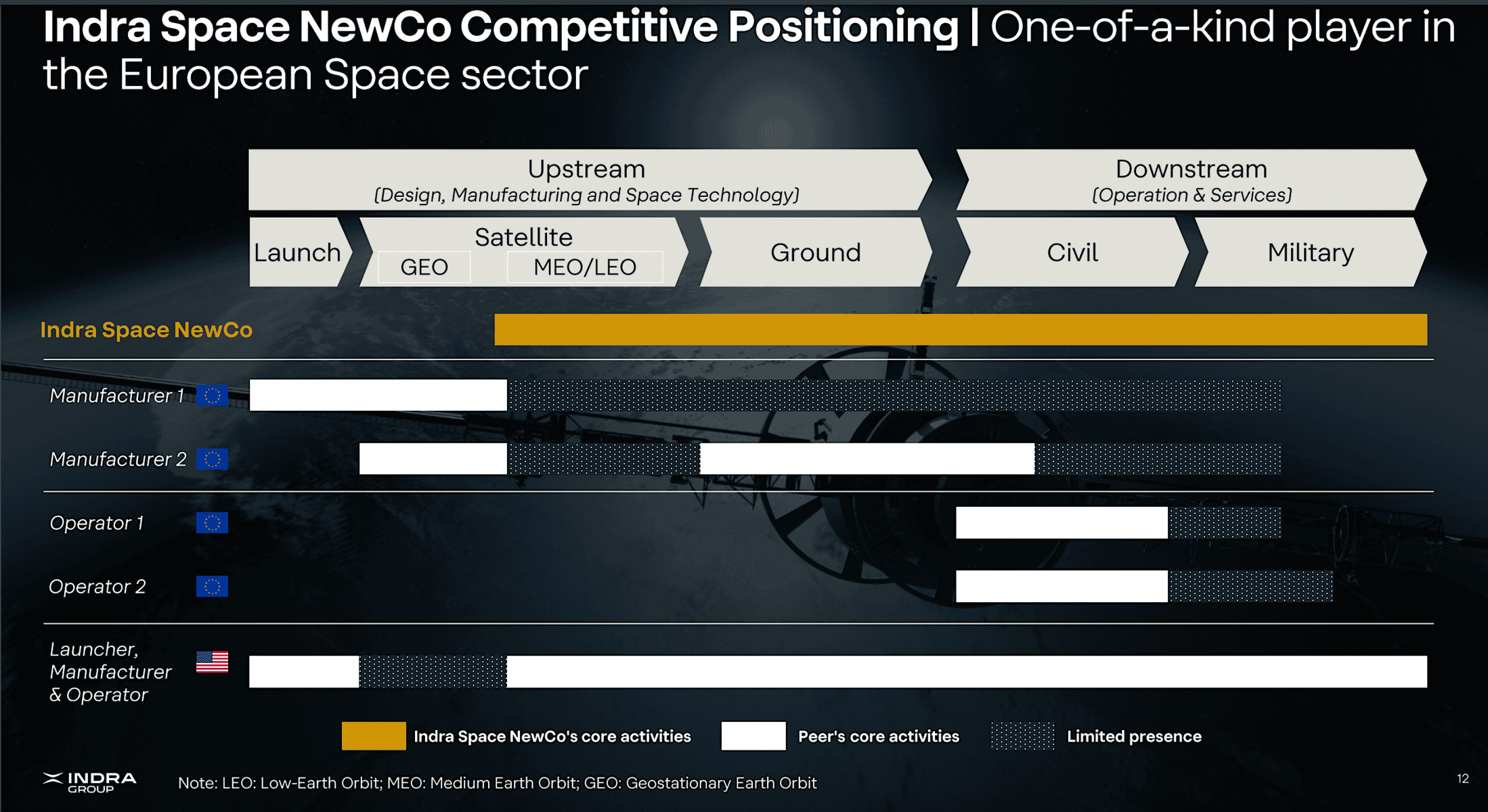
LA PLATA, Maryland — Indra Group of Spain has closed its acquisition of Spanish commercial satellite fleet operator Hispasat and military satellite operator Hisdesat, setting the stage for what Indra sees as a multi-year growth path for enlarged Indra Space.
Indra Group notified Spain’s stock market regulator on Dec. 30 that the transaction, announced Jan. 31, 2025, had been concluded “with the objective of consolidating Indra Group as the reference player in the satellite industry in Spain, pursuing a vertically integrated strategy and a strong commitment to defense through the consolidation of the company Hisdesat Services Estratégicos SA and its participation in the Iris2 European secure satellite connectivity system.”
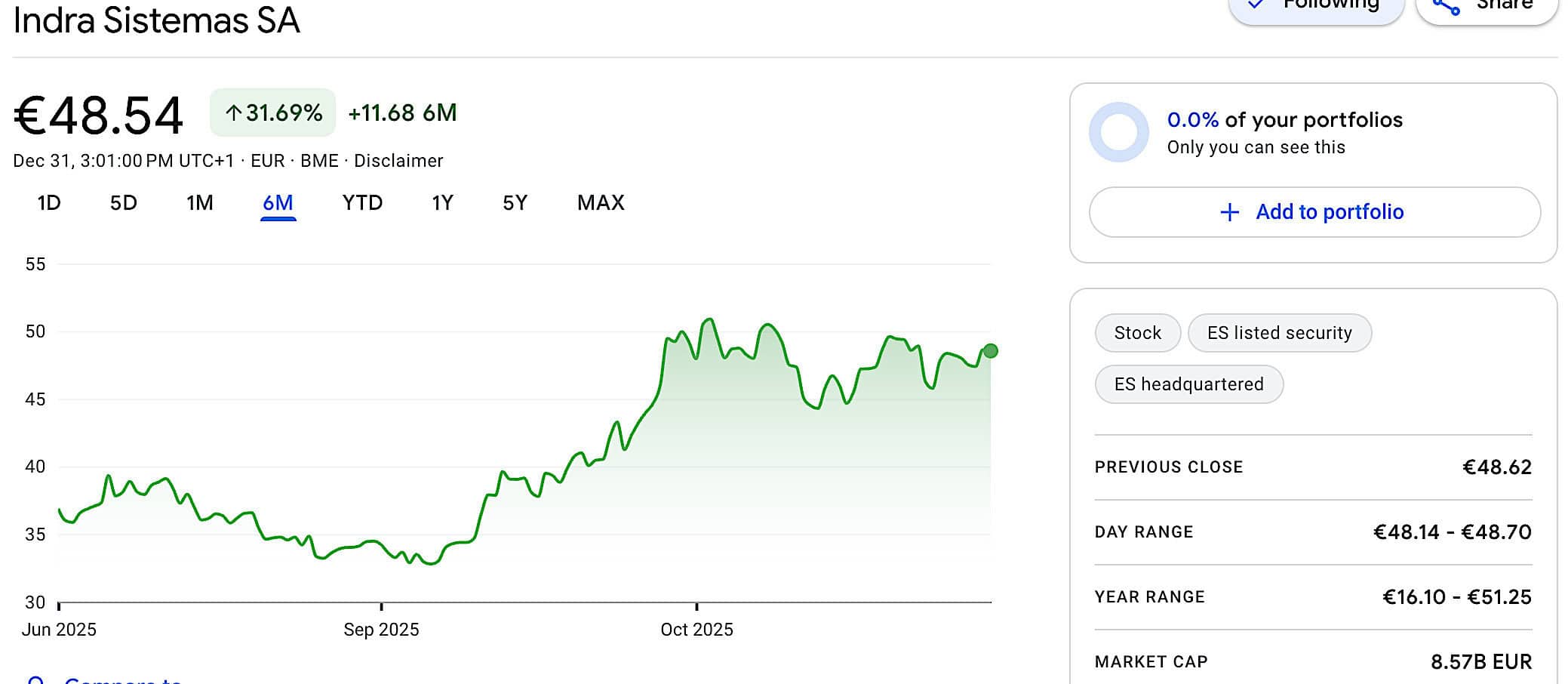
Credit: Google Finance
Indra paid 725 million euros officials have said Indra Space should be able to grow its revenue to 1 billion euros ($1.17 billion) by 2030. The combined revenue of Hispasat and Hisdesat in 2026 are forecasted at 400 million euros, excluding expected synergies of some 25 million euros for the year.
Hispasat reported revenue of 253.4 million euros in 2024, up 1.7% over 2023. Adjusted EBITDA was 142.4 million euros, up 12.8%.
Credit: Indra
Key growth elements of Indra Space’s portfolio include:
— Iris2: An equity stake of up to 600 million euros in the 11-billion-euro Iris2 multi-orbit secure communications network, in which the private sector consortium of SES, Eutelsat and Hispasat plan to invest a total of slightly more than 4 billion euros and the European Commission the remaining sum. Hispasat’s role includes the Iris2 ground segment and responsibility for the “low-LEO” component of the network, to focus on technology demonstration.
— GovSatCom: The launch of the two large SpainSat NG satellites into geostationary orbit in 2025 reinforces Hisdesat’s position as a provider of service to European Union militaries as part of GovSatCom’s pooling and sharing effort. France, Germany, Italy and Luxembourg will also be contributing satellite capacity to GovSatCom.
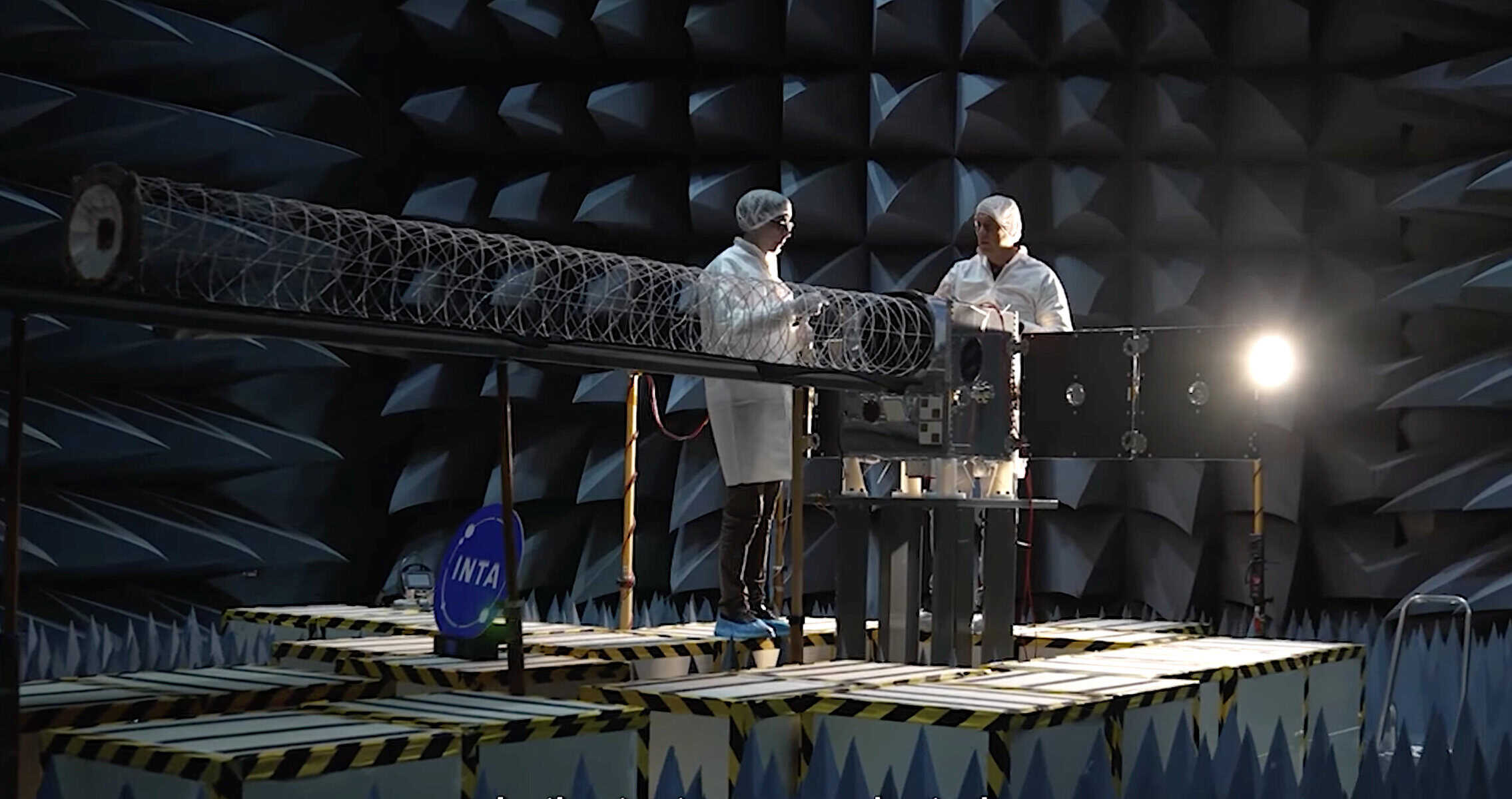
Among the decisions Indra Space needs to make in 2026: Whether to move forward on a constellation of ait traffic management satellites as part of the Startical project with Enaire. Credit: Indra
— Startical: Indra and Spanish air traffic authority Enaire are leading development of a constellation of low-orbiting satellites for global air traffic management using ADS-B and VHF capacity. Startical has been co-financed by the European Union’s Echoes program, part of the Connecting Europe Facility.
Two Startical demonstration satellites were launched in 2025, and Enaire has said the results are in line with expectations. Enaire and Indra will need to decide in 2026 whether to build out the planned 288-satellite constellation. GomSpace of Sweden built the IoD-1 satellite and Kongsberg NanoAvionics of Lithuania was prime contractor for IoD-2.
Indra Space management team
Indra announced that former Hispasat Chief Executive Miguel Angel Panduro will lead Indra Space, with Luis Mayo, an Indra Space director, to become CEO of Hispasat. Ana María Molina, a Hispasat corporate director, will be CEO of Hisdesat.
The strategy behind the Hispasat/Hisdesat acquisition as announced by Indra in early 2025 has only been reinforced in 2025 as the European Commission has doubled down on military and security investment in the face of Russia’s invasion of Ukraine and the Trump administration’s ambivalent view of NATO.
Spain now ESA’s 4th largest contributor
In parallel, Spain has doubled its investment in the European Space Agency (ESA), to 1.85 billion euros over the next three years, following negotiations at ESA’s Nov. 26-27 ministerial council. Spain is now ESA’s fourth-largest contributor after Germany, France and Italy.
Spain’s ESA investment at the ministerial featured a large contribution to the LEO-PNT program in which ESA is fielding a small constellation to demonstrate positioning, navigation and timing technologies in low Earth orbit, using new radio frequencies to mitigate the jamming of US GPS and European Galileo signals. The European Commission will be adopting this program in 2028.