
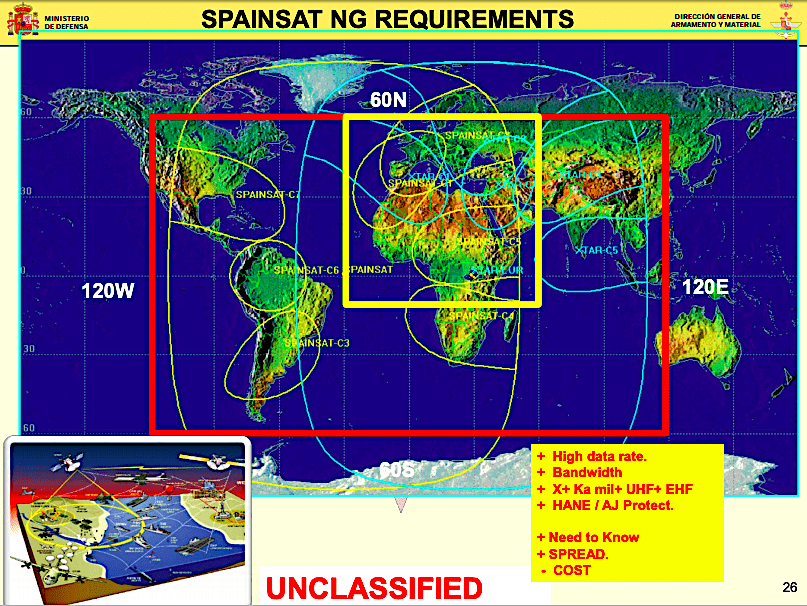
The new-generation Spainsat NG includes UHF capability in addition to X- and military Ka-band. Credit: Spanish Ministry of Defense
LA PLATA, Maryland — The large SpainSat NG 2 military telecommunications satellite launched in October remains stuck in its transfer orbit, apparently unable to move, raising the likelihood of a total loss of mission, industry officials said.
The failure will trigger an insurance claim of $400 million, attributed to space underwriters’ 2025 accounts, and turn what would have been a nicely profitable 2025 into a less-profitable one.
An early estimate of the year for space underwriters is for 2025 premium volume to be $675 million, with claims of $510 million including SpainSat NG 2
The 6,000-kg Airbus-built SpainSat NG 2 failed some time in December and has been in its transfer orbit of 69,650 kilometers by 3,840 kilometers after suffering a sudden failure that owner Indra Group and its Hisdesat military satellite division have ascribed to the impact of “a space particle.”
The failure bears a strong resemblance to the August 2023 failure of the Inmarsat 6 F2 satellite, owned by Viasat Inc. That too was ascribed to a micrometeorite, although several insurance underwriters were skeptical of this. They paid a claim for $348 million.
A similar failure on SpainSat NG 2 is likely to provoke a deeper look by underwriters into the Airbus Eurostar Neo platform and its vulnerabilities.
The two-satellite SpainSat NG program s managed as a public-private partnership between the Spanish Ministry of Defence and Hisdesat under a 19-year contract valued at 1.617 billion euros ($1.9 billion at current exchange rates). Spanish MoD agreed to pay 93.17 million euros per year for a share of the satellites’ resources.
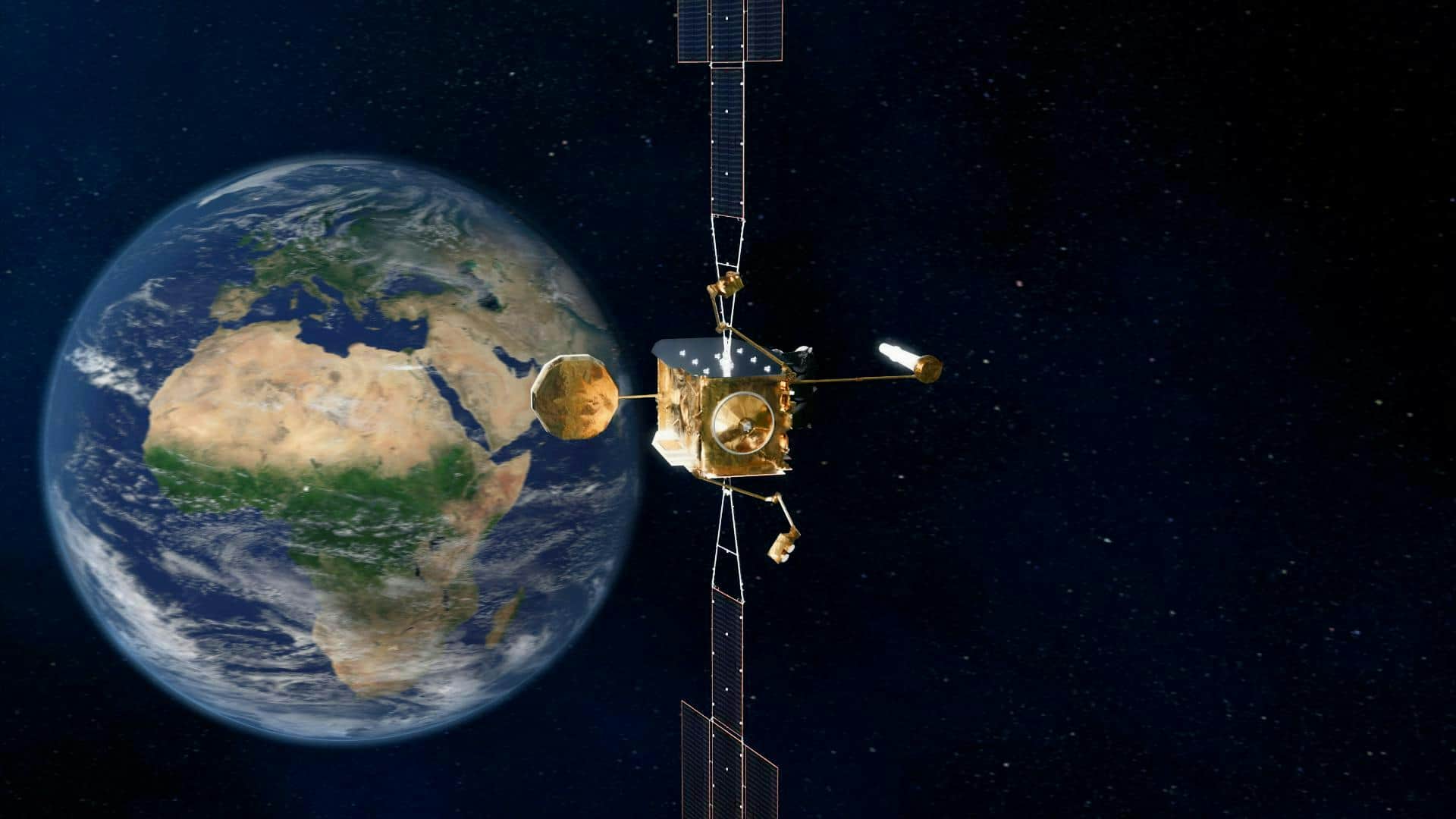
The SpainSat NG 1. Credit: Airbus

SpainSat NG 1 was launched in January and, after suffering an outage for several days, was restored to full service by December and is now operational at 29 degrees east.
Hisdesat and Indra on Jan. 16 announced they would issue a request for price quotes for a SpainSat NG 3 satellite given the likelihood that NG 2 is unable to perform its mission.
“Hisdesat has implemented this measure after analyzing the latest reports by the main contractor,” the company’s statement said. “Although the space particle that collided with the satellite was estimated to be millimetric in size and weigh only a few grams, the high speed of the impact on a vital area of the satellite caused non-recoverable damage.”
Hisdesat did not say whether Airbus had provided any evidence of damage from a micrometeorite or whether on-board cameras had been able to display an impact crater.
“The satellite is stable, complete and in a highly eccentric orbit, in such a way that it won’t interfere3 with any present or future space operations, and its loss wont cause any economic harm, as it’s insured against this kind of damage,” Hisdesat said.
Hisdesat said SpainSat NG1 and the aging SpainSat, at 30 degrees west, will provide uninterrupted service.
“Hisdesat remains committed to the strategic goals of the SpainSat NG program and the provision of the planned services.”
Beyond the Spanish military, Hispasat is free to market the remaining X-, Ka- and UHF-band satellite capacity to other governments and has secured agreements with the Belgian and Spanish defense ministries for SpainSat NG capacity.
Hisdesat also secured a commitment from the NATO alliance, with Spain joining the United States, France, Britain, Italy and Luxembourg in the NATO Satcom Services 6th Generation consortium. Spain and Luxembourg, though the GovSat company, joined the NATO consortium in April 2025.