
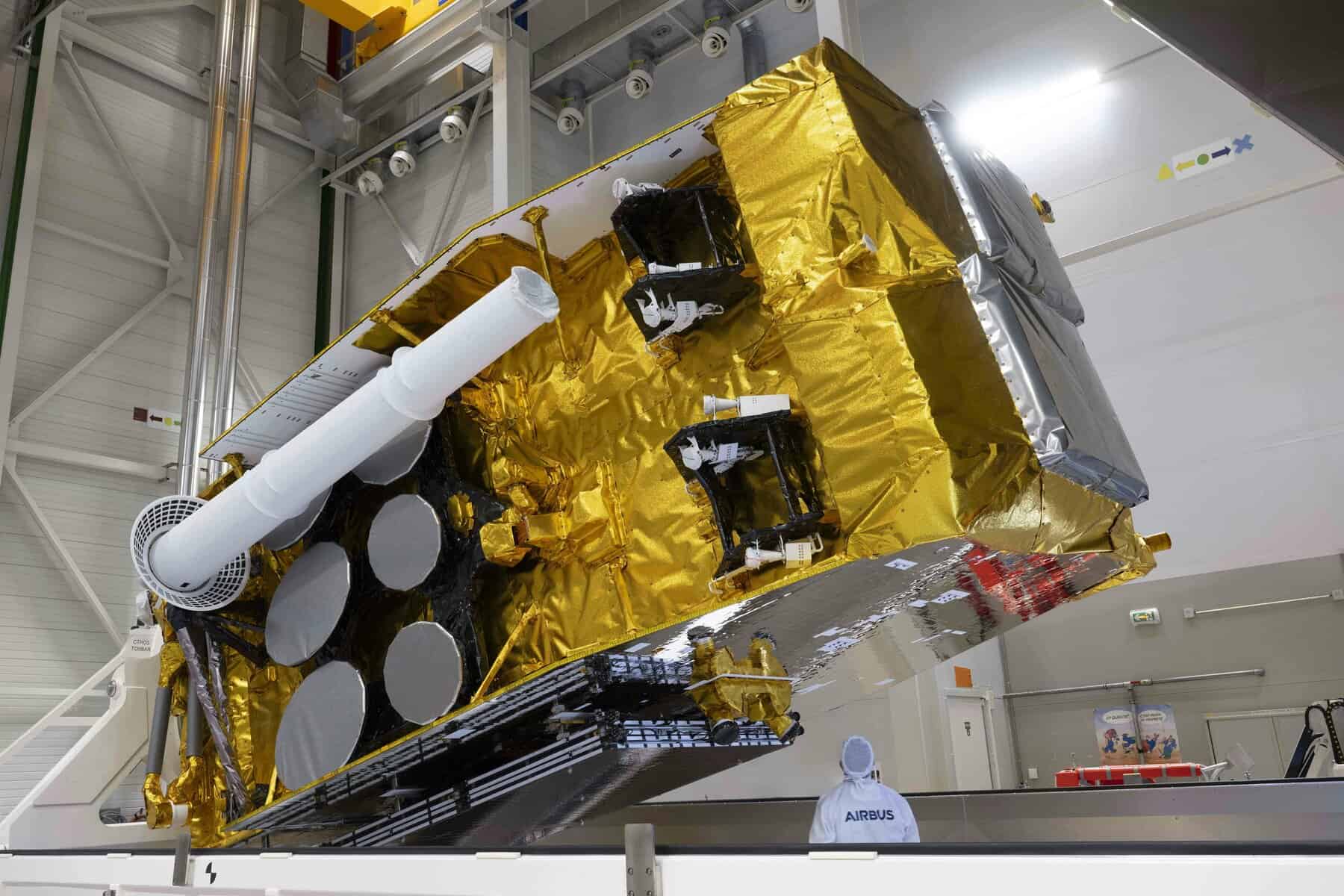
The SpainSat NG 2 being prepared for shipment. Credit: Airbus Defence and Space
LA PLATA, Maryland — The SpainSat NG 2 military telecommunications satellite launched in October has suffered a failure that owner Indra Group said was caused by “the impact of a space particle” as the satellite was making its way to its final position in geostationary orbit.
In its Jan. 2 statement, Indra, which as of Jan. 1 is majority-owner of commercial satellite fleet operator Hispasat and the Hisdesat military satellite operator, which owns the satellite, said Hisdesat has implemented a contingency plan to assure that the Spanish Ministry of Defense and other SpainSat customers are not affected.
“The incident occurred at a distance of 50,000 kilometers from Earth. Hisdesat remains committed to the strategic objectives of the SpainSat NG program and the provision of the planned services,” Indra said. “The technical team is analyzing the available data to determine the extent of the damage. If necessary, SpainSat NG 2 will be replaced as soon as possible.”
SpainSat NG consists of two identical 6,000-kg X-, Ka- and UHF-band satellites that were contracted with an Airbus Defence and Space-led consortium in April 2019. Thales Alenia Space and a multiple Spanish companies were involved in the satellites’ construction. The satellites use Airbus’s Eurostar Neo platform.
The satellites’ steerable Ka-band antennas were developed under the Paris 3 Partnership Project managed by the 23-nation European Space Agency (ESA). The X-band antenna system includes an active array that can shift capacity based on demand. The antenna is also capable of locating and disabling jamming attempts.
SpainSat NG 1 satellite suffered power loss but was returned to service
SpainSat NG 1 was launched in January and last summer suffered an on-board anomaly that caused the satellite to tumble in orbit for several days, raising fears that its instruments could freeze.
Industry officials said at the time that a software patch uploaded to the satellite had resolved the issue, and that measures were taken to assure that the same issue did not recur on SpainSat NG 2, whose launch proceeded as scheduled in October. Both satellites were launched by SpaceX Falcon 9 rockets.
Similarities with Viasat’s Inmarsat-6 F2 incident in 2023

The SpainSat NG 2 incident resembles the August 2023 failure of the Airbus-built Inmarsat-6 F2 satellite due to a power-system anomaly during its orbit-raising following a successful launch, shortly after Viasat Inc. purchased Inmarsat. At the time, Airbus had said the incident was unprecedented, and that none of its geostationary-orbit satellites had ever suffered in-orbit failures. The incident was subsequently ascribed to a micrometeorite..
Insurance underwriters were skeptical about that explanation but nonetheless paid a $349 million claim.
The Indra statement did not specify what led to the conclusion that the anomaly was caused by impact from an external source, or whether the satellite was responding to ground commands. One industry official said the failure occurred in mid-December.
Each SpanSat NG insured for around $400 million
Each SpainSat NG satellite was insured for around $400 million, industry officials said. To date there has been no formal insurance claim filed for SpainSat NG 1.
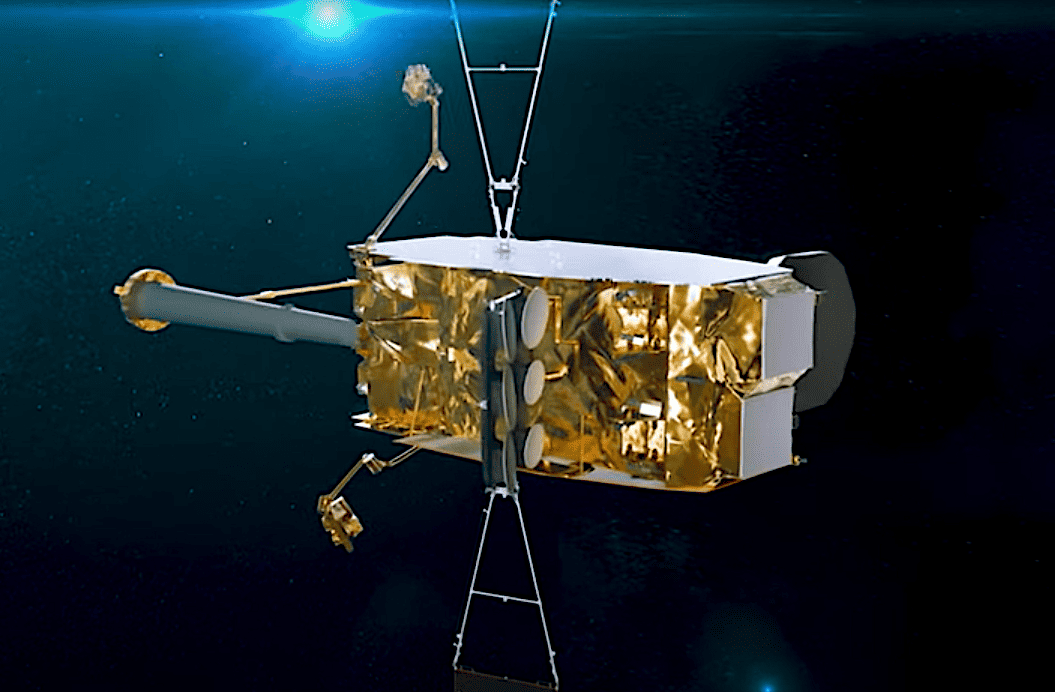
SpainSat NG. Credit: Airbus Defence and Space
The two-satellite SpainSat NG program s managed as a public-private partnership between the Spanish Ministry of Defence and Hisdesat under a 19-year contract valued at 1.617 billion euros ($1.9 billion at current exchange rates). Spanish MoD agreed to pay 93.17 million euros per year for a share of the satellites’ resources.
Hispasat was free to market the remaining capacity to other governments and has secured agreements with the Belgian and Spanish defense ministries for SpainSat NG capacity.
Hisdesat also secured a commitment from the NATO alliance, with Spain joining the United States, France, Britain, Italy and Luxembourg in the NATO Satcom Services 6th Generation consortium. Spain and Luxembourg, though the GovSat company, joined the NATO consortium in April 2025.
The European Commission has included SpainSat NG into its GovSatCom Hub program, which pools resources from several satellites owned by several EU nations.