

Starlink’s D2D satellite. Credit: Starlink 2025 Progress Report
LA PLATA, Maryland — SpaceX Starlink in 2025 increased satellite and user-kit production, reduced satellite jitter to boost its satellite lasers’ throughput and posted a 50%+ boost in average download and upload performance.
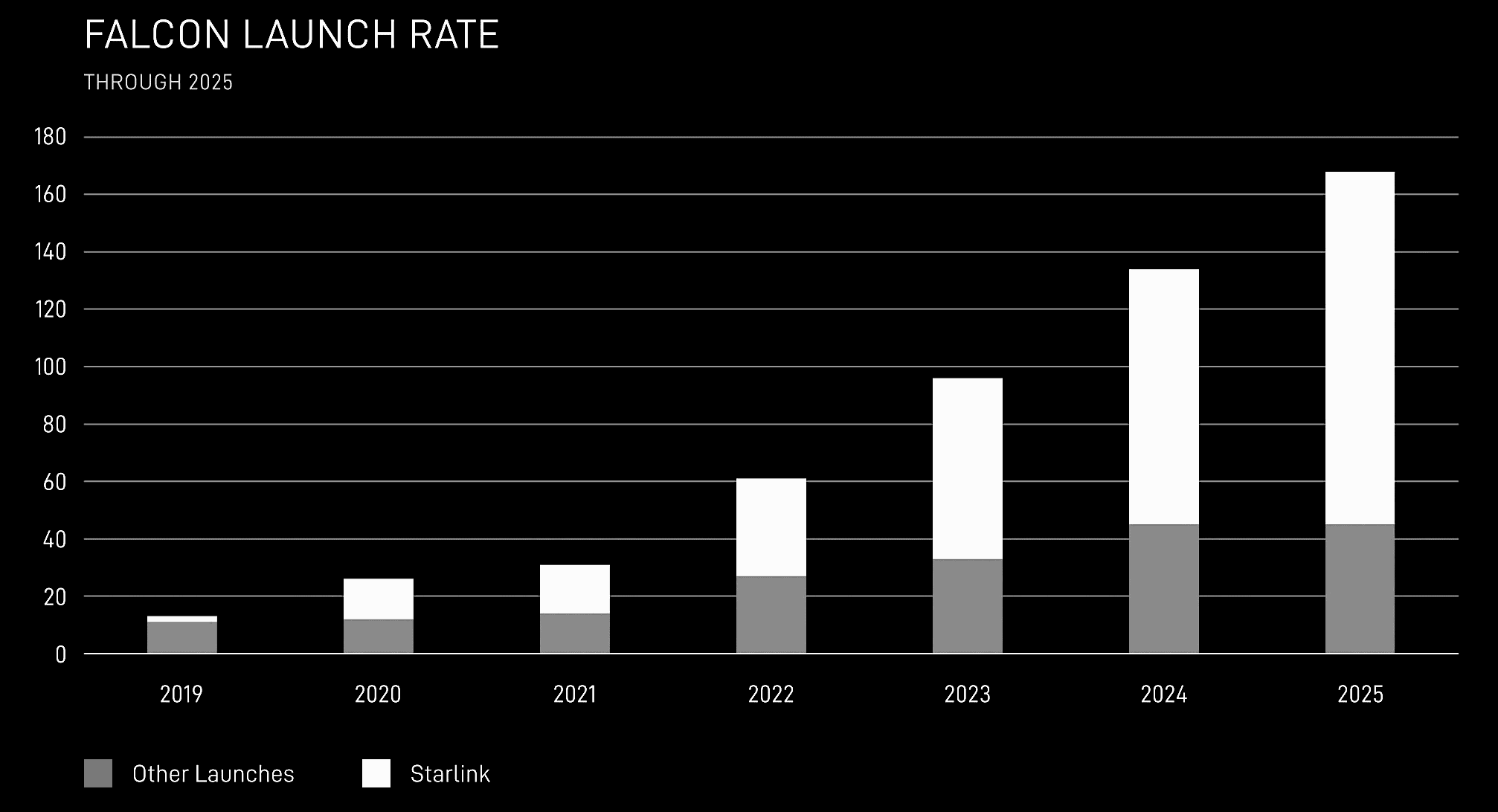
While maintaining a high rate of dedicated Starlink launches aboard the Falcon 9 rocket — 120 flights of the V2 Mini satellites, which weigh 575 kg less than the previous version — SpaceX was able to deploy more Starlinks per launch, with more than 3,000 V2 Minis orbited during the year.
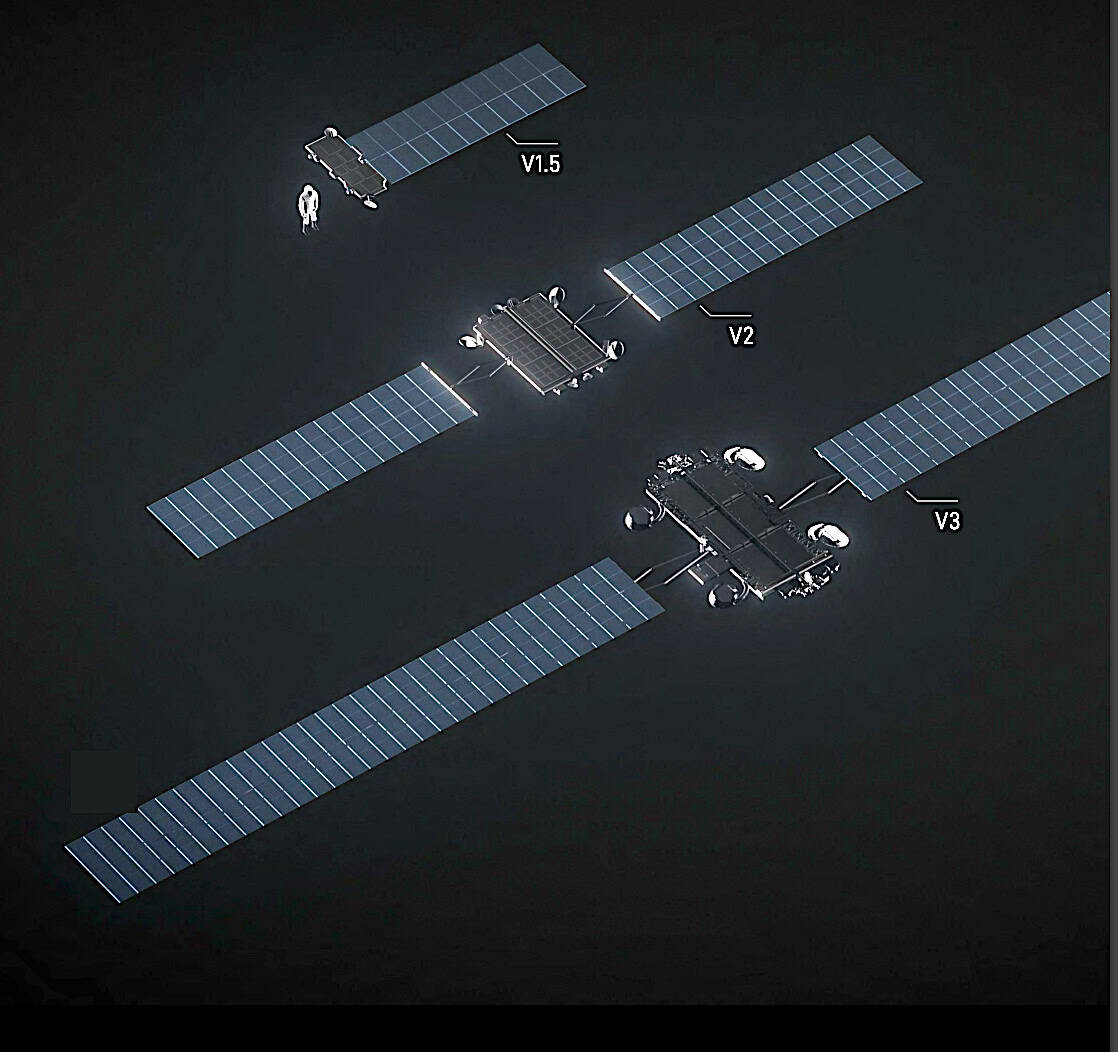
Starlink V1.5, V2 and V3 satellite evolution. Starlink expects the V3 satellites, which launch starting in 2026, to provide more than 1 Tbps of downlin and more than 200 Gbps of uplink, respectively 10x and 24x the performance of the V2 model. Credit: Starlink 2025 Progress Report.
Starlink’s 2025 Progress Report, published Jan. 1, must make for uncomfortable reading by Starlink competitors, both for broadband and direct-to-device (D2D) service, which require different satellite designs.
Nothing is forever, but it’s worth asking how many years it would take any current competitor, even well-endowed players like Amazon Leo, to equal Starlink’s reach and performance.
Credit: Starlink 2025 Progress Report
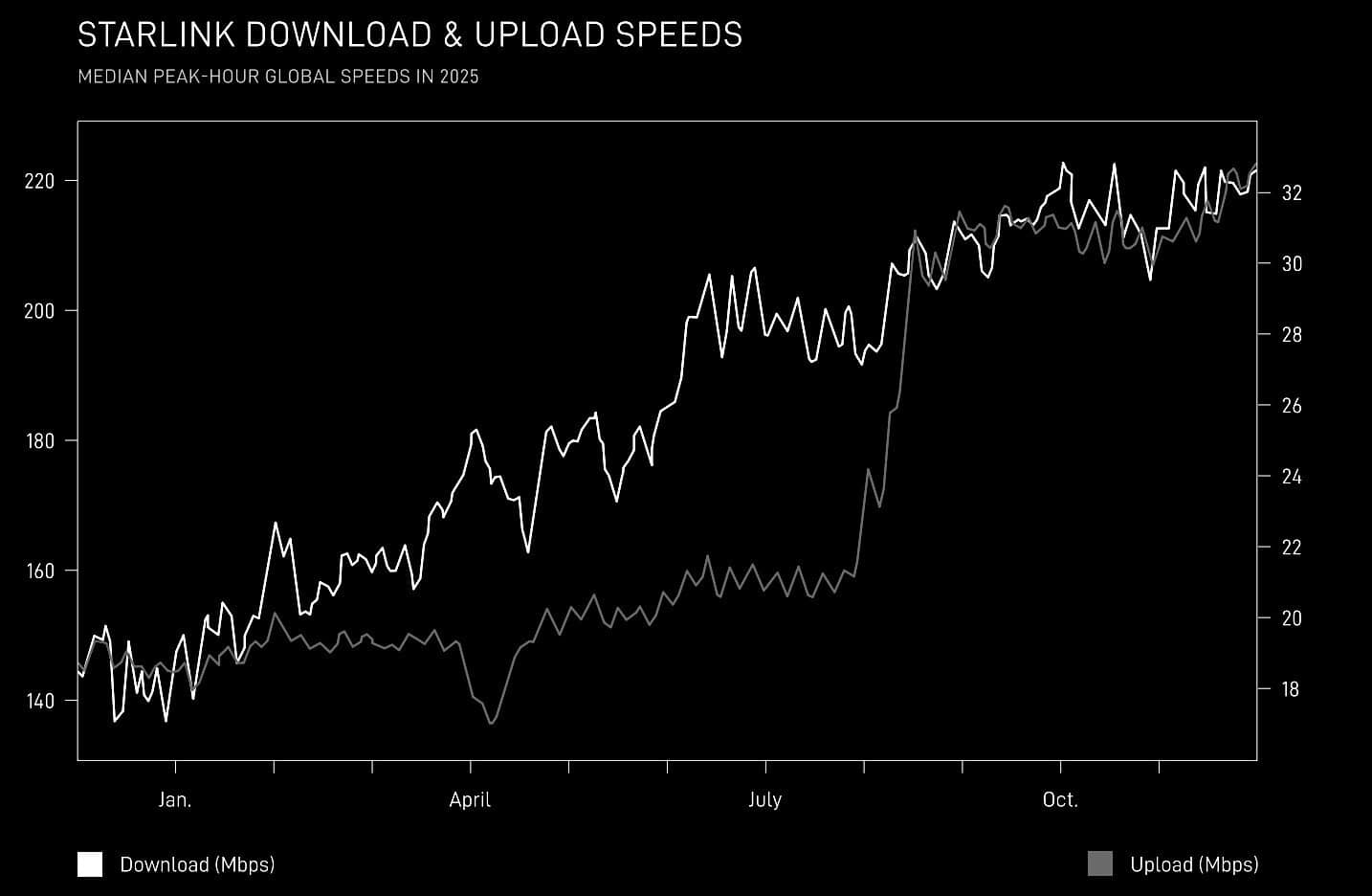
Starlink said median peak-hour downloads in 2025 averaged over 200 Mbps, with uploads more than 30 Mbps, 50% faster than in 2024. Median global latency was 25 milliseconds. The company said its goal is 20 milliseconds.
Major facility expansions increased satellite production capacity in Redmond and Woodinville, Washington, to 70 Starlinks per week. Adding 1 million square feet (92,900 square meters) in of factory space in Bastrop, Texas, accelerated Starling terminal production to 170,000 per week, the company said.
Starlink deployed more than 650 direct-to-device (D2D) satellites in the 18 months since it began launching them. These spacecraft operate at 360 kilometers, to better close the link between the satellites and user smartphones or other devices.
With its purchase of licensed mobile satellite service radio spectrum from EchoStar Corp. in 2025 — regulatory approval is expected by mid-2027 — SpaceX will be ramping its D2D service quickly.
The company said its second-generation D2D satellites will have 100 times the capacity and 20 times the throughput of the current-generation spacecraft, allowing it to claim performance that competitor AST SpaceMobile has made for years but that many have found far-fetched.
““In most environments, this will enable full 5G cellular connectivity with a comparable experience to current terrestrial service; and with partnerships with MNOs, will augment high-capacity terrestrial 5G networks.
“Customers will be able to experience high-speed internet connectivity on their smartphones, with the ability to stream movies, make video calls, listen to podcasts and work remotely, seamlessly transitioning between satellite and terrestrial networks without interruption or degradation in service.”
Credit: Starlink 2025 Progress Report.
That’s what you get when you have the satellite production and launch resources to throttle deployment far beyond what anyone else can do.
Starlink more than doubled its subscriber count in 2025, to more than 9 million, with more than 9,000 Starlink satellites in service at the end of the year.
Following on its landmark agreement to provide ruggedized Starlink terminals to owners of John Deere agricultural vehicles, Starlink in 2025 concluded similar partnership agreements with Stara and CNH.

Credit: Starlink

More than 1,400 commercial aircraft were fitted with Starlink terminals in 2025, four times the installation rate of 2024 including over 80 Airbus A350s. Business jet installations, which totaled some 200 aircraft a year ago, surpassed 1,000 as of Dec. 31.
Starlink’s maritime customers have installed units on more than 150,000 vessels, including a “community gateway” on the Royal Caribbean Star of the Seas, which entered service in August. Starlink said the network provides 10 Gbps of symmetrical throughput to the ship’s 5,600 passengers.

Credit: Starlink
Starlink manufactures its own laser terminals to provide links between satellites. An ongoing series of upgrades will allow a 2x-3x reduction in ping loss in the laser signal, which in 2026 will booster laser throughput to 400 Gbps, the company said. Each V2 Mini satellite has three lasers.
All these things Starlink can do on its own, so long as it continues to attract first-rate engineering talent and capital.
What it cannot control is the orbital environment in which it operates, even if Starlink accounts for some 80% of all satellites currently in operation.
The volume of satellite hardware and rocket bodies being launched into low Earth orbit and then being deorbited from their at the end of their missions is increasing to a point that collisions between satellites, or between satellites and rocket bodies or other debris, is a real concern.
Most observers agree that companies like Starlink and the future Amazon Leo are taking the steps needed to reduce the risk of collisions in low Earth orbit and the risk that pieces of retired satellites survive atmospheric reentry and cause damage on Earth.
Lowering 4,400 Starlinks’ orbit to 480 km in 2026
In a Jan. 1 post on X, Starlink Engineering Vice President Michael Nicolls said the company “is beginning a significant reconfiguration of its satellite constellation focused on increasing space safety.”
By the end of 2026, the approximately 4,400 Starlink satellites now orbiting at 550 km will be lowered to 480 km.
Credit: NOAA
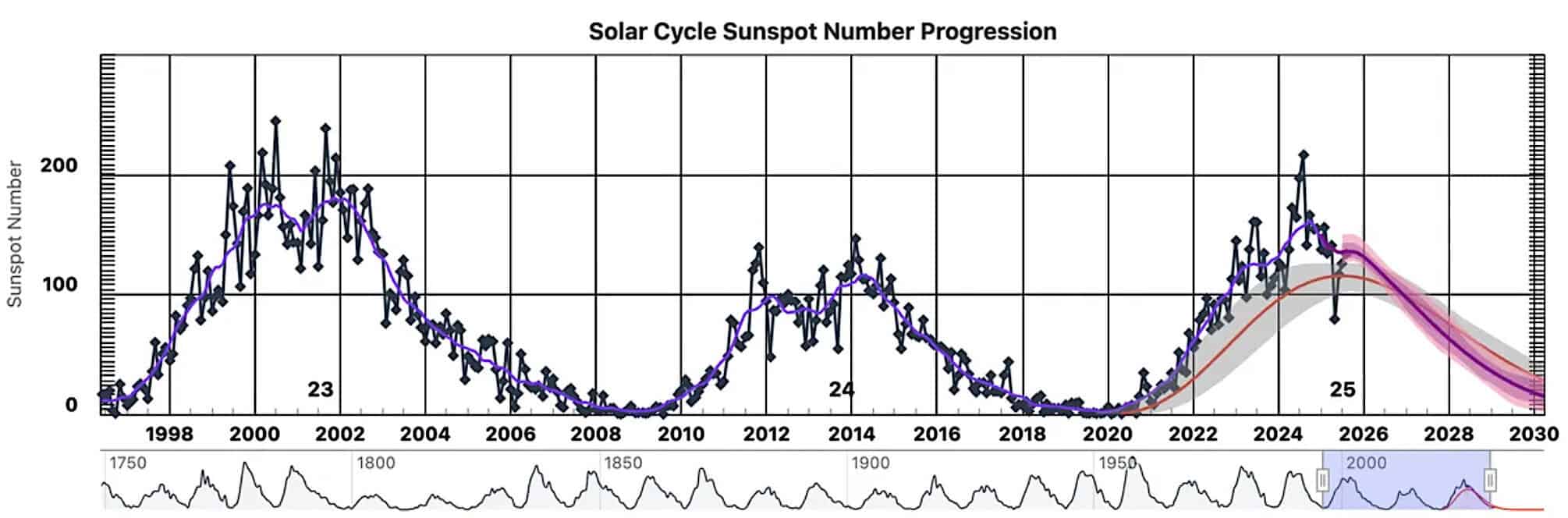
The intent is to speed the atmospheric reentry of failed satellites on the approach of a new 11-year solar cycle. Peak solar activity, or Solar maximum, occurred in early 2025. This causes the atmosphere to expand, allowing satellites in low Earth orbit to deorbit more quickly on their own as they are slowed by the residual atmosphere.
That disappears with solar minimum, when “decay time at any given altitude increases. Lowering [the orbit] will mean a more than 80% reduction in ballistic decay time i solar minimum, or 4+ years reduced to a few months,” Nicolls said, reducing collision risk.
Nicolls said only two satellites of current constellation of 9,000 satellites includes have failed.
“While we design with the intent to be confident that satellites demise with extremely low impact energy of any surviving components, we also retain the paranoia that we might be wrong,” Starlink says in its 2025 review.
“Successful targeted reentry requires maintaining attitude control down to very low altitudes, around 125 km, [which] allows us to fly satellites along a reference trajectory, using variable drag instead of propulsion to remove energy form the orbit. With this approach we are able to track an atmospheric entry point to within 10% of an orbit’s ground track, or around 10 minutes, which is sufficient accuracy to successfully target reentry of the entire potential debris ellipse over the open ocean.”
And if a Starlink component does survive reentry? The company says it is “targeting an impact energy of less than 3 Joules at the component level.” The current US Orbital Debris Mitigation Standard Practice calls for a maximum of 15 Joules, considered large enough to cause harm.