

Chris McLain. Credit: AscendArc
LA PLATA, Maryland — Startup small geostationary-orbit satellite manufacturer AscendArc, founded in 2023, has sold its first satellite to Korea Telecom’s KT Sat satellite operator for deliver in late 2027 by promising 400-500-Gbps throughput in a satellite weighing 1,000-1,500 kilograms and costing less than $100 million.
US-based AscendArc and KT Sat announced the contract on Sept. 4. KT Sat Chief Executive Young-soo Seo outlined why it selected a company that has yet to build its first satellite ahead of more-experienced competitors.
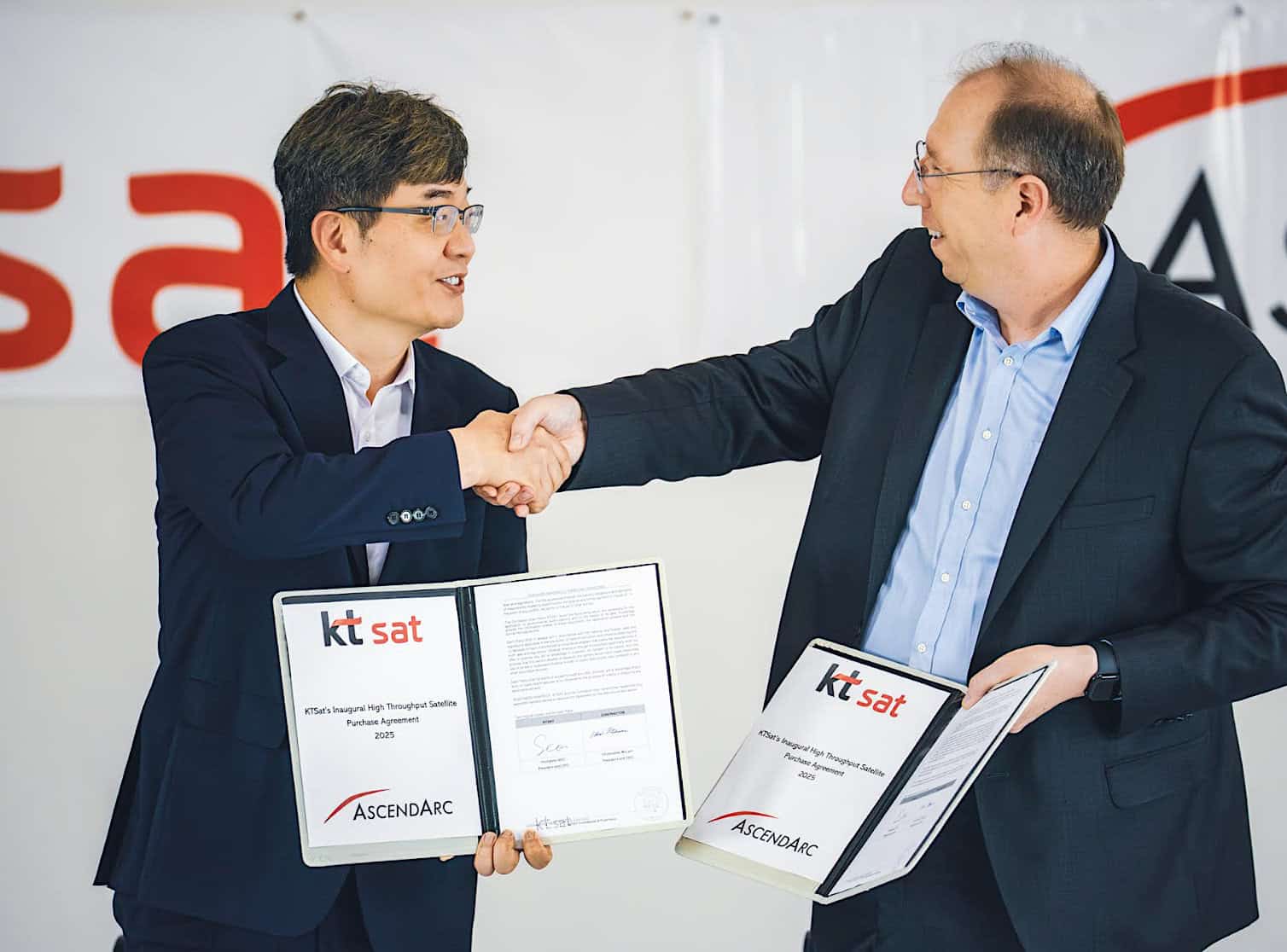
KT Sat CEO Young-soo Seo and AscendArc CEO Chris McLain. Credit: AscendArc
“The cost of terrestrial fibre solutions has stagnated, and so there is too often a negative return on investment to deliver access to more remote or poor regions. And while some recent new satellite options have helped, they simply do not lower the cost enough to penetrate as far as needed. AscendArc stood out for its cost-efficiency, flexibility, and scalability. Our high throughput satellite will serve as the cornerstone of regional expansion.”
In an interview, AscendArc Founder and Chief Executive Chris McLain — ex SpaceX, Panasonic, Boeing, Lockheed Martin — outlined the company’s business strategy and near-term goals, including a Series A funding round that’s needed to complete the KT Sat contract and scale capacity for future orders. The KT Sat contract includes an option that McLain described as “attractively priced.”
Geostationary orbit is not considered the most exciting part of the market these days. What do you see that others don’t?
It’s the part of the business that has historically been the most profitable. There have been a lot of people who have gone bankrupt trying to build LEO constellations. Others have tried other services but those have not been goldmines.
If you look at what has reliably made money in space, it’s geostationary communications. We think there is a lot of life and interest in that and opportunity yet to be tapped in that area.
You mean national satellite operators that want broadband but don’t want to be beholden to a global constellation domiciled outside their territories?
Yes, there is a big market for sovereign communications. That’s our beachhead. There are a lot of people who look at satellite communications as critical infrastructure and want to have that controlled locally. That’s something we can provide. We can sell a satellite like we’re selling to KT Sat and have that can be locally controlled. Nobody can turn it off and there’s no political influence there. That has a value to people.
The other thing that we provide is overwhelming economics — order-of-magnitude better than anything else out there, including Starlink. That allows us to grow beyond a limit number of nation satellites or satellites focused on sovereign communications.
“Order of magnitude” meaning really 10X?
Yes, that’s what we mean.
You know approximately what direct competitors Astranis, which leases satellites to its customers; and Swissto12, which is a conventional sales model, are selling their products for. You can provide 10x the value?
We will support both models — a sales model, which is what we’re doing with KT Sat; and a lease model. Obviously if you’re interested in sovereign control you are going to want to buy the asset and own it, and not have it leased and controlled from the United States.
Our purchase price is going to be a little bit lower than theirs, but we provide order-of-magnitude more capacity for that dollar, and an order-of-magnitude-lower cost megabit per bit per second. This is, ultimately, what the end customer wants.
So similar pricing for something that is at least 10 times higher, potentially 50 times higher, than the Swissto12 and Astranis capacities, depending on which model you’re talking about.
We are providing upwards of 400-500 Gbps as a maximum throughput, so a satellite more comparable to a [EchoStar Hughes] Jupiter 3 than to Astranis capacity, but at the Astranis price point or perhaps a bit less. That means you can provide services to your end customers at prices lower than Starlink, potentially.
Jupiter 3 was 9,000 kilograms. Replace chemical with electric and it would have been around 5,500 kg. You are providing that capacity for a satellite with a launch mass of 1,000-1,500 kg?
Somewhere in that ballpark. A couple of things provide us with that advantage. We have a spacecraft design that involves very large apertures. Aperture allows you to have small spot beams and large frequency reuse, and allows you to have a low-power payload. We exploit that to get a lot of capacity out of a relatively low number of kilograms and a relatively low number of kilowatts.
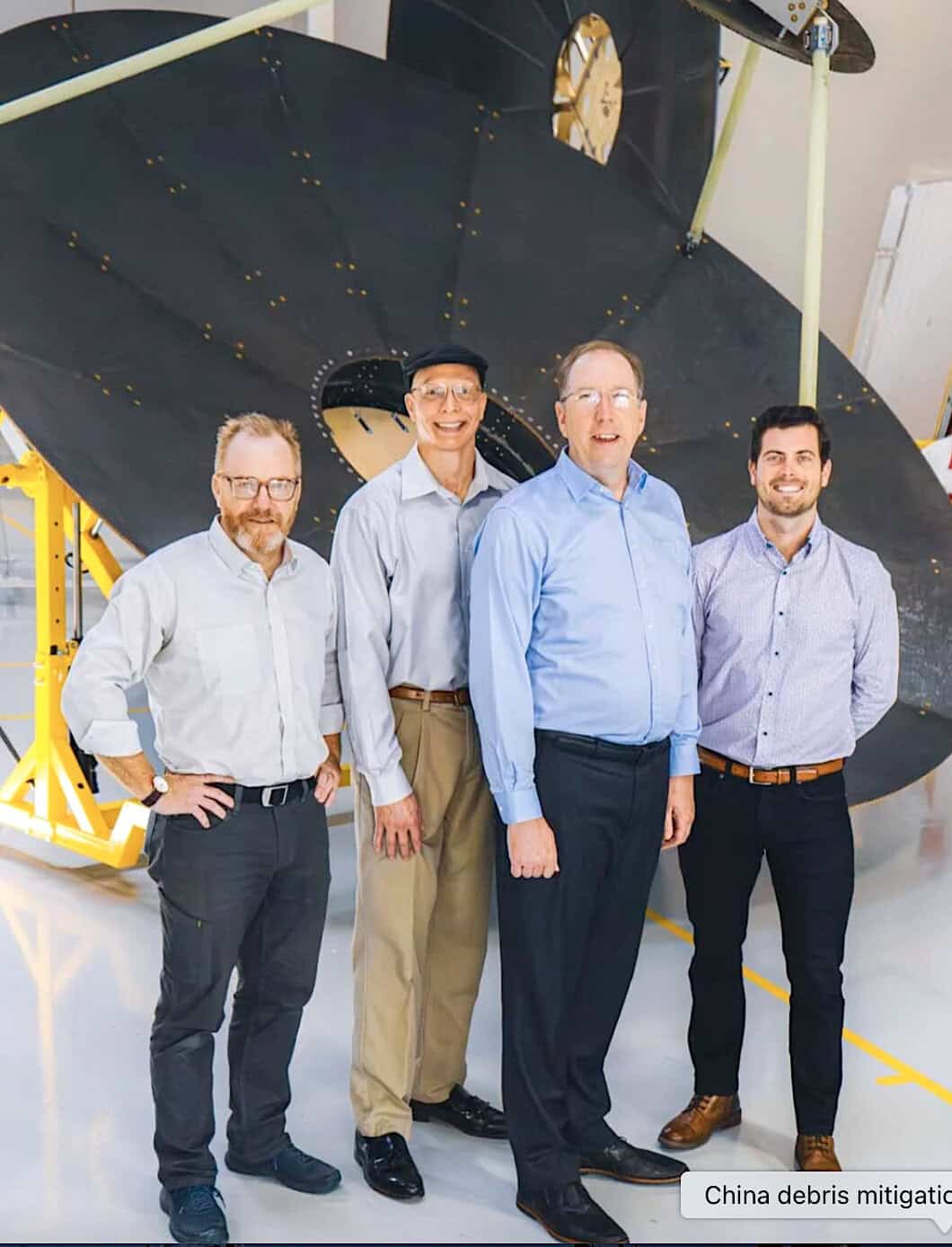
AscendArc personnel in front of the kind of antenna they’ll use to provide 400-500-Gbps capacity on a satellite weighing less than 1,500 kg. Credit: AscendArc
These are deployable mesh antennas?
A: Large-area antennas.
Your model is vertical integration, correct?
For the payload. We’re building all the payload technologies in-house, with a couple of selected partners for things like 3D printing. That’s the unique aspect of our project.
We’re working with external partners for the bus subsystems. We don’t need to reinvent the reaction wheel or the star tracker. Those things are available at reasonable cost and reliability off the shelf.
What about electric propulsion? That has been a pain point in the industry in the past couple of years, as the US Space Development Agency (SDA) will attest.
We are buying the thrusters from an established manufacturer in the United States that has lots of flight heritage. We are not relying on a new provider, with flight heritage components. We can put efforts into things that are unique to us — the payload.
We have tried to emphasize a lot of internal prototyping. At this point we have on the lab bench all of our electronics, the basic circuits for our satellite so that we can retire all that risk up front.
We’re taking a rapid-prototyping approach. We are hardware-rich and we’ve got all of the primary components that go into the satellite built at some stage so that we can verify the performance and verify that we’ve got a path to delivery. Almost all of it is in some form of hardware at this point.
KT Sat is buying your Ka-band satellite. Is that what you expect from most prospective customers?
You certainly get the best economics in Ka-band. We have done development work in Ku- and we’ve had a number of SBIR [Small Business Innovation Research] contracts with the Air Force to do designs in UHF-, X- and military-Ka bands. We can do a version of the satellite over a range of different frequencies. We expect Ka- will be the most popular, followed by Ku- and then X- or C- or UHF.
Whose responsibility is it to procure a launch service?
Ours. We’re having discussions a number of providers. There are a number of possible flights. It’s a matter of finding the most cost-effective one that lines up in the window.
We’re saying we are a ride-share mission, so we’re not taking an entire launch vehicle. We’re looking for partners to fly with.
But these would be satellites also going to GEO?
We’re capable of direct to GEO, GTO and LEO-to-GEO. it takes bit longer but we can potential go with a SpaceX ride-share mission.
That would take six months or so to get to GEO from LEO. That can work for you?
Yes. One reason we can is that we have a very high power-to-mass ratio, meaning you can do rapid orbit-raising, so two months for GTO to GEO, and 4-6-month LEO to GEO transfer. That will open a lot of possibilities.
About financing: You will need to scale. In five years, assuming the market responds as you hope, what average production do you see — 10-15 per year?
Yes, that’s our goal. We will have to grow out of our current space of ones and twos. Then upwards of 15 per year. That does not require a huge amount of space.

AscendArc partners and investors. Credit: AscendArc
You have raised $4+ million. You’ll need more to scale, correct?
Yes, we’re in the middle of a Series A raise now. We’ll raise a substantial amount of equity and we are also actively in discussions for debt facilities to give us working capital to buy parts and launches, without necessarily raising equity to cover the cost of the first and subsequent missions.
And without diluting the current owners…
That’s the idea! We’re hoping to finish that in the next three to six months. Our capital requirements to get through the development are pretty modest and we already have a fairly large amount of that committed from existing investors. Getting to our goal seems fairly achievable in that time period, especially with the KT Sat announcement.
We haven’t heard much from the US Export-Import Bank. Is that on your radar?
Yes, that’s one of the avenues we have been looking at. We’ve had meetings with them and they are very supportive. We are fortunate inn that we fall under a number of different categories there and we’re exactly what they’re supposed teen foster — an export-based US company. And the bite that we would take in terms of credit is much lower than someone with a $500-million satellite.
We’re hopeful that that avenue will pan out.