
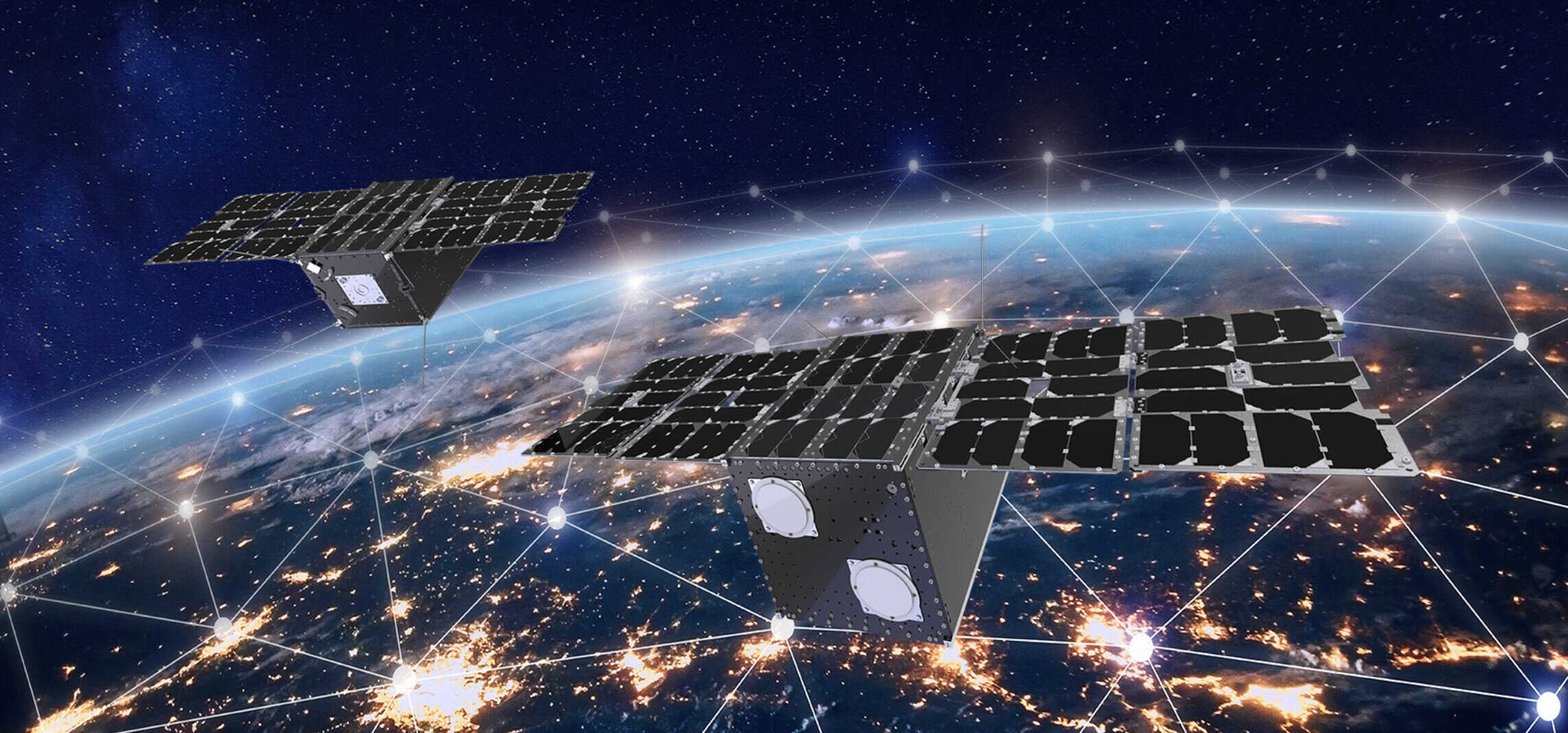
Omnispace’s Spark 1 nad Spark 2 satellites. Credit: Thales Alenia Space
LA PLATA, Maryland — Two struggling satellite direct-to-device operators, Lynk Global and Omnispace, are merging to combine Lynk’s relationships with some 50 mobile network operators (MNOs) whose spectrum Lynk will use with Omnispace’s 60 MHz of S-band spectrum licensed for mobile satellite services.
The move, announced Oct. 22, follows similar transactions by SpaceX, whose Starlink D2D offer began with using MNO spectrum and since has augmented that by purchasing EchoStar’s S-band assets; and by AST SpaceMobile, which began with MNO spectrum and has since purchased Ligado Networks’s L-band assets.
The question for both companies is whether the merged entity will be more successful in getting financing than they were separately. Both have been trying for years to secure the resources needed to build out their constellations.
Satellite fleet operator SES in March announced an investment in Lynk Global, but since then has not made clear exactly what it wants to do with it, and specifically if it will finance Lynk’s buildout of hundreds of small satellites.
“Following the merger, SES will become a major strategic shareholder, facilitating a robust deployment of D2D and IoT services for MNOs, enterprise and government customers as part of a multi-orbit, multi-spectrum network architecture,” the two companies said in their merger announcement.
SES Chief Executive Adel Al-Saleh said the merger “will offer SES access to new LEO capabilities that align with our strategic to diversify into this high-growth segment.
“The merger pairs an industry-lading global spectrum portfolio with a disruptive, cost-effective satellite technology platform — accelerating deployment and delivering significant value to our commercial and government customers,” Al-Saleh said.
SES did not immediately respond to questions about whether the merger would trigger a near-term investment in a LEO constellation.
The companies’ announcement said: “SES, a current investor in both companies, will deepen its partnership profile following the merger, ;providing access to its multi-orbit network and globally deployed ground infrastructure. SES will also support the engineering, operations and regulatory needs of the combined entity.”
Lynk, a pioneer in D2D technology, operates five satellites in low Earth orbit and already offers commercial service in several nations for store-and-forward messaging. The company has said it would need at least 25 satellites to offer global messaging every 30 minutes, and many more to offer continuous connectivity and the company’s goal of a broadband service.
Omnispace since 2012 has operated the F2 satellite in medium Earth orbit, which was launched in 2001 for the now-defunct ICO Global Communications. Omnispace in 2022 launched two satellites into LEO as part of its Spark technology-validation program.
Lynk had hoped to accelerate deployment of its constellation in a merger with Slam Corp., a Special-Purpose Acquisition Company (SPAC), that never solidified into a partnership. The two companies parted company in July.
Lynk said in a February filing with the US Securities and Exchange Commission that it had raised $85.2 million of a planned $214-million offer of equity. This occurred just weeks before SES’s announcement of an investment in Lynk’s Series B financing round.