

Credit: Telesat
TUPPER LAKE, NY — Telesat Canada’s heritage fleet of 14 geostationary-orbit satellites’ business has shrunk so far that its total backlog is less than that of the Telesat Lightspeed LEO broadband network, still two years away from commercial service.
Telesat had predicted this would happen, but the speed of the turnaround is still striking to witness.
In the six months ending June 30, Telesat revenue dropped 27%, to 223 million Canadian dollars ($162.1 million), mainly due to non-renewals of contracts from North American direct-to-home satellite television providers including Dish Network and Rogers.
Telesat’s adjusted EBITDA, which historically has been among the highest in its peer group, was 56.6% for the six-month period compared to 70.3% a year ago.
“On GEO, the reality is it’s generating a lot of cash right now,” Telesat Chief Executive Daniel S. Goldberg said in an Aug. 6 investor call. “We haven’t been building new GEO satellites so there his not a lot of capex going out. Still it has a very favorable EBITDA margin and we have nearly 1 billion Canadian dollars of backlog on GEO.”
The company’s focus now is securing contracts for Lightspeed, a constellation to orbit at 1,300 km, much higher than Amazon Kuiper or SpaceX Starlink, and slightly higher than Eutelsat OneWeb, to provide broadband to government and industry customers.
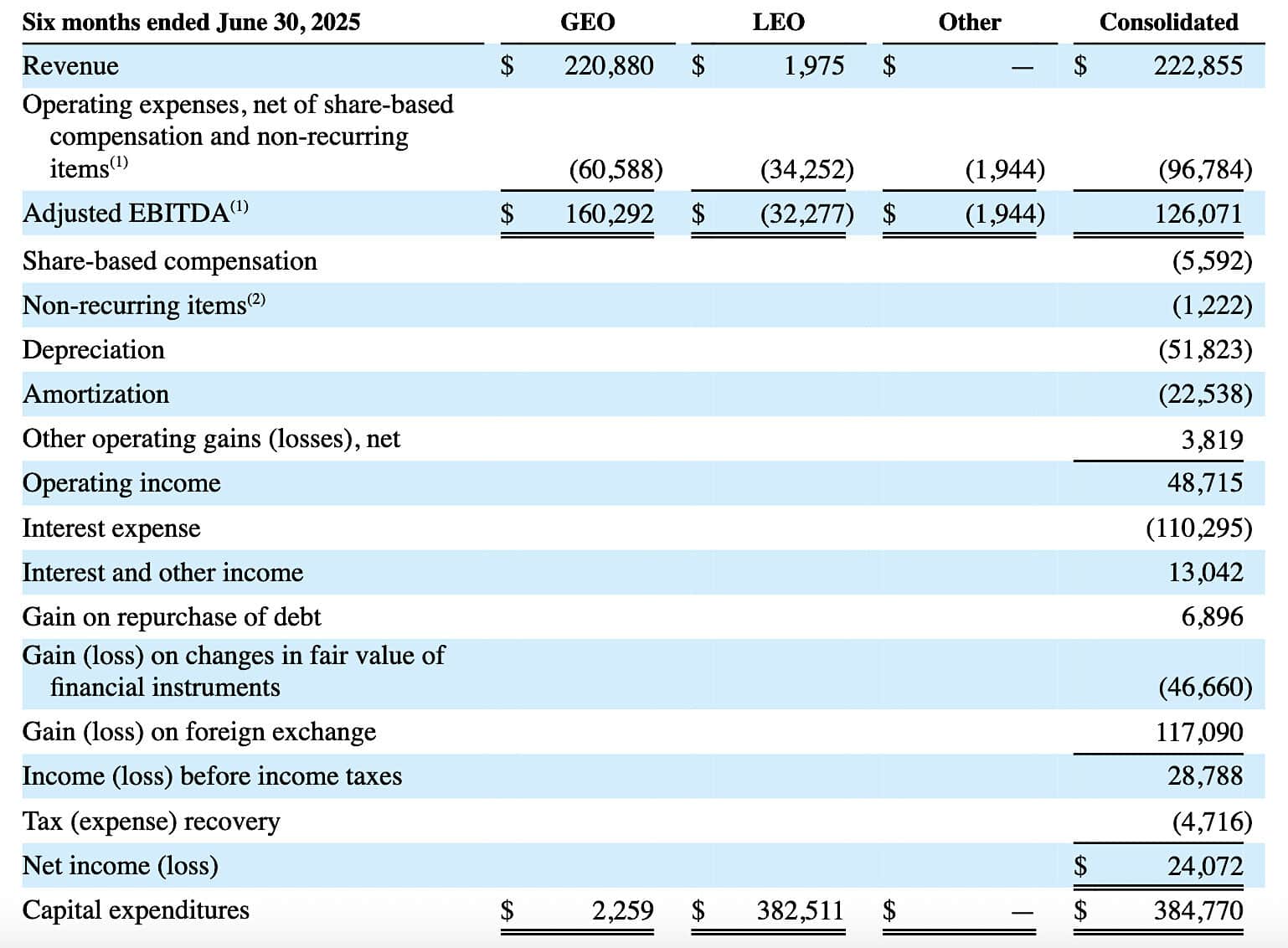
Credit: Telesat Aug. 6, 2025, SEC filing
The Lightspeed backlog as of June 30 stood at slightly more than 1 billion Canadian dollars, a figure not much changed from the last quarter in part because of the recent increase in the value of the Canadian dollar relative to the US dollar.
In an Aug. 6 investor call, Telesat Chief Executive Daniel S. Goldberg said the early results from the initial Lightspeed contracts are in line, and perhaps even higher, than what the company had expected when it decided to move forward on Lightspeed.
Because the commercial aeronautical and government sectors take time before commitment, with aero also having post-contract delays associated with selecting in-flight-connectivity hardware for their planes and getting it certified, it’s these two markets that have shown the most early interest, Goldberg said.
We envisioned a world where pricing would be lower than today and would come down over time,” Goldberg said. “The pricing in the contracts we closed on has been consistent with or north of what’s in our model. That’s true of opportunities in the pipeline. We are in service in end 2027 and the most concrete opportunities now are in aero because you need a longer horizon for partners to equip the airlines.
“I am glad we are getting as much traction as few are getting even thought Lightspeed is not on line for two and one-half years.”
As is true of just about every large satellite fleet operator, Telesat looks at the likely growth in defense spending in Canada and Europe and elsewhere and sees Lightspeed as positioned to take advantage of it.
The government of Canada, which has been a laggard among NATO nations in its defense effort when measured against Canada’s GDP, could use contracts for Lightspeed to share that capacity with other NATO allies. Luxembourg has made such arrangements with SES as a way to make good on its NATO commitment through purchases of SES geostationary-orbit and medium-Earth-orbit satellite capacity.
Lightspeed offers opportunities to Canada in terms of northern sovereignty and future NORAD modernization as well, Goldberg said. He said it was even possible that, depending on negotiations between Canada and the United States, Lightspeed could play a role in the US Golden Dome missile shield.
Golden Dome’s program manager has said the project’s need to move quickly and not invent capability existing in the commercial sector means non-US companies could be given a role: http://bit.ly/4fmbfy0
Any Lightspeed modifications to attract D2D market? No
One market Telesat is determined not to chase with Lightspeed is satellite direct to device (D2D), which is seeing substantial investment from SpaceX Starlink, AST SpaceMobile, Iridium Communications, Globalstar/Apple and, most recently, a $5-billion constellation announced by EchoStar Corp.
Might Lightspeed satellites be modified to add a D2D capability?
“We are sticking to our knitting,” Goldberg said. “We have to stay focused and we are.” There will be no Lightspeed satellite modifications for D2D.