

Thales Group Chief Financial Officer Pascal Bouchiat. Credit: Thales
LA PLATA, Maryland — Thales Group sought to put into context the extraordinary estimate by Thales, Airbus and Leonardo that a merger of their space divisions would generate 400-600 million euros ($464-$696 million) in annual opening income from synergies five years after the close of the deal, expected in 2027.
In an Oct. 23 presentation of Thales’s financial results, Chief Financial Officer Pascal Bouchiat conceded that 500 million euros in annual synergies might seem extravagant given that the three companies’ space businesses in 2024 generated just 6.5 billion euros in revenue. But he said a growing space market, especially from European governments, will propel revenue growth during the period.
Takeaways from Thales Group Q3 earnings results
— The merger of the space divisions of Airbus, Leonardo and Thales is expected to occur in mid-2027, meaning its first full year of operations will be 2028 given what’s likely to be long negotiations with competition regulators. “We believe our case is pretty strong,” Bouchiat said.
— The three companies have agreed to a formula of compensation if one of them reports results that is at variance with the agreed-to shareholding structure of Airbus at 35%, with Thales and Leonardo each at 32.5%. “The mechanism has been agreed, but the outcome will be finalized at closing,” Bouchiat said.
— Thales’s existing space joint venture with Leonardo, Thales Alenia Space, reported increased revenue for the first nine months of 2025. While modest — about 2% — the return to growth confirmed Thales’s earlier forecasts that the restructuring of the space business had borne fruit. Thales Alenia Space reported revenue of about 2.2 billion euros in 2024.
Thales Alenia Space has won contracts for two commercial geostationary-orbit telecommunications satellites so far this year — Space Norway’s Thor 8 and the JSat-32 satellite for Japan’s Sky Perfect JSat. The contracts are worth more than 100 million euros each.
Thales Alenia Space in January booked an 862-million-euro contract with the 23-nation European Space Agency (ESA) for the Argonaut lunar descent module, to deliver cargo to the lunar surface.
Credit: Thales Group
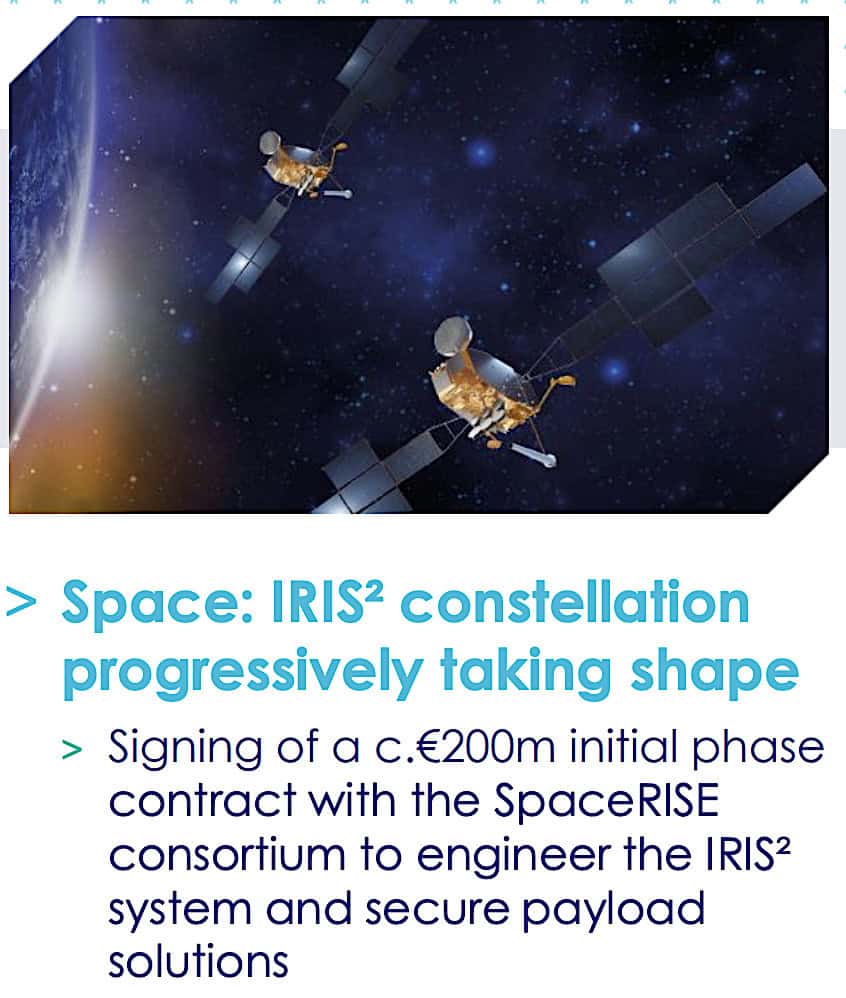
— In a sign that the European Commission-led Iris2 multi-orbit secure connectivity project is moving forward, Thales won a 200-million-euro contract from the Iris2 SpaceRise consortium, composed of satellite fleet operators SES, Eutelsat and Hispasat, for engineering development of the payloads for the Iris2 constellation.
“Other discussions are ongoing with the European Commission and SpaceRise,” Bouchiat said. “This is an encouraging sign that the project is progressively taking shape.”
Bouchiat said Airbus, Thales and Leonardo, after months of assessment of a merger, have concluded that it could deliver substantial synergies by streamlining R&D activities to avoid the considerable duplication that now occurs, especially between Thales Alenia Space and Airbus Defence and Space.
Bouchiat said the three companies assume material growth in the overall revenue from the combined company compared to today’s business.
With the merger, synergies here, there and everywhere
“It’s about working more and more on integrated offers, avoiding duplication in development and, because of that, freeing resources to invest in new opportunities,” Bouchiat said.
“And of course program management — we believe we can make substantial savings, and SG&A [sales, general and administrative expenses] is also a matter where we can expect synergies, not to mention procurement.
“So quite a wide spectrum of synergies, all in a context where we believe the level of growth in the market should pick up. The recent news in Europe on the need to invest more in space capabilities is making the overall framework positive to develop these types of synergies.
“Of course, it’s much easier to get synergies in a growing market than in a shrinking market,” Bouchiat said.
The irony here is that a merger that began at a time of losses in the Airbus and Thales space divisions, mainly in their satellite manufacturing lines, is now moving forward when the crisis appears over.
Italy’s Leonardo SpA, less exposed to the telecommunications satellite market, was never as keen on the merger as the two other companies, but apparently has become convinced by the year-plus due diligence on what a merger could bring, with the headline number being the synergies.

Credit: European Commission
The growth in European government space spending, focused on security and defense but including civil projects, has given all three companies confidence that their space businesses are entering a multi-year growth cycle.
If the best time to repair the roof is when the sun is shining, the merger talks started in heavy rain but are now accelerating in clear weather.
Bouchiat stressed that the first full year of the merged company’s operations is likely to be 2028, not 2027. The synergy figure then would apply to 2032’s results, which he said is time to digest the costs of the merger and take advantage of the increasing government space and defense budgets.
“We expect quite significant growth” in the merged company’s revenue in the coming years, he said. “Also keep in mind that this allows Thales to be more exposed to the growing business, especially services. Thales Alenia Space doesn’t provide services, that is part of Telespazio.”
Telespazio, based in Italy, is 67% owned by Leonardo and 33% by Thales. Its results are not consolidated in Thales’s accounts and has reported regular growth in the past couple of years.
The Oct. 23 statement of the three companies said: “Associated costs to generate those synergies are expected to be in line with industry benchmark.” Bouchiat reiterated that but declined to put a number on the benchmark. “At this time we cannot be more precise,” he said.