
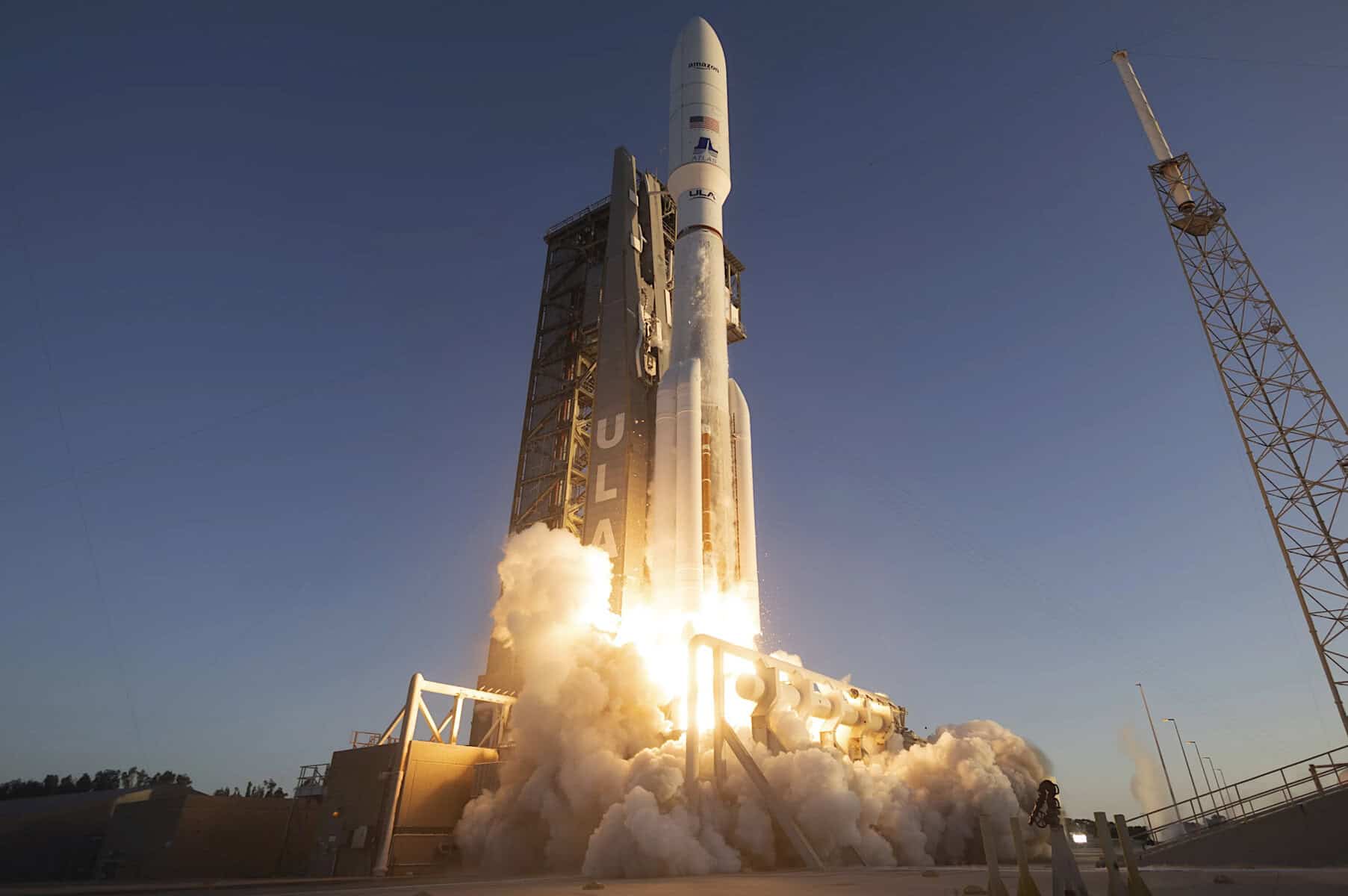
A ULA Atlas 5 rocket lifts of June 23, 2025, carrying 27 Amazon Project Kuiper satellitles. Credit: ULA
TUPPER LAKE, NY — United Launch Alliance (ULA) expects to conduct just nine missions this year as it confronts the delays associated with the October 2024 loss of the nozzle on a solid-rocket booster (SRB) and other issues that have slowed its schedule, ULA Chief Executive Tory Bruno said.
In an Aug. 7 press briefing, Bruno said ULA’s work at the Vandenberg and Cape Canaveral launch sites will permit ULA to end the year with a cadence of two launches per month, a cadence it expects to continue in 2026 and 2027.
The October failure of the Northrop Grumman-built SRB on a Vulcan Centaur rocket was traced to a manufacturing error. Bruno said corrective measures have been put into place and the issue “is really behind us.”
That’s part of the reason why ULA, which had earlier projected up to 20 missions this year before revising it down to a dozen, will be limited to nine Atlas and Vulcan launches in 2025.
“Earlier we had expected more, but it’s a simple matter of getting started a little later in the year as we resolved the SRB and had to synchronize with customer satellite deliveries. Now it will be more like nine,” Bruno said.
“We expect to hit our twice-a-month tempo before the end of the year so that as we role into 2026 that forecast is between 20 and 25 launches, based on weather and all other things being the same and satellites being available.”
Bruno said the launches for the coming several years, including this year, will be 60% for commercial customers and 40% US government civil and military launches.
The news that ULA has been forced to reduce its launch temp by 50% this year is particularly problematic for Amazon’s Project Kuiper, which has ordered 38 Vulcan launches, each carrying 45 Kuiper satellites to low Earth orbit; and six more Atlas 5 rockets (27 Kuipers each).
Amazon is under a regulatory deadline that obliges it to launch half its 3,232 satellites by the end of July of next year. That’s 1,616 satellites. It has already launched 78, with another 24 scheduled for launch this week aboard a SpaceX Falcon 9 rocket.
It is difficult to see how Amazon launches another 1,514 satellites in less than 12 months, even if it has contracted multiple launches with Blue Origin’s New Glenn and the Arianespace Ariane 6 vehicles. One possible option would be to negotiate a bulk launch deal for Falcon 9 launches. Kuiper so far has only booked three Falcon 9 missions.
Amazon’s deadline to launch the remaining half of its constellation is July 30, 2029.
The good news for ULA customers is that the company is on the verge of completing a major infrastructure investment, including a second Vulcan mobile launch platform and Vehicle Integration Facility at Cape Canaveral, that will make it easier to ramp launch cadence.
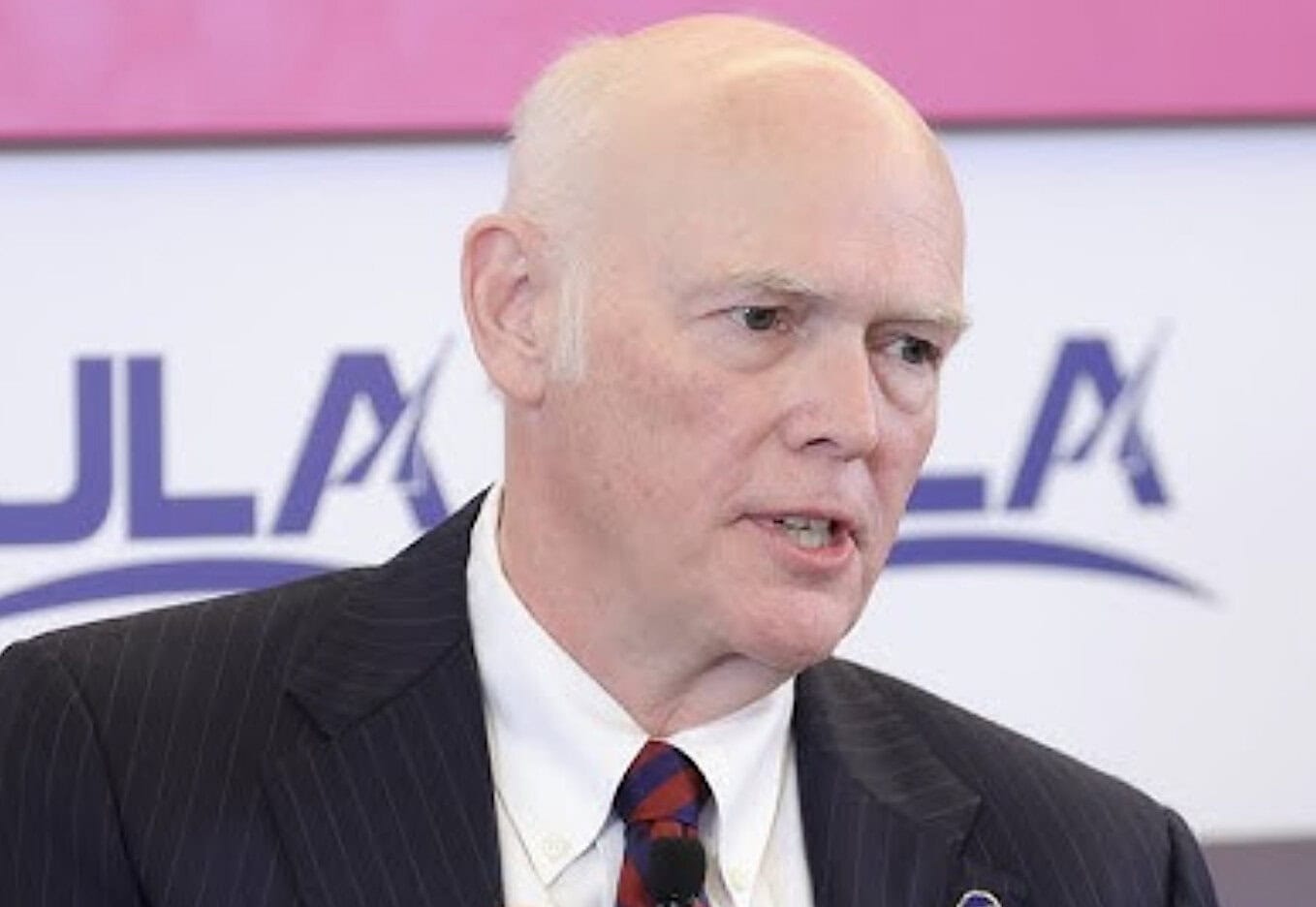
Tory Bruno. Credit: Youtube
“In the past you would build and fly, and build and fly,” Bruno said. “Now we have a stockpile of both Atlases and Vulcans fully built, ready to fly. That is another thing that kicks up the confidence” in launching 20-25 per year starting in 2026.
The last 13 Atlas rockets about completed, and a half-dozen Vulcans are also built and in storage
“There are 13 Atlases to go [before the vehicle is retired]. All but the last two are literally finished and in storage, and the last two will be finished shortly. We have almost halve a dozen Vulcans fabricated and in storage, and lots and lots of SRMs, up into the 40s.”
Surging launch demand is putting stresses on the Cape Canaveral and Vandenberg launch sites. Bruno said one of the issues recently has been the difficulty in finding personnel qualified to work with the special requirements of a spaceport.
“It has been a little bit of a battle,” Bruno said, with “shortages in tradespeople — structural welders, pipe fitters who do cryogenic, and even the electricians. It’s not a typical industrial application. The reason these tradespeople have been in short supply is because everyone in aerospace and space is building infrastructure. We are all pulling on the same set of highly skilled technicians, who are in short supply.
“Believe it or not, there has been holdover from Covid on the sub-tier supply chain, and shortages of equipment — high-power electronics, environmental control systems, valving — and we have had to work through all of that.
We are literally living on site in trailers. But we are 76%, coming up to 77% complete on SLC-3 [Space Launch Complex-3 at Vandenberg], and expect to have that facility certified and able to fly missions before the end of the year.
“The same thing is going on on the East Coast, where we’re adding a second Vehicle Integration Facility, a second Vulcan Mobile Launch Platform. It’s the same contractors and the same issues.”
He said ULA was fully booked for the rest of 2025 and that even with a cadence boost to 20-25 launches, booking a flight in 2026 would require a current customer to leave its place in the queue.
Space in 2027 looks a little better, but “ it’s really the same story. We have more customers wanting to ride on this rocket [Vulcan] than is easy to accommodate.”
ULA’s first Vulcan launch for a US national security mission is scheduled for the coming days, carrying two satellites directly into geostationary orbit.
The US Space Force has rights to assure its access to Vulcan rockets. Depending on weather conditions and testing campaigns that can reduce spaceport availability, these rights may upset launch dates even when 60% of ULA’s launches are commercial for the coming years.
Here is how Bruno explained the process.
“We have a long-standing methodology for putting people on the manifest and what happens if they are not ready to go, or we are not ready to launch them. Roughly it’s first-come, first-served, other than monument missions typically associated with NASA where you have a launch window that doesn’t come around very often, so we make a hole for that.
“The Space Force also has the ability to tell us that missions are critical to them and they want to prioritize those and have control of that Track. The first set of Space Force missions we will be flying, this next one included, they have told us those are high-priority missions and they will be first in line when they are ready and we are ready to fly them out of Track G, for government.
“There might be some [commercial] Atlases that are flown in between, because some of those missions for the Space Force are spaced out. And if that happens we would want to fly a commercial mission on one of the remaining Atlases.”