
Credit: Viasat May 28, 2026, investor presentation
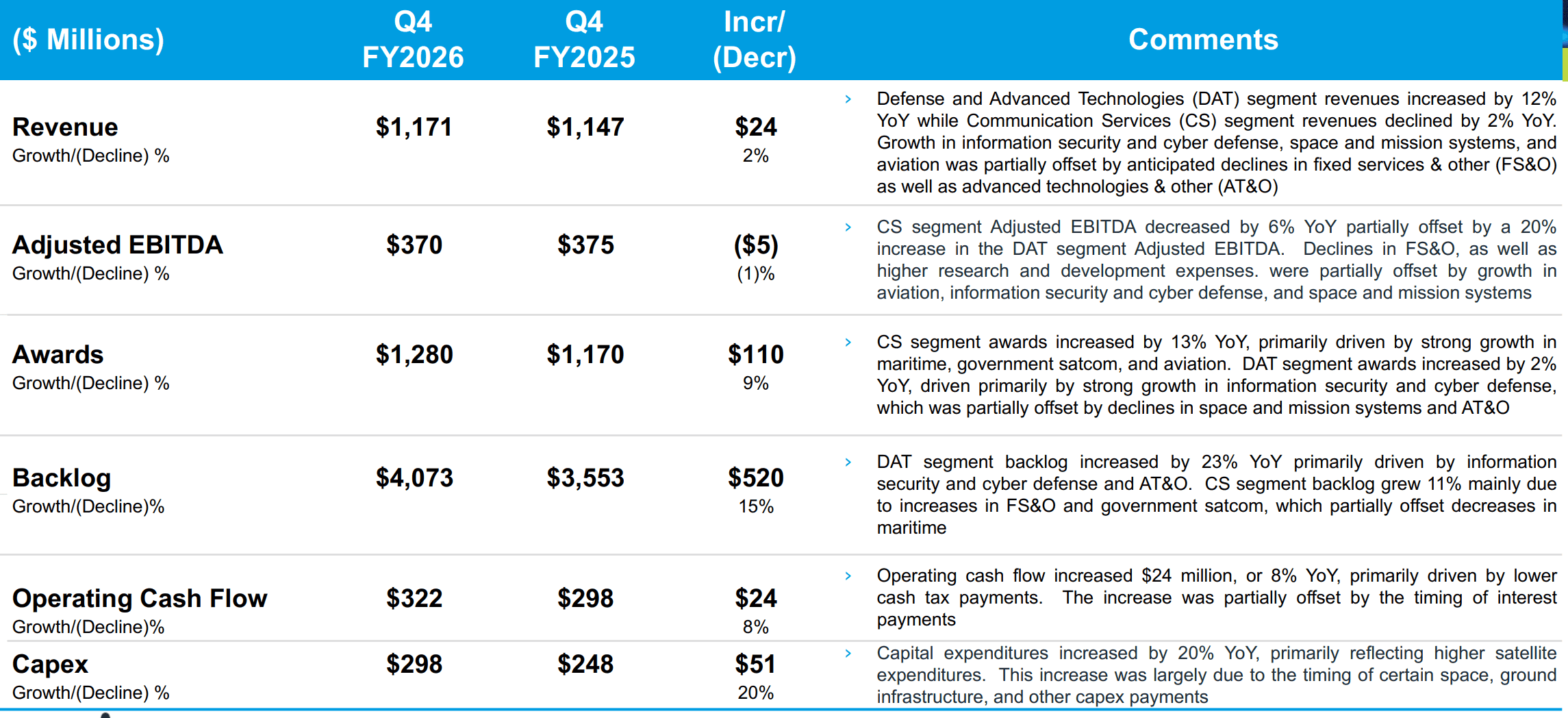
LA PLATA, Maryland— Satellite broadband hardware and service provider Viasat Inc. fell short of its goal of returning its maritime and fixed consumer broadband businesses to growth in the 12 months ending March 31 but reported 2% revenue growth for the year on the strength of its Aviation connectivity and Defense and Advanced Technologies divisions.
Credit: Viasat May 28, 2026, investor presentation
In a May 28 investor call, Viasat said it expects its consumer business, whose revenue has dropped by 38% in two years as consumer subscriptions fell and SpaceX Starlink took overt market, hitting 130,000 as of March 31, will stabilize once the Viasat-3 satellite enters service later this year.
The Viasat-3 F2 satellite, launched in November, has deployed its boom and its large reflector antenna and is awaiting US Federal Communications Commission (FCC). This is the satellite that will provide service over the Americas.
The Viasat 3 F3, launched in April, will arrive at its geostationary-orbit slot by July and to enter service by September over the Asia-Pacific.
The three-satellite Viasat 3 program, with each satellite designed to provide 1 Tbps of throughput, has faced years of delays, including a defective antenna deployment on the Viasat-3 F1 now in orbit. Once all three are in service, Viasat will be able to assess how costly the delays have been with competitors’ entry into the market.
Viasat has insisted that even in a market with 10,000 Starlink satellites, the Viasat-3 constellation offers advantages in providing concentrated bandwidth in high-use areas such as airports and seaports.
Whether the arrival of fresh Viasat-3 capacity will improve the company’s prospects in consumer broadband remains to be seen.
Chief Executive Mark Dankberg said that while the company had no plans to build orbital data centers, the work it has done on the Viasat 3 satellites in power generation — each satellite has an estimated 25 kW of power at the end of its 15-year life — as well as adaptive beam-forming and heat dissipation will have a value for companies entering the space data center business.
Credit: Viasat May 28, 2026, investor presentation
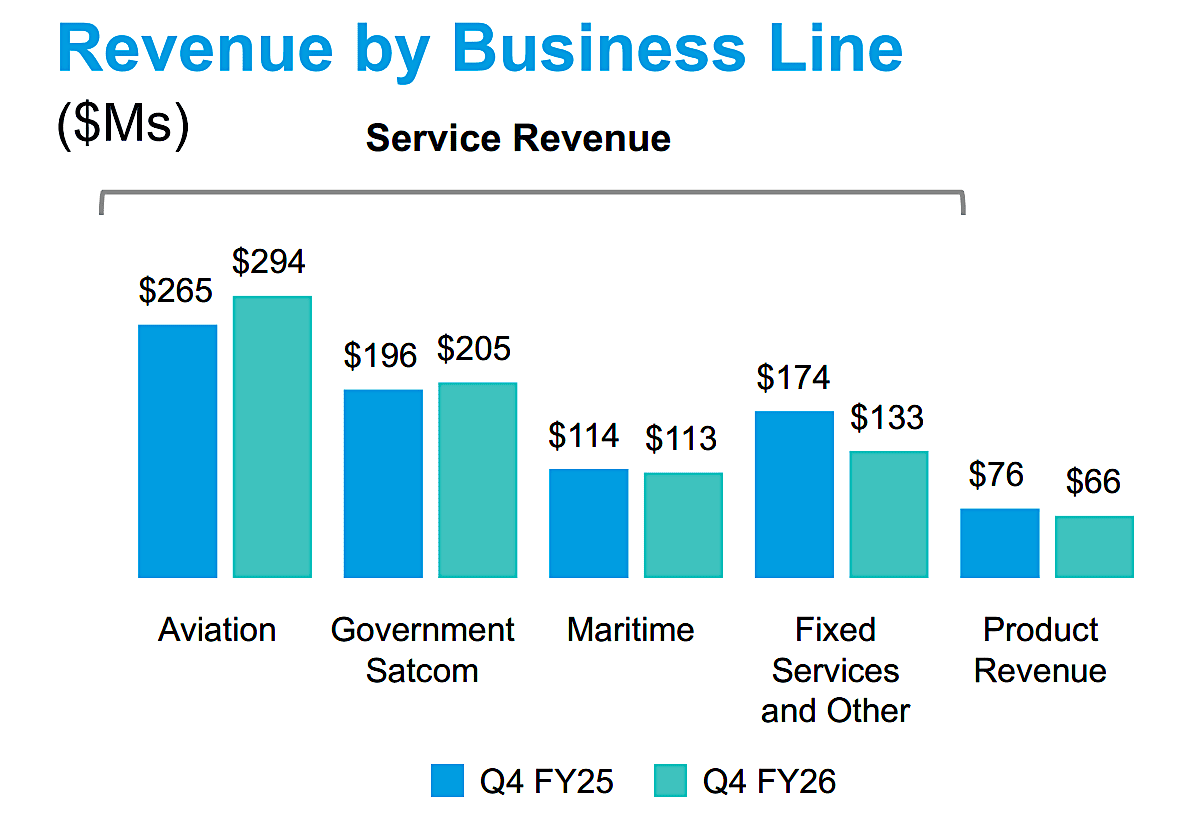
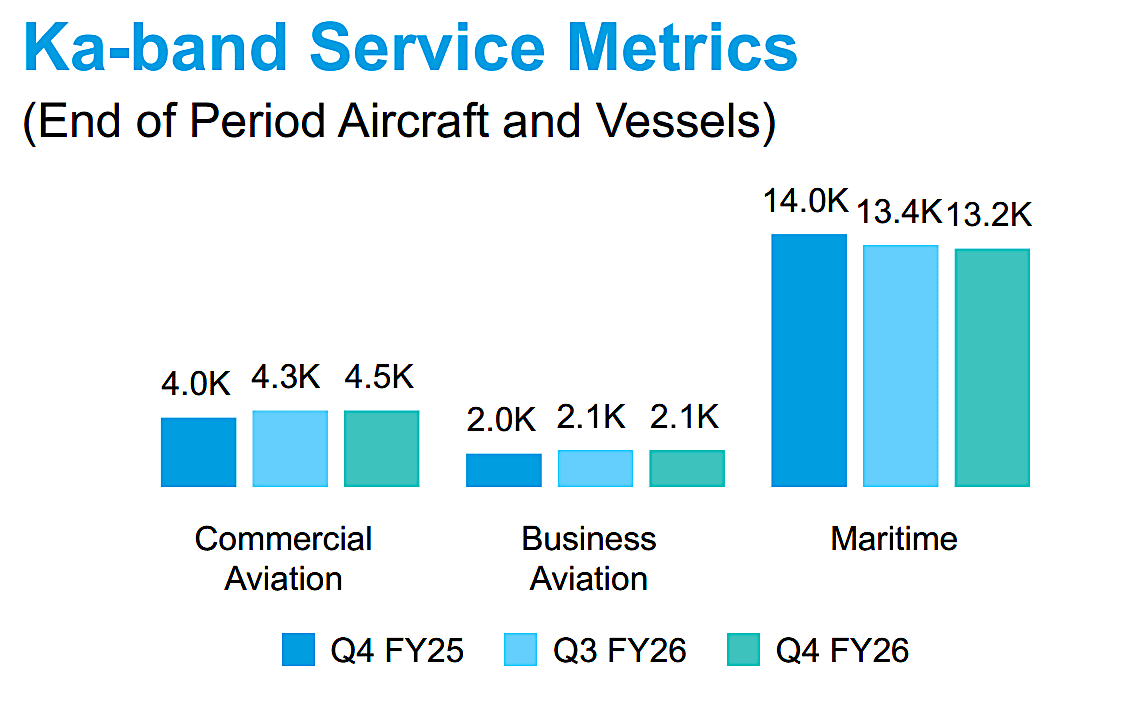
Viasat said its maritime business service revenue dropped marginally in the three months ending March 31, to $113 million, with the number of vessels declining to 13,200.
Commercial aircraft fitted with Viasat in-flight connectivity gear grew to 4,450 at March 31, up 10% from a year ago. Business aviation, with 2,100 aircraft in service, was up 5% on the year.
Aviation service issue was up 10.9%, to $294 million. Dankberg said aviation connectivity has become highly competitive and that the company’s rate of growth in this segment would slow, but that demand for in-flight connectivity was increasing and, with it, revenue per aircraft.

Equatys JV with Space42: No partner announcement but still planned 2029 service start
Much of the call was devoted to the Equatys joint venture between Viasat and Space42 of Abu Dhabi, which plans to launch a constellation of low-orbiting satellites for IoT and direct-to-device services by 2029.
Space42 had hoped to announce a strategic partner for Equatys this month, saying that the manufacture of the satellite bus likely would be a co-investor with the two Equatys founders.
Dankberg acknowledged that selecting a bus provider — Viasat will build the payload — and a launch-service provider will need to be completed soon to make the 2029 date, and that the two companies are “just waiting to finalize associated agreements before we disclose those details.”
He declined to estimate the size of Viasat’s investment in Equatys. Space42 has said it is spending $600 million in capex for the project between 2026 and 2027. The two companies have said their goal is to be equal partners in the venture.
“Viasat is providing the lead for network payload technology, the beam-forming, and we are open to partners for launch, [satellite] buses, and could include low-cost manufacturers associated with given geographic regions and would be preferred by regional spectrum holders or service providers,” Dankberg said.
Equatys is designed as a constellation of ultimately 2,800 satellites that would provide infrastructure for multiple satellite operators’ L- or S-band satellite spectrum at a lower cost than would be available to them elsewhere.
For a regional satellite player contemplating a LEO constellation that would spend most of its orbit over areas outside a regional operator’s interest, Equatys is positioned as an alternative.

Credit: Viasat
Dankberg said the recent proposed joint venture with AT&T, T-Mobile and Verizon in the United States “is an example of an application we see as a good growth opportunity for Viasat as both a service prodder and the initial Equatys technology provider, supporting MNOs in applying satellite to augment their terrestrial networks.”
As part of its acquisition of Inmarsat of London, Viasat operates the European Aviation Network (EAN), a service that provides air-to-ground connectivity on European short-haul flights, with an S-band satellite also available to provide throughput. Viasat’s license expires in May 2027.
The European Commission recently announced it would allow non-European companies to bid for part of the S-band spectrum being made available.
Dankberg said Viasat had a strong case to make to the Commission that EAN is a public good and that Equatys could help modernize it. “It’s on 100s of airplanes now. We absolutely will be applying to extend it,” he said.